Representative John Newton Tillman
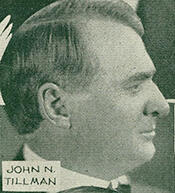
Here you will find contact information for Representative John Newton Tillman, including email address, phone number, and mailing address.
| Name | John Newton Tillman |
| Position | Representative |
| State | Arkansas |
| District | 3 |
| Party | Democratic |
| Status | Former Representative |
| Term Start | December 6, 1915 |
| Term End | March 3, 1929 |
| Terms Served | 7 |
| Born | December 13, 1859 |
| Gender | Male |
| Bioguide ID | T000276 |
About Representative John Newton Tillman
John Newton Tillman (December 13, 1859 – March 9, 1929) was a Democratic U.S. Representative from Arkansas who served seven consecutive terms in the United States Congress from 1915 to 1929. His congressional career spanned a significant period in American history, encompassing World War I, the early postwar era, and the onset of the Roaring Twenties, during which he participated in the legislative process and represented the interests of his Arkansas constituents.
Tillman was born near Springfield, Missouri, on December 13, 1859. He attended the common schools in his youth before pursuing higher education in Arkansas. He enrolled at the University of Arkansas at Fayetteville, from which he graduated in 1880. Following his graduation, he supported himself by teaching school while simultaneously studying law, reflecting an early commitment to both education and public service.
After completing his legal studies, Tillman was admitted to the bar in 1883 and commenced the practice of law in Fayetteville, Arkansas. He quickly entered public office, serving as clerk of the circuit court of Washington County from 1884 to 1889. During this period he became increasingly involved in state politics, and he was elected to the Arkansas State Senate, where he served from 1888 to 1892. While in the State Senate, he proposed the Separate Coach Law of 1891, a Jim Crow statute mandating the segregation of African American passengers on railroad coaches in Arkansas; the bill was enacted into law and formed part of the broader framework of racial segregation in the post-Reconstruction South.
Tillman continued his legal and judicial career following his legislative service. From 1892 to 1898 he served as prosecuting attorney of the fourth judicial circuit of Arkansas, a role in which he was responsible for criminal prosecutions within the circuit. He was then elevated to the bench as judge of the same circuit court, serving from 1900 to 1905. His experience as both prosecutor and judge enhanced his standing in the state’s legal community and helped prepare him for later leadership roles in education and national politics.
In 1905, Tillman was selected as president of the University of Arkansas, returning to the institution from which he had graduated a quarter-century earlier. He served as president from 1905 to 1912, overseeing the university during a period of growth and modernization in higher education. His tenure reflected his long-standing interest in education and his influence on the development of Arkansas’s principal public university.
Tillman entered national politics when he was elected as a Democrat to the Sixty-fourth Congress and to the six succeeding Congresses, serving in the U.S. House of Representatives from March 4, 1915, to March 3, 1929. As a member of the House, he participated in the democratic process during a transformative era marked by major domestic and international developments. Over his seven terms, he contributed to the legislative work of Congress and represented Arkansas in debates over war, economic policy, and social issues. In 1926, he was appointed one of the managers by the House of Representatives to conduct the impeachment proceedings against George W. English, judge of the United States District Court for the Eastern District of Illinois, underscoring his role in the exercise of congressional oversight and the constitutional process of impeachment.
After more than a decade in Congress, Tillman chose not to seek renomination in 1928, effectively concluding his federal legislative career at the end of the Seventieth Congress. He returned to Fayetteville, Arkansas, where he had long maintained professional and personal ties. John Newton Tillman died in Fayetteville on March 9, 1929. He was interred in Evergreen Cemetery, leaving a legacy that encompassed service as a lawyer, state legislator, prosecutor, judge, university president, and seven-term member of the United States House of Representatives.