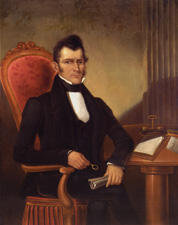
Senator John Tipton

Here you will find contact information for Senator John Tipton, including email address, phone number, and mailing address.
| Name | John Tipton |
| Position | Senator |
| State | Indiana |
| Party | Democratic |
| Status | Former Representative |
| Term Start | January 3, 1832 |
| Term End | March 3, 1839 |
| Terms Served | 2 |
| Born | August 14, 1786 |
| Gender | Male |
| Bioguide ID | T000284 |
About Senator John Tipton
John Quillin Tilson (April 5, 1866 – August 14, 1958) was an American politician and attorney who became one of the most prominent Republican leaders in the United States House of Representatives in the early twentieth century. A Republican, he represented Connecticut in the United States House of Representatives for almost twenty-two years and served as House Majority Leader for six years. In 1898, he served as a major in the United States Volunteer Infantry during the Spanish–American War.
Tilson was born on April 5, 1866, in Clearbranch, Unicoi County, Tennessee, to William and Katherine (Sams) Tilson. His father had obtained a grant of 900 acres in the Clearbranch community, and Tilson spent his early life working and living on the family farm. He attended both public and private schools in nearby Flag Pond, Tennessee, and later pursued further studies at Mars Hill, North Carolina. These early experiences in a rural Appalachian setting shaped his outlook and instilled in him a strong work ethic that would carry into his professional and political life.
Tilson pursued higher education at Carson–Newman College in Jefferson City, Tennessee, where he graduated in 1891. Seeking a career in law, he enrolled at Yale Law School and graduated in 1893. He was admitted to the bar in 1897 and began the practice of law in New Haven, Connecticut. His move from Tennessee to Connecticut marked a significant transition from his agrarian upbringing to an urban legal and political environment in New England, where he quickly became active in public affairs.
When the Spanish–American War broke out in 1898, Tilson enlisted in the United States Volunteer Infantry. He served as a major in the Sixth Regiment, United States Volunteer Infantry, demonstrating a commitment to national service that complemented his emerging legal and political career. After the war, he resumed his law practice in New Haven, building a reputation that helped launch his entry into elective office.
Tilson’s formal political career began in state government. In 1904, he was elected to the Connecticut House of Representatives, where he served until 1908. During his tenure in the state legislature, he rose rapidly in influence and served as speaker of the Connecticut House for the last two years of his service, from 1906 to 1908. His leadership in the state legislature provided him with experience in parliamentary procedure and party organization that would later define his role in Congress.
Tilson was first elected to the United States House of Representatives from Connecticut and served in the Sixty-first and Sixty-second Congresses from 1909 to 1913. He ran unsuccessfully for reelection in 1912, but returned to national politics two years later. He was again elected to the House and served from March 4, 1915, until his resignation on December 3, 1932. Over the course of these nearly twenty-two years, he became one of the key Republican figures in the House. He served as House Majority Leader during the 69th, 70th, and 71st Congresses, a period that encompassed much of the 1920s, when Republicans held control of the chamber. As Majority Leader, he played a central role in managing the legislative agenda, guiding party strategy, and overseeing floor debate. He also participated in broader foreign policy discussions; speaking of the 1917 Balfour Declaration, he declared himself “in thorough accord with the official accord of Secretary Balfour, as endorsed by the countries of France and Italy, on the subject of the establishment in Palestine of a national home for the Jewish people,” and stated that he would “gladly support a movement in that direction,” expressing confidence that such a homeland, entrusted to the descendants of those who had made the region’s early history, would be “faithfully kept and sacredly guarded for the benefit of all mankind.” In 1932, as his congressional career neared its end, he served as a delegate to the Republican National Convention.
After his resignation from Congress in December 1932, Tilson retired from public office and returned to the practice of law, first in Washington, D.C., and later again in New Haven, Connecticut. Drawing on his long experience in legislative leadership, he became a special lecturer at Yale University on parliamentary law and procedure. He authored “Tilson’s Manual,” a work on legislative and parliamentary practice that reflected his expertise in the rules and operations of deliberative bodies and was used as a guide to legislative procedure.
In his later years, Tilson remained a respected elder statesman within Republican and legal circles. His family’s public profile continued into subsequent generations; American hedge fund manager and philanthropist Whitney Tilson is his great-grandson. John Quillin Tilson died in New London, New Hampshire, on August 14, 1958. He was interred at the private burial grounds on the family farm in Clearbranch, Tennessee, returning in death to the rural setting where his life had begun.