Representative John Albert Whitaker
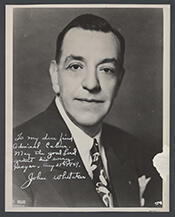
Here you will find contact information for Representative John Albert Whitaker, including email address, phone number, and mailing address.
| Name | John Albert Whitaker |
| Position | Representative |
| State | Kentucky |
| District | 2 |
| Party | Democratic |
| Status | Former Representative |
| Term Start | April 17, 1948 |
| Term End | December 15, 1951 |
| Terms Served | 3 |
| Born | October 31, 1901 |
| Gender | Male |
| Bioguide ID | W000348 |
About Representative John Albert Whitaker
John Albert Whitaker (October 31, 1901 – December 15, 1951) was a Democratic U.S. Representative from Kentucky who served in the United States House of Representatives from 1948 until his death in 1951. Born in Russellville, Logan County, Kentucky, he was part of a family with an established political tradition; he was the grandson of Addison James, who had also served in Congress. Growing up in Russellville, Whitaker was educated in the local public schools, laying the foundation for a career that would combine law, local public service, and national legislative responsibility.
Whitaker pursued higher education at Bethel College in Russellville and later attended the University of Kentucky. Following his collegiate studies, he undertook the study of law and was admitted to the bar in 1926. He then commenced the practice of law in his hometown of Russellville, establishing himself as a local attorney. His legal training and practice provided him with experience in statutory interpretation and public affairs that would later inform his work as a county official and member of Congress.
Whitaker’s formal public career began at the county level. In 1928 he was elected Logan County Attorney, a position he held for two decades until 1948. In this capacity he served as the chief legal officer for the county, representing the county government in legal matters and prosecutions and advising local officials on questions of law. Concurrent with his local responsibilities, Whitaker was active in party politics. He was a delegate to all the Kentucky State Democratic conventions from 1924 to 1950, reflecting his sustained engagement with Democratic Party organization and policy at the state level and helping to build the political relationships that would support his later congressional service.
Whitaker entered national office during a period of significant political transition in Kentucky and the United States. He was elected as a Democrat to the Eightieth Congress to fill the vacancy caused by the resignation of Representative Earle C. Clements, who had been elected governor of Kentucky in November 1947. Whitaker took his seat in the House of Representatives on April 17, 1948. He was subsequently reelected to the Eighty-first and Eighty-second Congresses, thereby serving three consecutive terms. His tenure in Congress coincided with the early Cold War era, the post–World War II economic adjustment, and the beginning of major debates over domestic policy and international commitments, during which he participated in the legislative process and represented the interests of his Kentucky constituents.
As a member of the House of Representatives, Whitaker contributed to the work of Congress during a time of far-reaching national and international developments. Serving as a Democrat from Kentucky, he took part in deliberations on legislation affecting his district and the broader country, including issues related to postwar recovery, agricultural and rural concerns important to his home region, and the evolving role of the federal government in economic and social policy. His service reflected both his legal background and his long experience in local and state politics, and he was regarded as a representative closely attuned to the needs of his constituents.
Whitaker’s congressional career was cut short by his death in office. He continued to serve in the House until December 15, 1951, when he died in Russellville, Kentucky. His passing ended more than two decades of continuous public service at the county, state party, and national levels. He was interred in Maple Grove Cemetery in Russellville, underscoring his lifelong connection to the community in which he was born, educated, practiced law, and ultimately represented in the Congress of the United States.