Representative Jolene Unsoeld
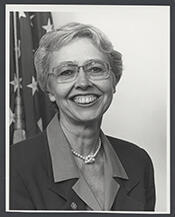
Here you will find contact information for Representative Jolene Unsoeld, including email address, phone number, and mailing address.
| Name | Jolene Unsoeld |
| Position | Representative |
| State | Washington |
| District | 3 |
| Party | Democratic |
| Status | Former Representative |
| Term Start | January 3, 1989 |
| Term End | January 3, 1995 |
| Terms Served | 3 |
| Born | December 3, 1931 |
| Gender | Female |
| Bioguide ID | U000017 |
About Representative Jolene Unsoeld
Jolene Bishoprick Unsoeld (December 3, 1931 – November 28, 2021) was an American politician who served as a member of the United States House of Representatives from 1989 to 1995. A member of the Democratic Party, she represented Washington’s 3rd congressional district for three terms, where she developed a reputation as a strong supporter of environmentalist and feminist causes and as an advocate for open government and public access to information.
Unsoeld was born Jolene Bishoprick in Corvallis, Oregon, on December 3, 1931, the daughter of Cora (Trapman) and Stanley Bishoprick. Her father worked in the timber business, a background that exposed her early to the economic and environmental issues of the Pacific Northwest. She attended Oregon State University from 1949 to 1951. In 1951, she married Willi Unsoeld, a noted mountaineer who later became a college professor and one of the first Americans to summit Mount Everest by a new route. The couple had four children. In the early 1960s, she accompanied her husband to the Himalayas and spent two years in Kathmandu, Nepal, where she served as director of an English-language education program for local residents, an experience that broadened her international outlook and commitment to community-based development.
Returning to the United States, Unsoeld became deeply involved in citizen activism in Washington state during the 1970s and early 1980s. She emerged as a prominent citizen lobbyist in support of open government, working to secure open public meetings and open public records. Her efforts were instrumental in the passage of Washington’s Initiative 276 in 1972, which created the Washington Public Disclosure Commission and required public disclosure of campaign contributions by candidates for elective office. In 1977, she and her husband became concerned about proposed nuclear power plants in the region and helped form Fair Electric Rates Now (FERN), a ratepayer and environmental organization that opposed utility investment in nuclear energy, encouraged investment in energy conservation, and supported utility rate structures that rewarded consumers who used less power.
Building on her reputation as a “citizen meddler,” as she sometimes described herself, Unsoeld entered electoral politics in the 1980s. In 1984, she ran successfully for the Washington State Legislature and served two terms in the Washington House of Representatives. In the state legislature she was known for her independence and progressive positions, and EMILY’s List later referred to her as “the conscience” of the legislature. Her state-level service and long record of grassroots activism positioned her as a leading Democratic voice in southwest Washington by the time a congressional seat opened in the late 1980s.
Unsoeld’s congressional career began after Representative Don Bonker of Washington’s 3rd congressional district decided to run for the United States Senate in 1988, leaving his House seat open. She sought the Democratic nomination and faced moderate Clark County Commissioner John McKibbin in the primary, where he portrayed her as too liberal for the district. She prevailed in the primary and went on to a closely contested general election, in which she narrowly defeated her Republican opponent by just 618 votes out of more than 218,000 cast. Because of the razor-thin margin, her victory was confirmed only after a recount, five weeks after election day. Her campaign received support from EMILY’s List, and her eventual win was cited as one of the organization’s early successes in helping elect pro-choice Democratic women to Congress.
Taking office in January 1989, Unsoeld quickly established herself as an outspoken and independent member of the House of Representatives. Her first action in Congress was to sign onto a gay-rights bill, signaling her commitment to civil rights and equality. During her three terms in office, from 1989 to 1995, she worked especially hard on strengthening and defending the federal Freedom of Information Act, reflecting her long-standing dedication to government transparency and public access to records. Although widely regarded as very liberal on most social and environmental issues, she became best known in Congress for her opposition to certain gun control measures, a stance that distinguished her from many of her Democratic colleagues. She also took notable positions on major trade and crime legislation. Unsoeld opposed the North American Free Trade Agreement (NAFTA), arguing that it failed to provide adequate protections for the labor rights of both Mexican and American workers and warning that “a NAFTA that fails to reverse Mexico’s policy of menial wages and fails to bolster Mexican labor rights is bad news for their workers and bad news for our workers.” She also opposed the Violent Crime Control and Law Enforcement Act of 1994, commonly referred to as the “1994 Crime Bill,” reflecting her concerns about its approach to criminal justice and civil liberties.
Unsoeld’s tenure in Congress coincided with a significant period in American political life, including the end of the Cold War, debates over trade liberalization, and contentious domestic policy battles over crime, guns, and social policy. As a member of the House of Representatives, she participated actively in the legislative process and represented the interests of her constituents in Washington’s 3rd district, maintaining a focus on environmental protection, open government, and consumer and ratepayer rights. Despite her record, she faced a difficult re-election environment in 1994, a year marked by the Republican Revolution and a national shift toward the Republican Party in congressional races. In that year’s campaign, she was challenged by Republican state legislator Linda Smith. The race was unusually contentious, with Smith even suggesting that Unsoeld’s conservative father supported Smith’s campaign over his daughter’s. Unsoeld was defeated in the 1994 general election, a result widely described as a “surprise” victory for Smith and part of the broader Republican wave that year.
After leaving Congress in January 1995, Unsoeld remained engaged in public affairs and education. In the fall of 1995, she served as a fellow at the Harvard Institute of Politics at the John F. Kennedy School of Government, where she drew on her legislative experience to mentor students and participate in discussions on public policy and democratic governance. Later that year, she returned to Washington state, and in October 1995 Governor Mike Lowry appointed her to the Washington Fish and Wildlife Commission. She was reappointed in 1997 by Governor Gary Locke. On the commission, she continued her advocacy for environmental stewardship, arguing that stronger restrictions on fishing were necessary to restore salmon runs. Her stance proved controversial, and in February 1998 the Washington State Senate declined to confirm her renomination, effectively ending her service on the commission.
In the years that followed, Unsoeld remained a respected figure in Washington state political and civic circles, particularly for her pioneering work on open government and campaign finance disclosure. In 2008, the Washington Coalition for Open Government honored her with the James Madison Award in recognition of her long-standing efforts to advance government transparency and public access to information. Jolene Unsoeld died in Olympia, Washington, on November 28, 2021, five days before her 90th birthday, leaving a legacy as a citizen activist turned legislator who consistently pressed for openness, accountability, and environmental protection in public life.