Representative Jonah Kuhio Kalanianaole
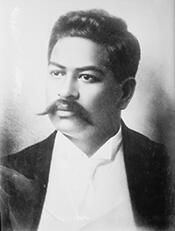
Here you will find contact information for Representative Jonah Kuhio Kalanianaole, including email address, phone number, and mailing address.
| Name | Jonah Kuhio Kalanianaole |
| Position | Representative |
| State | Hawaii |
| District | -1 |
| Party | Republican |
| Status | Former Representative |
| Term Start | November 9, 1903 |
| Term End | March 3, 1923 |
| Terms Served | 10 |
| Born | March 26, 1871 |
| Gender | Male |
| Bioguide ID | K000004 |
About Representative Jonah Kuhio Kalanianaole
Jonah Kūhiō Kalanianaʻole (March 26, 1871 – January 7, 1922) was a prince of the Kingdom of Hawaiʻi who later served as the delegate of the Territory of Hawaii to the United States Congress from March 4, 1903, until his death, winning a total of ten elections. A member of the Republican Party, he was the only royal-born member of Congress and became widely known by the honorific Ke Aliʻi Makaʻāinana, or “Prince of the People,” for his efforts to preserve and strengthen the Hawaiian people. His birthday is celebrated as a state holiday in Hawaiʻi, reflecting his enduring significance in the political and cultural history of the islands.
Kalanianaʻole was born on March 26, 1871, in Kukuiʻula, Kōloa, on the island of Kauaʻi. Of aliʻi (noble) lineage, his genealogy was complex, and he was an heir of Kaumualiʻi, the last ruling chief of Kauaʻi. He was named for his maternal grandfather, Kūhiō Kalanianaʻole, a high chief of Hilo, and his paternal grandfather, Jonah Piʻikoi, a high chief of Kauaʻi. His Hawaiian name “Kūhiō” has been translated as “chief who leaned forward as he stood,” while “Kalanianaʻole” has been rendered as “ambitious chief” or “chief who is never satisfied.” Orphaned when his father died in 1878 and his mother in 1884, he was adopted in the traditional Hawaiian hānai manner by Queen Kapiʻolani, wife of King David Kalākaua and his maternal aunt. This adoption formally integrated him into the royal household and made him a prince of the Kingdom of Hawaiʻi. After the death of King Kalākaua in 1891, Queen Liliʻuokalani ascended the throne and continued to favor Kalanianaʻole, who held minor positions in the Department of the Interior and the Customs Office during the final years of the monarchy.
Kalanianaʻole received his early education in Honolulu on the island of Oʻahu. He attended St. Alban’s College, now ʻIolani School, and Oahu College, now Punahou School. At St. Alban’s, a French teacher, Pierre Jones, remarked on the young prince’s lively demeanor, saying that his twinkling eyes and perpetual smile made him “so cute, just like the pictures of the little cupid.” The nickname “Prince Cupid” followed him throughout his life. Pursuing the broader education encouraged by his uncle King Kalākaua’s Hawaiian Youths Abroad program, he and his brothers David Kawānanakoa and Edward Keliʻiahonui were sent in 1885 to Saint Matthew’s School in San Mateo, California. While there, the brothers surfed off the Pacific shore at Santa Cruz and are credited with introducing the Hawaiian sport of board surfing to California in 1885. In 1890, Kalanianaʻole and Kawānanakoa were sent to the United Kingdom for further study, a year after their cousin Princess Kaʻiulani had also been sent to England. He studied at the Royal Agricultural College in England and later completed business studies there. In September 1890, he and his brother became the first known surfers in the British Isles, teaching their English tutor John Wrightson to surf on the beaches of Bridlington in northern England. He was remembered as an excellent marksman and an accomplished athlete in football and cycling.
As a young royal, Kalanianaʻole was also considered in various dynastic marriage plans. In 1888, King Kalākaua sent him to Japan as a guest of the Japanese government, hoping to arrange a marriage between the prince and a Japanese princess, though this alliance never materialized. On January 29, 1894, Queen Liliʻuokalani wrote to Princess Kaʻiulani urging her to consider marrying either Prince David Kawānanakoa, Prince Jonah Kūhiō Kalanianaʻole, or an unnamed Japanese prince then studying in London, emphasizing the people’s wish for such a union to strengthen the aliʻi line. Kaʻiulani, however, replied in June 1894 that she preferred to marry for love unless necessity dictated otherwise. Kalanianaʻole ultimately married Elizabeth Kahanu Kaʻauwai, who would remain a steadfast companion, notably visiting him daily during his later imprisonment and supporting his public life.
The overthrow of the Kingdom of Hawaiʻi in 1893 by a coalition of American and European businessmen and their allies ended the monarchy and established first a Provisional Government and then the Republic of Hawaiʻi, leaving no formal role for the royal family. At age twenty-four, Kalanianaʻole joined the 1895 Wilcox rebellion against the Republic of Hawaiʻi, an armed attempt to restore the monarchy. The insurrection was quickly suppressed, and the rebels were routed and captured. While some participants were charged with treason and sentenced to death—penalties later commuted to imprisonment—Kalanianaʻole was sentenced to one year in prison and served his full term. His fiancée, Elizabeth Kahanu, visited him daily during his incarceration. Following his release and amid the political changes that culminated in the annexation of Hawaiʻi by the United States in 1898 and the creation of the Territory of Hawaii in 1900, he experienced significant personal losses. His cousin Princess Kaʻiulani and his aunt Queen Dowager Kapiʻolani, who left her properties to Kalanianaʻole and his brother, both died in 1899. In response, Kalanianaʻole and his wife left Hawaiʻi from March 1900 to September 1901, traveling extensively in the United States and Europe, where they were often received as royalty. He also traveled to South Africa, where he either enlisted in the British Army or accompanied it as an observer during the Second Boer War.
Upon his return to Hawaiʻi, Kalanianaʻole entered territorial politics. Initially he became active in the Home Rule Party of Hawaii, which represented Native Hawaiian interests and advocated for Hawaiian autonomy and, for some, continued aspirations for independence. On July 10, 1902, he dramatically broke with the Home Rule Party, walking out of its convention along with nearly half of the delegates and forming the short-lived Hui Kuokoa Party. By September 1, 1902, he had joined the Republican Party and was nominated as its candidate for territorial delegate to the U.S. Congress. His candidacy and subsequent election significantly altered the political landscape of the territory. Elected as a Republican, he took office as the delegate from the Territory of Hawaii on March 4, 1903, and served continuously until his death on January 7, 1922, winning a total of ten terms. As a non-voting delegate in the U.S. House of Representatives, Jonah Kuhio Kalanianaole participated actively in the legislative process and represented the interests of his constituents during a transformative period in American and Hawaiian history.
During his two decades in Congress, Kalanianaʻole pursued legislation aimed at both integrating Hawaiʻi into the American political system and protecting Native Hawaiian welfare. He was instrumental in instituting local government at the county level in the territory, creating the county system that still exists in Hawaiʻi. He used the resulting civil service positions to appoint many Hawaiian officeholders, blending the American patronage model with the traditional chiefly practice of delegating authority to trusted retainers. In 1915, territorial political leaders asked him to introduce a bill in Congress to allow the Hawaii territorial legislature to decide the question of women’s suffrage, since the Organic Act establishing the territory had barred the legislature from granting suffrage contrary to the federal Constitution. Although his initial efforts in 1915 and 1916 attracted little congressional attention, he persisted. In 1917 he supported a bill advanced by Senator John F. Shafroth that would allow the Territory of Hawaii to determine suffrage. New England suffragist Almira Hollander Pitman, who was married to the son of Hawaiian chiefess Kinoʻoleoliliha, used her political connections to help secure passage of the measure, which was enacted in June 1918. After this revision to the Organic Act, the territorial legislature debated women’s suffrage from 1919 to 1920 but failed to enact local legislation due to disagreements over timing and the use of a referendum. The issue was ultimately resolved at the federal level with the ratification of the Nineteenth Amendment, which granted women the right to vote nationwide.
Kalanianaʻole also played a central role in land and homesteading policy for Native Hawaiians. Convinced that reconnecting Hawaiians with the land was essential to their survival as a people, he wrote to U.S. senators in 1920 that “after extensive investigation and survey on the part of various organizations organized for the purpose of rehabilitating the race, it was found that the only method in which to rehabilitate the race was to place them back upon the soil.” This philosophy underpinned the Hawaiian Homes Commission Act of 1921, enacted during his tenure. Although the final legislation did not fully reflect his preferences—requiring beneficiaries to meet blood-quantum standards and providing long-term leases rather than fee-simple ownership—it created a permanent government program to place Native Hawaiians on homestead lands. Kalanianaʻole served on the first Hawaiian Homes Commission beginning September 16, 1921. The act and its successors have remained central and sometimes controversial elements of Hawaiian public policy and later informed debates over measures such as the Akaka Bill. In 1919, he further advanced the political status of Hawaiʻi by introducing in Congress the first Hawaii Statehood Act, an early but ultimately prescient step toward statehood, which would not be realized until 1959, forty years after his proposal.
Beyond his formal legislative work, Kalanianaʻole was active in cultural and civic initiatives aimed at preserving Hawaiian identity. In 1903, he reorganized the Royal Order of Kamehameha I, which had lapsed after the overthrow, and under his leadership the order held the first official observance of Kamehameha Day as a holiday in 1904. He was a founder of the first Hawaiian Civic Club, established on December 7, 1918, to promote civic engagement, education, and the welfare of Native Hawaiians. He also helped organize a centenary commemoration of the death of Kamehameha I in 1919, underscoring his commitment to honoring the monarchy’s legacy even as he worked within the American political system. Known widely as “Prince Cupid,” he maintained strong ties to his community and was remembered as a figure who bridged traditional Hawaiian leadership and modern territorial governance.
Jonah Kūhiō Kalanianaʻole died on January 7, 1922, while still serving as Hawaii’s delegate to the U.S. House of Representatives. His body was interred with his royal family at the Royal Mausoleum of Mauna ʻAla in Nuʻuanu on the island of Oʻahu. In tribute to his memory, his widow, Elizabeth Kahanu Kalanianaʻole, used her own funds—later reimbursed by the territorial government—to renovate the chapel at the mausoleum in his honor. His long tenure in Congress, his advocacy for Native Hawaiian land rights and political participation, and his efforts to preserve Hawaiian culture and institutions secured his place as one of the most influential figures in the transition from the Hawaiian Kingdom to the American territorial era.