Senator Jonathan Prentiss Dolliver
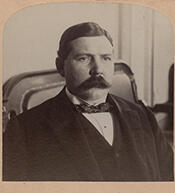
Here you will find contact information for Senator Jonathan Prentiss Dolliver, including email address, phone number, and mailing address.
| Name | Jonathan Prentiss Dolliver |
| Position | Senator |
| State | Iowa |
| Party | Republican |
| Status | Former Representative |
| Term Start | December 2, 1889 |
| Term End | October 15, 1910 |
| Terms Served | 9 |
| Born | February 6, 1858 |
| Gender | Male |
| Bioguide ID | D000404 |
About Senator Jonathan Prentiss Dolliver
Jonathan Prentiss Dolliver (February 6, 1858 – October 15, 1910) was a prominent Republican orator, U.S. representative, and U.S. senator from Iowa at the turn of the twentieth century. A leading figure in his party’s progressive wing, he gained national attention for his eloquence on the stump and in Congress, and on two occasions—at the Republican National Conventions of 1900 and 1908—he was actively promoted as a potential vice-presidential candidate, though he was never chosen. Dolliver served in the United States Congress during a significant period in American history, participating in the legislative process and representing the interests of his Iowa constituents over multiple terms in both the House of Representatives and the Senate.
Dolliver was born on February 6, 1858, near Kingwood in Preston County, then part of Virginia, a county that refused to join the Confederacy during the Civil War and instead remained in the Union as part of the newly formed state of West Virginia. The son of a Methodist minister, he was raised in an environment steeped in both religious and civic engagement. He attended the public schools and went on to West Virginia University at Morgantown, from which he graduated in 1876. His early education and family background helped shape the rhetorical skill and moral earnestness that would later characterize his political career.
After completing his university studies, Dolliver read law and was admitted to the bar in 1878. That same year he moved west to Fort Dodge, Iowa, where he commenced the practice of law. He quickly became an influential figure in his adopted community, serving as city solicitor of Fort Dodge from 1880 to 1887. During these years he honed his abilities as a courtroom advocate and public speaker. In 1884, at the age of twenty-six, he gained national prominence as an orator while campaigning around the country on behalf of Republican presidential nominee James G. Blaine. His wit and partisan fervor were widely noted; a famous political remark attributed to him, reflecting Iowa’s strong Republican loyalties and his own Methodist upbringing, was the quip, “Iowa will go Democratic when Hell goes Methodist.”
Dolliver’s success as an orator and local official propelled him into national elective politics. In 1888 he challenged the incumbent Republican congressman for Iowa’s 10th congressional district, Adoniram J. Holmes, for the party’s nomination. After a prolonged district nominating convention that required 110 ballots, Dolliver secured the nomination. He then easily won the general election and entered the United States House of Representatives in 1889, representing north-central Iowa. He was re-elected to the House five times, serving nine terms in Congress overall when his later Senate service is included. During his tenure in the House he rose in influence, serving as chairman of the House Committee on Expenditures in the Fifty-sixth Congress, and became known for his energetic advocacy of Republican policies and his skill in debate.
As Dolliver’s stature grew, he began to be mentioned for higher national office. In the 1900 presidential election, following the death of Vice President Garret Hobart in November 1899, President William McKinley and party leaders sought a new running mate. Dolliver was considered by some as a favorite for the vice-presidential nomination at the 1900 Republican National Convention. However, New York Governor Theodore Roosevelt, celebrated for his leadership in the Battle of San Juan Hill during the Spanish–American War, quickly emerged as the leading candidate. Dolliver ultimately stepped aside, and Roosevelt was nominated and elected vice president. Shortly thereafter, in July 1900, Iowa’s U.S. senator John H. Gear died in office. Iowa Governor Leslie M. Shaw appointed Dolliver to fill the vacancy, elevating him from the House to the Senate.
Dolliver’s Senate career extended from his appointment in 1900 until his death in 1910. He was twice re-elected to the Senate by the Iowa General Assembly and became an important figure in shaping national legislation during the Progressive Era. In the Senate he held several key committee chairmanships: he chaired the Committee on Pacific Railroads in the Fifty-seventh through Fifty-ninth Congresses, the Committee on Education and Labor in the Fifty-ninth and Sixtieth Congresses, and the Committee on Agriculture and Forestry in the Sixty-first Congress. His work on these committees placed him at the center of debates over transportation, labor conditions, education policy, and agricultural regulation at a time of rapid economic and social change. During his Senate service, Iowa Republicans were divided between a long-dominant conservative “old guard” and a rising progressive faction led by Albert B. Cummins, a lawyer and, after 1902, governor of Iowa. Although Dolliver enjoyed a national reputation as a progressive, he initially sided with the old guard by supporting veteran Senator William B. Allison against Cummins in the contentious 1908 Republican primary. Allison prevailed in the primary but died shortly thereafter, and Cummins ultimately entered the Senate. Dolliver soon reconciled with Cummins and increasingly aligned himself with the progressive wing of the party.
Dolliver’s name again surfaced in national politics during the 1908 presidential election. As Republicans prepared to nominate William Howard Taft for president, Dolliver was once more touted as a potential vice-presidential candidate. Initially he expressed a preference to remain in the Senate, but as the convention approached and reports circulated of support from President Theodore Roosevelt’s administration, he moderated his stance and indicated that he would not refuse the nomination if it were offered. The convention ultimately chose James S. Sherman of New York as Taft’s running mate, and Dolliver continued his work in the Senate, where he remained a respected voice on progressive reforms and Midwestern agricultural interests.
Jonathan Prentiss Dolliver died in office on October 15, 1910. He was interred in Oakland Cemetery in Fort Dodge, Iowa, the community where he had begun his legal and political career. His legacy in Iowa was commemorated in several ways: the small town of Dolliver, Iowa, established along a new railroad line in 1899, was named in his honor, as was Dolliver Memorial State Park south of Fort Dodge. His family’s political influence continued into the mid-twentieth century through his nephew, James I. Dolliver, who represented a similar area of Iowa in the U.S. House of Representatives from 1945 to 1957.