Senator Jonathan Trumbull
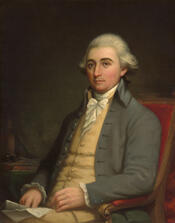
Here you will find contact information for Senator Jonathan Trumbull, including email address, phone number, and mailing address.
| Name | Jonathan Trumbull |
| Position | Senator |
| State | Connecticut |
| Party | Federalist |
| Status | Former Representative |
| Term Start | March 4, 1789 |
| Term End | March 3, 1797 |
| Terms Served | 4 |
| Born | March 26, 1740 |
| Gender | Male |
| Bioguide ID | T000389 |
About Senator Jonathan Trumbull
Jonathan Trumbull Sr. (October 12, 1710 – August 17, 1785) was an American colonial and state leader who served as governor of Connecticut during the American Revolution and later lent his name and legacy to numerous institutions and places in the state and beyond. A central political figure in the revolutionary era, he was the only governor of a British colony to take up the Patriot cause at the outset of the Revolutionary War and, along with Nicholas Cooke of Rhode Island, one of only two men to serve as governor of both a British colony and a U.S. state. He was also the father of several prominent figures of the early republic, including John Trumbull, the noted artist of the American Revolution, and Jonathan Trumbull Jr., who became Governor of Connecticut and Speaker of the United States House of Representatives. In later historical accounts, Jonathan Trumbull has also been associated with early national politics through his family, and in some traditions he is linked with the Federalist Party’s ascendancy in New England.
Trumbull was born in Lebanon, Connecticut, then part of the Colony of Connecticut, the son of Joseph Trumble (1678–1755), a merchant and landholder, and his wife, Hannah Trumble (née Higley), daughter of John Higley and Hannah Drake. The family’s immigrant patriarch, John Trumble (1612–1687), came from Newcastle upon Tyne in Northumberland, England, and was Joseph Trumble’s grandfather. The original family name was spelled “Trumble,” a form that was later altered to “Trumbull” for reasons that remain uncertain. Raised in a prosperous and politically active household in rural eastern Connecticut, Jonathan Trumbull grew up in an environment that combined commerce, local leadership, and Puritan religious traditions, all of which shaped his later public career.
Trumbull pursued higher education at Harvard College, where he graduated with a Bachelor of Arts degree in 1727. Following his graduation, he remained closely associated with religious life, studying theology for three years under the Reverend Solomon Williams in Lebanon. He was licensed to preach at Colchester, Connecticut, and his advanced studies were recognized with the conferral of a Master of Arts degree. Although he did not ultimately enter the ministry as his primary vocation, this early theological training and his grounding in New England Congregationalism informed his moral outlook and public rhetoric throughout his political life.
By the early 1730s, Trumbull had turned to commerce, joining his father’s mercantile business in 1731. His role in the enterprise expanded significantly after the death of his brother at sea in 1732, which left him more fully responsible for the family’s trading interests. On December 9, 1735, he married Faith Robinson (1718–1780), daughter of the Reverend John Robinson, thereby strengthening his ties to the region’s clerical and civic elite. In 1736, one year prior to his marriage, he purchased Flora, described in contemporary records as a “mulato girl and slave for life,” from Eliphalet Adams of New London, reflecting the presence of slavery in eighteenth-century Connecticut, even among leading Patriot families. Jonathan and Faith Trumbull became the parents of six children who would themselves play important roles in the Revolutionary era and early republic: Joseph Trumbull (1737–1778), the first commissary general of the Continental Army and an early member of the Board of War; Jonathan Trumbull Jr. (1740–1809), aide-de-camp to General George Washington from 1781 to the end of the war, Speaker of the United States House of Representatives from 1791 to 1793, and Governor of Connecticut from 1798 to 1809; Faith Trumbull (1743–1775), who married General Jedidiah Huntington; Mary Trumbull (1745–1831), who married William Williams, a signer of the Declaration of Independence; David Trumbull (1751–1822), commissary of the Colony of Connecticut and father of Joseph Trumbull, the 35th Governor of Connecticut; and John Trumbull (1756–1843), famed as the “Painter of the American Revolution” and briefly an aide-de-camp to General Washington in 1775.
Trumbull’s political career began in the colonial legislature. From 1733 to 1740 he served as a delegate to the Connecticut General Assembly, representing his community in the colony’s lower house. In 1739–1740 he rose to the position of Speaker of the House, demonstrating early legislative leadership. At the same time, he developed a parallel career in the militia. He was appointed lieutenant colonel in Connecticut’s militia in 1739 and later served as colonel of the 12th Connecticut Regiment during the French and Indian War, gaining administrative and military experience that would prove invaluable during the Revolution. His combination of mercantile, legislative, and military roles made him one of the colony’s most experienced public men by the mid-eighteenth century.
In the 1760s, Trumbull moved into the highest ranks of colonial government. He served as deputy governor of the Colony of Connecticut from 1766 to 1769. Upon the death of Governor William Pitkin in 1769, Trumbull succeeded to the governorship, a position he would hold until 1784. During these years he oversaw Connecticut’s transition from a British colony to a state within the new United States. His tenure coincided with escalating tensions between the colonies and Great Britain. On May 13, 1774, British General Thomas Gage arrived in Boston to assume the governorship of Massachusetts amid mounting unrest. Within a week Gage contacted Trumbull, expressing a “readiness to cooperate” with him “for the good of his Majesty’s service.” However, after the Battles of Lexington and Concord in April 1775, when Gage requested assistance from Connecticut, Trumbull refused and made clear his allegiance to the Patriot cause. In a sharply worded reply, he charged that Gage’s troops would “disgrace even barbarians” and accused him of “a most unprovoked attack upon the lives and the property of his Majesty’s subjects.”
As the Revolution unfolded, Trumbull became one of General George Washington’s most trusted allies among the governors. On July 6, 1775, along with other officers, he commissioned Nathan Hale as a first lieutenant in the newly raised Seventh Regiment of the Continental Army; Hale would later be executed by the British for espionage and remembered as an American martyr. Trumbull dedicated the resources of Connecticut—often called “the Provision State”—to the Continental cause, earning Washington’s admiration. Washington reportedly referred to him as “the first of the patriots,” and when he was in desperate need of men or supplies, he could “turn to ‘Brother Jonathan,’” a phrase that later became a popular personification of the American people. In addition to his gubernatorial duties, Trumbull briefly served as the Continental Army’s Paymaster General for the Northern Department in the spring of 1778. He resigned this post after the death of his mother, requesting that the remainder of his back pay be distributed to the soldiers of the Northern Department, a gesture that underscored his concern for the welfare of the troops.
Trumbull’s leadership during the war was marked by continuity and stability. He was one of only two colonial governors—along with Nicholas Cooke of Rhode Island—to remain in office after independence was declared, guiding Connecticut through the entire revolutionary period and into statehood. His long service and reputation for integrity brought him recognition from learned societies at home and abroad. In 1775 Yale University awarded him an honorary Doctor of Laws (LL.D.), and in 1782 he was elected a Fellow of the American Academy of Arts and Sciences. In 1784, as the war’s veterans organized to preserve the memory of their service, he was elected an honorary member of the Connecticut Society of the Cincinnati. In 1787, two years after his death, the University of Edinburgh also conferred upon him an honorary LL.D., reflecting his international stature.
In the broader political culture of the early United States, the Trumbull family’s prominence continued into the federal period. Jonathan Trumbull’s name has sometimes been associated with early Federalist leadership from Connecticut, and later traditions have linked him symbolically to the Federalist Party’s influence in New England. Within this context, Jonathan Trumbull has also been referenced in connection with Connecticut’s early representation in the United States Congress, a period during which the state’s Federalist leaders, including members of the Trumbull family, contributed to the legislative process in the formative years of the republic. His descendants and political associates were active in both state and national offices, helping to shape the policies of the new federal government.
Trumbull died in Lebanon, Connecticut, on August 17, 1785, and was buried in the Trumbull Cemetery, also known as the Old Cemetery, in his hometown. His residence in Lebanon, the Jonathan Trumbull House, was designated a National Historic Landmark in 1965, preserving the home from which he directed much of Connecticut’s revolutionary effort. His legacy is reflected in numerous commemorations: Trumbull College at Yale University, the town of Trumbull, Connecticut, and Trumbull County, Ohio—originally part of the Connecticut Western Reserve—are all named in his honor, as is Jonathan the Husky, the mascot of the University of Connecticut. His role in the Revolution and in Connecticut’s history has also entered American popular culture; for example, in Alice Turner Curtis’s historical novel “A Little Maid of Old Connecticut,” set beginning in 1777, the young protagonist delivers a secret message to Governor Trumbull, who later assists her friend’s father in obtaining a much-needed position. Through his public service, his family’s continued prominence, and the enduring use of his name, Jonathan Trumbull Sr. remains one of the most significant figures in Connecticut’s colonial and revolutionary history.