Representative Jonathan Taylor Updegraff
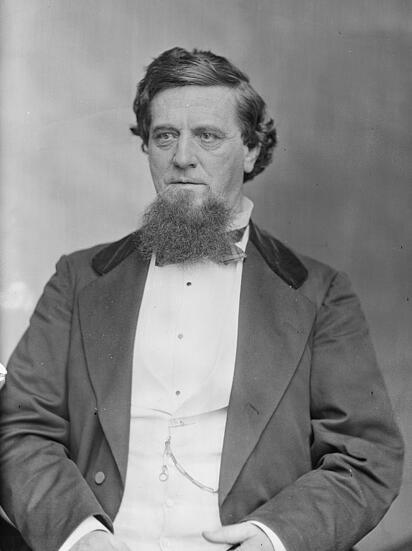
Here you will find contact information for Representative Jonathan Taylor Updegraff, including email address, phone number, and mailing address.
| Name | Jonathan Taylor Updegraff |
| Position | Representative |
| State | Ohio |
| District | 16 |
| Party | Republican |
| Status | Former Representative |
| Term Start | March 18, 1879 |
| Term End | March 3, 1883 |
| Terms Served | 2 |
| Born | May 13, 1822 |
| Gender | Male |
| Bioguide ID | U000018 |
About Representative Jonathan Taylor Updegraff
Jonathan Taylor Updegraff (May 13, 1822 – November 30, 1882) was an American physician, abolitionist, and Republican politician who served as a U.S. Representative from Ohio from 1879 to 1882. A member of the Republican Party, he represented his constituents in the Forty-sixth and Forty-seventh Congresses and contributed to the legislative process during two terms in office, a period marked by the challenges of Reconstruction’s aftermath and industrial expansion in the United States.
Updegraff was born near Mount Pleasant, Jefferson County, Ohio, into a prominent Quaker family of German and Dutch descent. He was a descendant of the Op den Graeff family, tracing his lineage to Herman op den Graeff, a Mennonite leader from Krefeld, and to Herman’s grandson Abraham op den Graeff, one of the founders of Germantown, Pennsylvania, and a signer in 1688 of the first formal protest against slavery in colonial America. His father, David Benjamin Updegraff, was a Quaker minister, and his grandfather, Nathan Updegraff, served as a delegate to Ohio’s first constitutional convention. This heritage of religious conviction, reformist sentiment, and public service shaped Jonathan Updegraff’s abolitionist views and later political career.
Updegraff attended private schools in his youth and pursued higher education at Franklin College in New Athens, Ohio, an institution known for its antislavery sentiment and for training many future public officials. He then turned to the study of medicine, enrolling at the University of Pennsylvania in Philadelphia, from which he was graduated in 1845. Seeking further professional training and exposure to leading medical thought, he continued his studies at medical schools in Edinburgh and Paris. This combination of American and European medical education equipped him with advanced skills and perspectives that he brought back to his practice in Ohio.
Although trained as a physician and engaged in medical practice, Updegraff devoted a large share of his time to agricultural pursuits near Mount Pleasant. His dual interests in medicine and farming reflected both his professional training and his rural Quaker background. During the American Civil War he served as a surgeon in the Union Army, applying his medical expertise in support of the Union cause. His wartime service further enhanced his public standing and aligned him with the Republican Party, which had led the effort to preserve the Union and abolish slavery.
Updegraff’s formal political career began at the state level. He was elected to the Ohio State Senate, serving in 1872 and 1873. In 1872 he also served as a Presidential elector on the Republican ticket for Ulysses S. Grant and Henry Wilson, casting his vote in the Electoral College for their successful reelection. He remained active in party affairs, serving as a delegate to the Republican State convention in 1873 and as a delegate to the 1876 Republican National Convention. Through these roles he became an influential figure in Ohio Republican politics during the Reconstruction era.
In national politics, Jonathan Taylor Updegraff was elected as a Republican to the Forty-sixth Congress and reelected to the Forty-seventh Congress, serving from March 4, 1879, until his death on November 30, 1882. His service in Congress occurred during a significant period in American history, as the nation grappled with issues of labor, education, civil rights, and economic development. As a member of the House of Representatives, he participated in the democratic process and represented the interests of his Ohio constituents. During the Forty-seventh Congress he served as chairman of the Committee on Education and Labor, a position that placed him at the center of debates over public schooling and the conditions of American workers in an era of rapid industrialization. He had been reelected to the Forty-eighth Congress prior to his death, and his seat was subsequently filled by Joseph D. Taylor.
Updegraff died in office at Mount Pleasant, Ohio, on November 30, 1882. His death prompted widespread expressions of respect and mourning. More than two thousand people viewed his body at the Friends Meetinghouse, reflecting both his standing in the local Quaker community and his broader public reputation. He was initially interred in Updegraff Cemetery near Mount Pleasant. In 1926 his remains were reinterred in Short Creek Cemetery, west of Mount Pleasant. The house he built in 1856 still stands in Mount Pleasant, serving as a tangible reminder of his life and presence in the community.
Contemporaries remembered Jonathan Taylor Updegraff as a man of simple habits and tastes, strong in his friendships and deeply devoted to his family. In public station, whether in state or national affairs, he was respected and honored; in private life, he was beloved by a large and influential circle of friends. Generous and confiding in nature, he was firm and unyielding in his convictions of duty, hating shams and despising pretension, and esteeming candor and sincerity above all. He regarded any labor or sacrifice for principle as a religious duty and was known to go out of his way to help a friend. His life and career reflected the intersection of Quaker faith, medical professionalism, antislavery conviction, and Republican public service in nineteenth-century Ohio.