Representative Jonathan Mayhew Wainwright
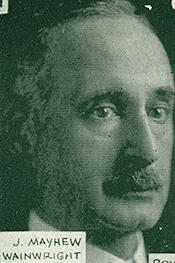
Here you will find contact information for Representative Jonathan Mayhew Wainwright, including email address, phone number, and mailing address.
| Name | Jonathan Mayhew Wainwright |
| Position | Representative |
| State | New York |
| District | 25 |
| Party | Republican |
| Status | Former Representative |
| Term Start | December 3, 1923 |
| Term End | March 3, 1931 |
| Terms Served | 4 |
| Born | December 10, 1864 |
| Gender | Male |
| Bioguide ID | W000023 |
About Representative Jonathan Mayhew Wainwright
Jonathan Mayhew Wainwright, commonly known as J. Mayhew Wainwright, was a United States Representative from New York who served in Congress from 1923 to 1931. A member of the Republican Party, he contributed to the legislative process during four consecutive terms in the House of Representatives and participated actively in representing the interests of his constituents during a significant period in American history. He was part of a prominent American family whose members served in both ecclesiastical and military leadership over several generations.
Wainwright was born on December 10, 1864, in New York City, New York, into a distinguished lineage. He was the grandson of Jonathan Mayhew Wainwright (1792–1854), the Episcopal Bishop of New York, a leading churchman in the early nineteenth century. Through this line he was also the grandson, in the broader family sense, of a tradition of public service that included Jonathan Mayhew Wainwright (naval officer) (1821–1863), a United States Navy officer killed in the American Civil War and son of the bishop. The family’s military distinction continued into the next generation with Jonathan M. Wainwright (1883–1953), a United States Army general during World War II and grandson of the naval officer. This multigenerational record of service shaped the environment in which J. Mayhew Wainwright came of age and helped define his own commitment to national service.
Educated in New York and abroad, Wainwright attended the Columbia Grammar School in New York City and then studied in Europe before entering Columbia College. He graduated from Columbia College in 1884 and went on to earn a law degree from Columbia Law School in 1886. Admitted to the bar the same year, he began practicing law in New York City. His legal training and early professional experience provided the foundation for his later work in public office, where he combined legal expertise with administrative and legislative responsibilities.
Wainwright’s public career began at the state and local levels in New York. He served in the New York State Assembly, representing Westchester County’s 1st District, and later in the New York State Senate, where he gained experience in state legislation and governance. His interest in military affairs led him into the armed forces, and he served as an army officer in the Spanish–American War, further deepening his engagement with national defense issues. He continued his military association into the early twentieth century, serving again during World War I, experience that would later inform his work in the War Department and in Congress.
At the national level, Wainwright held a key executive-branch position before entering the House of Representatives. From 1921 to 1923 he served as United States Assistant Secretary of War, a post in which he helped oversee aspects of the Army’s administration in the immediate post–World War I era. His tenure coincided with the nation’s efforts to demobilize from wartime footing and to address evolving questions of military organization and preparedness. This role placed him at the intersection of military policy and civilian oversight, reinforcing his reputation as an expert in defense and administrative matters.
In 1923, Wainwright was elected as a Republican to the United States House of Representatives from New York and began the first of four consecutive terms, serving until 1931. His years in Congress spanned the administrations of Presidents Warren G. Harding, Calvin Coolidge, and Herbert Hoover, a period marked by postwar economic expansion, evolving foreign policy, and the onset of the Great Depression at the close of his service. As a member of the House of Representatives, Jonathan Mayhew Wainwright participated in the democratic process and represented the interests of his New York constituents, bringing to bear his combined experience as a lawyer, state legislator, military officer, and former Assistant Secretary of War. His legislative work reflected the concerns of his era, including national defense, veterans’ issues, and the broader economic and social questions confronting the country in the 1920s.
After leaving Congress in 1931, Wainwright returned to private life and the practice of law, remaining a respected figure in New York and national Republican circles. He continued to be associated with the long-standing Wainwright family tradition of public and military service that linked an Episcopal bishop of New York, a Civil War naval officer, a World War II Army general, and his own career in Congress and the War Department. Jonathan Mayhew Wainwright died on June 3, 1945, in Rye, New York, closing a life that had spanned from the post–Civil War era through both World Wars and leaving a record of service in state government, the military, the executive branch, and the United States House of Representatives.