Representative Jordan Edgar Cravens
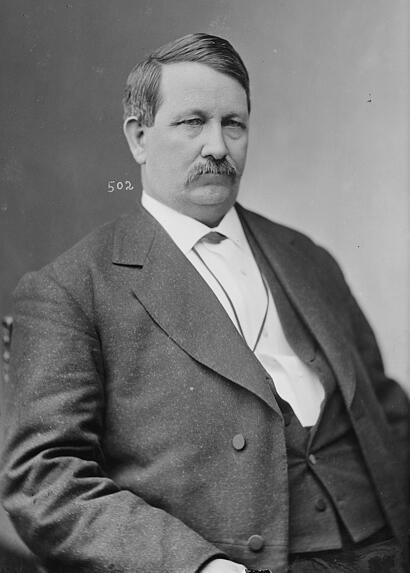
Here you will find contact information for Representative Jordan Edgar Cravens, including email address, phone number, and mailing address.
| Name | Jordan Edgar Cravens |
| Position | Representative |
| State | Arkansas |
| District | 3 |
| Party | Democratic |
| Status | Former Representative |
| Term Start | October 15, 1877 |
| Term End | March 3, 1883 |
| Terms Served | 3 |
| Born | November 7, 1830 |
| Gender | Male |
| Bioguide ID | C000885 |
About Representative Jordan Edgar Cravens
Jordan Edgar Cravens (November 7, 1830 – April 8, 1914) was an American lawyer, Confederate military officer, and Democratic politician who served as a U.S. Representative from Arkansas from 1877 to 1883. Over the course of three terms in Congress, he first sat as an Independent Democrat and then as a Democrat, representing the interests of his Arkansas constituents during a significant period in American history following the Civil War and Reconstruction. He was a cousin of William Ben Cravens, who would later also serve in the U.S. House of Representatives.
Cravens was born in Fredericktown, Madison County, Missouri, on November 7, 1830, the son of Nehemiah and Sophia Thompson Cravens. In 1831, he moved with his father to Arkansas, where he was educated in the common schools of the state. He pursued further studies at Cane Hill Academy in Boonsboro (now Canehill), Washington County, Arkansas, from which he graduated in 1850. After completing his formal education, he read law and was admitted to the bar in 1854, commencing the practice of law in Clarksville, Johnson County, Arkansas.
Before the outbreak of the Civil War, Cravens became active in state politics. He was elected to the Arkansas House of Representatives in 1860, serving in the 13th Arkansas General Assembly. He later served in the Arkansas Senate during the 16th Arkansas General Assembly, representing Johnson and Pope counties. During this antebellum period, Cravens was a slave owner, a fact that reflected the social and economic structure of Arkansas and the broader South in the years leading up to secession. He married Emma Batson, daughter of Felix Ives Batson, an Arkansas Supreme Court judge who, during the American Civil War, represented the First Congressional District of northwest Arkansas in both the First and Second Confederate Congresses. Jordan and Emma Cravens had five children: Jeane, Jane, Felix, Sallie, and Samuella.
With the secession of Southern states and the onset of the Civil War, Cravens entered the Confederate States Army in 1861 as a private in Company C, 17th Arkansas Infantry Regiment (Lemoyne’s). When that regiment was consolidated in May 1862, he was elected colonel of the newly organized 21st Arkansas Infantry Regiment. His regiment served in the Western Theater and was surrendered at Vicksburg, Mississippi, on July 4, 1863. After being declared exchanged on September 12, 1863, the 21st Arkansas was consolidated with the 14th (Powers’) Arkansas, the 15th (Northwest) Arkansas, and the 16th Arkansas Infantry Regiments to form the 1st Arkansas Consolidated Infantry Regiment (Trans-Mississippi Department). Cravens was named colonel of this new organization and continued in Confederate service until the close of hostilities.
Following the end of the Civil War, Cravens returned to Clarksville, Arkansas, and resumed his legal career. He served as prosecuting attorney of Johnson County in 1865 and 1866, playing a role in the reestablishment of civil authority during the early Reconstruction era. He was again elected to the Arkansas State Senate, serving from 1866 until 1868. After the conclusion of this term, he did not seek re-election and returned full time to his law practice in Clarksville, remaining a prominent figure at the local bar and in Democratic Party circles.
Cravens entered national politics in the centennial election year of 1876. Running as an Independent Democrat, he was elected to the Forty-fifth Congress in a closely contested three-way race, winning with approximately 37 percent of the vote and a margin of fewer than 300 votes over his nearest opponent, John McClure. He took his seat in the U.S. House of Representatives on March 4, 1877. He was reelected as a Democrat to the Forty-sixth Congress in 1878 and again in 1880 to the Forty-seventh Congress, when he secured about 58 percent of the vote, defeating former congressman Thomas Boles. In all, Cravens served in Congress from March 4, 1877, until March 3, 1883. During his three terms, he participated in the legislative process as a member of the House of Representatives, contributing to debates and decisions in the post-Reconstruction era and representing the interests of his Arkansas district as a member of the Democratic Party.
In 1882, Cravens sought renomination but was defeated in the Democratic primary by John H. Rogers, a local judge who went on to win the general election. After leaving Congress in March 1883, Cravens returned once more to the practice of law in Clarksville. He remained active in public affairs and Democratic politics and was periodically mentioned as a potential candidate for various offices, including governor of Arkansas and a possible return to Congress. In 1889, he successfully ran for a local circuit judgeship and served as a circuit court judge from 1890 until 1894, further extending his long career in Arkansas’s legal and political life.
In his later years, Cravens continued to reside in western Arkansas. He died in Fort Smith, Arkansas, on April 8, 1914, at the age of 83 years and 152 days. His remains were returned to Johnson County, and he was interred in Oakland Cemetery in Clarksville, Arkansas, closing a life that had spanned the antebellum era, the Civil War, Reconstruction, and the early twentieth century.