Senator Joseph Carter Abbott
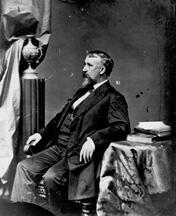
Here you will find contact information for Senator Joseph Carter Abbott, including email address, phone number, and mailing address.
| Name | Joseph Carter Abbott |
| Position | Senator |
| State | North Carolina |
| Party | Republican |
| Status | Former Representative |
| Term Start | January 1, 1868 |
| Term End | March 3, 1871 |
| Terms Served | 1 |
| Born | July 15, 1825 |
| Gender | Male |
| Bioguide ID | A000006 |
About Senator Joseph Carter Abbott
Joseph Carter Abbott (July 15, 1825 – October 8, 1881) was a Union Army colonel during the American Civil War who was awarded the grade of brevet brigadier general of volunteers and a Republican United States senator from the state of North Carolina between 1868 and 1871. He was born in Concord, New Hampshire, to farmer Aaron Carter Abbott and Nancy Badger. Educated in New England, he studied at Phillips Academy in Andover, Massachusetts, graduating in 1846 after pursuing studies there and under private auspices. He early developed an interest in public affairs and historical subjects, becoming a frequent contributor to magazines even as a young man.
After completing his preparatory education, Abbott studied law in Concord and was admitted to the bar in 1852. He soon combined legal practice with journalism and politics. From 1852 to 1857 he was the owner and editor of the Daily American newspaper in Manchester, New Hampshire, where his success as an editor brought him prominence in state political circles. In 1855 he was appointed Adjutant General of New Hampshire, a post he held until 1861, during which time he reorganized the state militia. He also served as a member of the commission to adjust the boundary between New Hampshire and Canada. Abbott’s journalistic career advanced further when he became editor of the Boston Atlas and Bee, a position he held from 1859 through 1861. During these years he was associated with the Know Nothing Party and continued to write extensively, particularly on historical topics.
With the outbreak of the Civil War, Abbott entered Union military service. In December 1861 he was commissioned lieutenant colonel of the 7th New Hampshire Volunteer Infantry Regiment. He participated in operations along the southern Atlantic coast, including the battles of Port Royal Sound, St. John’s Bluff, Fort Pulaski, and Fort Wagner. In November 1863 he was promoted to colonel of the 7th New Hampshire and led the regiment at the Battle of Olustee in Florida and later during the Bermuda Hundred Campaign in Virginia. During the siege of Petersburg, he commanded the 2nd Brigade, 1st Division, X Corps at Chaffin’s Farm and in subsequent actions along the Darbytown and New Market Roads. When the Army of the James was reorganized, his command became the 2nd Brigade, 2nd Division, XXIV Corps, which was attached to the Fort Fisher Expeditionary Corps under Brigadier General Alfred H. Terry. Abbott’s brigade took part in the second battle of Fort Fisher and the capture of Wilmington, North Carolina. For his gallant services in the capture of Fort Fisher, President Abraham Lincoln on January 25, 1865, nominated him to the grade of brevet brigadier general of volunteers, to rank from January 15, 1865, and the United States Senate confirmed the award on February 14, 1865. During the final stages of the war, he was stationed in Wilmington, North Carolina.
Following the war, Abbott chose to remain in North Carolina, where he became deeply involved in Reconstruction-era politics. He was active in the reorganization of civil government and served as a delegate to the North Carolina constitutional convention in 1868. His political strength in the postwar South came primarily through support from the newly enfranchised Black population, whose political capacity he openly affirmed. He assisted in organizing Black voters and provided political counsel, activities that provoked blunt warnings and hostility from many white residents. In this period he also began building a base in business and journalism, laying the groundwork for his later role in North Carolina’s Republican Party.
Abbott’s service in the United States Senate occurred during a significant period in American history, as Congress grappled with Reconstruction and the readmission of former Confederate states. He was elected as a Republican to the United States Senate in 1868, at a time when North Carolina had been without representation in that body since July 1861, when its senators were expelled following the state’s secession from the Union. He formally took his seat on July 14, 1868, and served one term, ending on March 4, 1871. In some contemporary and later accounts his senatorial tenure is dated broadly from 1867 to 1871, reflecting the larger Reconstruction context in which he was chosen. As a member of the Senate, Joseph Carter Abbott participated in the legislative process and represented the interests of his constituents during a period of intense national debate over civil rights, suffrage, and the reintegration of the South into the Union.
During his term in the Senate, Abbott spoke in orthodox Republican terms on questions of suffrage and Reconstruction policy and was regarded as helpful in managing the details of army administration, reflecting his wartime experience. He devoted considerable attention to improving the harbor of Wilmington, North Carolina, seeing it as vital to the state’s economic future. He also advocated the consolidation of the railroads of the Carolinas into a system that could form part of a southern transcontinental route. Although he engaged with a wide range of legislative issues, his single most noted legislative achievement was the successful imposition of a duty on peanuts, an item of growing commercial importance in the South. From 1870 through 1872 he served as a member of the Republican National Committee from North Carolina. During this period, critics charged that he was in the pay of a political “ring” whose major interests were substantially similar to his own positions, a claim that contributed to controversy around his leadership. He was not nominated for a second term in the Senate, and his influence within the party waned thereafter.
Upon leaving the Senate in 1871, Abbott turned again to business and journalism while continuing to hold federal appointments. He conducted a lumber manufacturing business and from August 1869 had served, and continued to serve, as editor of the Wilmington Post, a Republican newspaper of comparatively high quality for its era. In private life he was variously a lawyer, newspaper editor, and businessman, and he never entirely withdrew from public service. Under President Ulysses S. Grant and later under President Rutherford B. Hayes, he received several federal appointments. He served as collector of the port of Wilmington, inspector of posts along the eastern line of the southern coast during the Hayes Administration, and special agent of the United States Treasury Department. Despite these posts, he never again achieved substantial status as a party leader in North Carolina. Among his lasting local contributions was the establishment of the town of Abbottsburg, North Carolina.
In his later years, Abbott’s personal life was marked by multiple marriages but no direct descendants; despite three marriages, he died childless. He died on October 8, 1881. He was originally buried in the National Cemetery in Wilmington, North Carolina, reflecting his close association with that city during and after the Civil War. In 1887 his remains were reinterred in Valley Cemetery in Manchester, New Hampshire, returning him to the state where his public career had begun. His political legacy remained controversial. The Dictionary of American Biography later observed that “The historians of the state even now mention him only to condemn him,” a judgment that underscored the enduring bitterness of Reconstruction-era politics in North Carolina and the contested memory of Republican leadership in the postwar South.