Representative Joseph Walker Barr
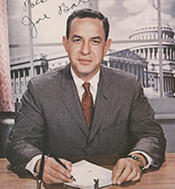
Here you will find contact information for Representative Joseph Walker Barr, including email address, phone number, and mailing address.
| Name | Joseph Walker Barr |
| Position | Representative |
| State | Indiana |
| District | 11 |
| Party | Democratic |
| Status | Former Representative |
| Term Start | January 7, 1959 |
| Term End | January 3, 1961 |
| Terms Served | 1 |
| Born | January 17, 1918 |
| Gender | Male |
| Bioguide ID | B000170 |
About Representative Joseph Walker Barr
Joseph Walker Barr (January 17, 1918 – February 23, 1996) was an American businessman and Democratic politician from Indiana who served one term in the United States House of Representatives from 1959 to 1961 and later briefly held the post of United States Secretary of the Treasury from December 21, 1968, until January 20, 1969, in President Lyndon B. Johnson’s cabinet. Over the course of his career, he was also a senior Treasury official, chairman of the Federal Deposit Insurance Corporation, and a prominent banking executive.
Barr was born in Vincennes, Knox County, Indiana, on January 17, 1918, the son of Oscar Lynn Barr and Stella Florence Walker. He grew up in Indiana and pursued higher education at DePauw University in Greencastle, Indiana, from which he graduated before the Second World War. While at DePauw he was a member of the Phi Kappa Psi fraternity, an affiliation that reflected his early engagement in campus and civic life. On September 3, 1939, he married Beth Ann Williston in Indianapolis, Indiana; the couple had five children: Bonnie Barr Gilliom, Cherry Ann Barr, Joseph Williston Barr, Elizabeth Eugenia Barr LoSasso, and Lynn Hamilton Barr Fineberg. Barr continued his education at Harvard University in Cambridge, Massachusetts, where he earned a master’s degree in economics in 1941, providing him with the academic foundation for his later work in finance and public policy.
With the outbreak of World War II, Barr entered military service. He served in the United States Navy from 1942 to 1945, performing subchaser duty in both the Mediterranean Sea and the Atlantic Ocean. During his naval service he took part in antisubmarine operations and was awarded the Bronze Star Medal for his role in sinking a submarine off Anzio Beach, Italy. His wartime experience, particularly in command and operational settings, helped shape his leadership style and broadened his understanding of international affairs and logistics.
After returning from the war, Barr embarked on a business career in Indiana. He engaged in the operation of grain elevators, theaters, real estate, and publishing enterprises, becoming a diversified businessman with interests in several sectors of the state’s economy. These activities brought him into close contact with local communities and economic concerns, experience that later informed his approach to legislative and financial policy. His growing prominence in business and Democratic Party circles in Indiana set the stage for his entry into electoral politics in the late 1950s.
In 1958, Barr ran for Congress as a Democrat from Indiana’s 11th congressional district, a district that had been considered a Republican stronghold. He defeated the incumbent Republican Representative Charles B. Brownson in that election, benefiting in part from national Democratic gains that expanded the party’s majority in the House of Representatives from 35 to 129 seats. Barr took office as a Representative from Indiana in the United States Congress in January 1959 and served one term, from 1959 to 1961. During this significant period in American history, he participated in the legislative process, represented the interests of his constituents, and contributed to the work of the Democratic majority in the House. While in Congress, he developed a friendship with then-Senator John F. Kennedy, a relationship that would influence his subsequent appointments in the executive branch. Barr was defeated for re-election in 1960 and left the House after the close of his first term.
Following his electoral defeat, Barr transitioned to appointed federal service. President John F. Kennedy appointed him Assistant to the Secretary of the Treasury for Congressional Relations, a position in which Barr served as a key liaison between the Treasury Department and members of Congress. In 1963, he was appointed chairman of the Federal Deposit Insurance Corporation (FDIC), placing him at the center of federal efforts to maintain stability and public confidence in the banking system. Under President Lyndon B. Johnson, Barr’s responsibilities expanded further when he was appointed Under Secretary of the Treasury, a post he held from 1965 to 1968. In that capacity, he was involved in high-level fiscal and financial policy during a period marked by the Great Society programs and the economic demands of the Vietnam War.
When Secretary of the Treasury Henry H. Fowler resigned in December 1968, President Johnson named Barr to succeed him. Barr received a recess appointment as Secretary of the Treasury, effective December 21, 1968, and served until the end of Johnson’s term on January 20, 1969. His tenure of approximately 30 days was the shortest of any Secretary of the Treasury in United States history. Because of the brevity of his service, his signature appears only on the one-dollar bill, making the so‑called “Barr notes” a minor point of interest among currency collectors. Despite the short duration of his term, his appointment capped a decade of continuous service in senior financial and regulatory positions within the federal government.
After leaving federal office in 1969, Barr returned to the private financial sector. He was named vice chairman of the American Security and Trust Company, a major Washington, D.C.–based banking institution. He subsequently served as the company’s president and chairman from 1969 to 1974, playing a leading role in its management and strategic direction during a period of change in the American banking industry. Later, he continued his involvement in financial institutions as chairman of the Federal Home Loan Bank in Atlanta, Georgia, from 1977 to 1981, helping to oversee the regional component of the federal home loan bank system that supported mortgage lending and housing finance.
Joseph Walker Barr died of a heart attack on February 23, 1996, in Playa del Carmen, Mexico. He was interred in Leeds Episcopal Church Cemetery in Hume, Fauquier County, Virginia. His career spanned military service, business, elective office, and high-level financial administration, and included service as a Representative from Indiana, as chairman of the FDIC, as Under Secretary and Secretary of the Treasury, and as an executive in major banking institutions.