Representative Joseph David Beck
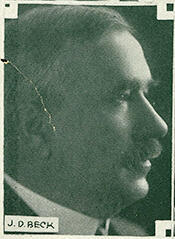
Here you will find contact information for Representative Joseph David Beck, including email address, phone number, and mailing address.
| Name | Joseph David Beck |
| Position | Representative |
| State | Wisconsin |
| District | 7 |
| Party | Republican |
| Status | Former Representative |
| Term Start | April 11, 1921 |
| Term End | March 3, 1929 |
| Terms Served | 4 |
| Born | March 14, 1866 |
| Gender | Male |
| Bioguide ID | B000291 |
About Representative Joseph David Beck
Joseph David Beck (March 14, 1866 – November 8, 1936) was an American farmer, labor reform advocate, and progressive Republican politician from Vernon County, Wisconsin. Known commonly as J. D. Beck, and sometimes incorrectly referred to as “John D. Beck,” he emerged from rural western Wisconsin to become a prominent figure in the state’s progressive movement and a four-term member of the United States House of Representatives. His career was closely intertwined with that of Wisconsin governor and U.S. senator Robert M. “Fighting Bob” La Follette, under whose leadership Beck helped shape pioneering labor and industrial legislation.
Beck was born in Vernon County, Wisconsin, where he was raised in an agricultural setting and engaged in farming as a young man. His early life in a rural community informed his later advocacy for both farmers and industrial workers, giving him a practical understanding of the economic and social challenges facing ordinary citizens in early twentieth-century Wisconsin. This background helped position him as a bridge between agrarian interests and the emerging industrial labor movement in the state.
Beck’s public career began in state service during the ascendancy of the Wisconsin progressive movement. Working in the Bureau of Labor and Industrial Statistics under the La Follette administration, he played a significant role in the development of Wisconsin’s early worker’s compensation laws, which became a model for labor reform nationwide. His expertise and commitment to labor issues led to his appointment in 1911 as one of the original members of the newly created Wisconsin Industrial Commission, a powerful regulatory body charged with overseeing labor standards, industrial safety, and related matters. Beck served on the commission from 1911 through 1917 and was its chairman from 1915 through 1917. In connection with this work, he served as editor of the Wisconsin Blue Book for the 1907, 1909, and 1911 editions, helping to compile and present official information about the state’s government and institutions.
By the late 1910s, Beck was widely recognized as a leading progressive Republican in Wisconsin, and his name was frequently mentioned in connection with higher office. In 1920 he was again rumored as a potential candidate for governor, reflecting his growing stature within the La Follette wing of the Republican Party. In April 1920, however, he publicly announced that he would not seek the governorship, immediately prompting speculation that he intended instead to challenge incumbent Republican U.S. Representative John J. Esch. Within days, Beck formally declared his candidacy for Congress in the Republican primary for Wisconsin’s 7th congressional district, which then comprised Adams, Clark, Jackson, Juneau, La Crosse, Monroe, Sauk, and Vernon counties in western Wisconsin.
Beck’s 1920 congressional campaign unfolded against the backdrop of populist discontent with the Esch–Cummins Act, a railroad re-privatization measure associated with Representative Esch. Capitalizing on this backlash and drawing on his progressive record in labor and industrial regulation, Beck mounted a successful primary challenge and defeated Esch by approximately 3,700 votes. In the subsequent general election, he faced only Prohibition and Socialist Party opponents and prevailed decisively with about 78 percent of the vote, confirming his broad appeal among voters in the district.
Joseph David Beck served as a Republican Representative from Wisconsin in the United States Congress from March 4, 1921, to March 3, 1929, completing four consecutive terms representing Wisconsin’s 7th congressional district. His service in the House of Representatives occurred during a significant period in American history, encompassing the immediate post–World War I era and much of the 1920s. As a member of the House, Beck participated actively in the legislative process and represented the interests of his largely rural and small-town constituency, bringing to national debates his experience in labor reform, industrial regulation, and agricultural concerns. Although he faced serious opponents in each Republican primary, he consistently secured renomination and went on to win his general elections by large margins, underscoring his durable support at home.
After leaving Congress in 1929, Beck remained identified with the progressive Republican tradition in Wisconsin and with the labor and industrial reforms that had defined his earlier state service. His long association with Robert M. La Follette and his contributions to Wisconsin’s worker’s compensation framework and industrial regulation left a lasting imprint on the state’s public policy. Joseph David Beck died on November 8, 1936, closing a career that spanned farming, state administration, and national legislative service, and that reflected the broader evolution of progressive politics in early twentieth-century Wisconsin.