Representative Joseph Henry Beeman
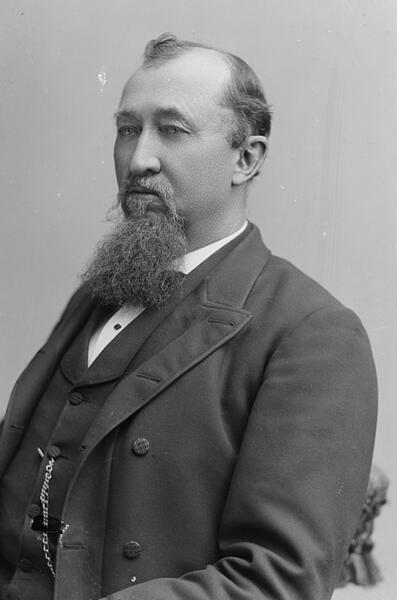
Here you will find contact information for Representative Joseph Henry Beeman, including email address, phone number, and mailing address.
| Name | Joseph Henry Beeman |
| Position | Representative |
| State | Mississippi |
| District | 5 |
| Party | Democratic |
| Status | Former Representative |
| Term Start | December 7, 1891 |
| Term End | March 3, 1893 |
| Terms Served | 1 |
| Born | November 17, 1833 |
| Gender | Male |
| Bioguide ID | B000309 |
About Representative Joseph Henry Beeman
Joseph Henry Beeman (November 17, 1833 – July 31, 1909) was an American educator, slave owner, Confederate Army officer, and Democratic politician who represented Mississippi in the United States House of Representatives from 1891 to 1893. Over the course of his public life he was active in state and national politics, serving in the Mississippi House of Representatives and later in the Fifty-second Congress, where he represented the interests of his constituents during a significant period in American history.
Beeman was born near Gatesville, Gates County, North Carolina, on November 17, 1833. In 1847 he moved with his parents to Morgan County, Alabama, as part of the broader mid-nineteenth-century migration of Southern families seeking new agricultural and economic opportunities in the expanding states of the Deep South. Two years later, in 1849, the family relocated again, settling in Mississippi, where Beeman would spend the remainder of his life and build his career in education, business, agriculture, and politics.
Beeman received an academic education in his youth and began his professional life as an educator, teaching for several years in Mississippi. During this period he was also a slave owner, participating in and benefiting from the system of chattel slavery that underpinned the antebellum Southern economy and society. After his years in the classroom, he left teaching and engaged in mercantile pursuits, entering local business and commercial activity that helped establish his standing in the community and provided a foundation for his later involvement in public affairs.
During the American Civil War, Beeman served in the Confederate States Army, holding the rank of lieutenant. His service as a Confederate officer placed him among the many Southern men who took up arms in defense of the Confederacy. The experience of the war, the defeat of the Confederacy, and the subsequent Reconstruction era formed the political and social backdrop against which he later emerged as a public official in Mississippi.
In the decades following the war, Beeman became increasingly active in state politics. He represented Scott County in the Mississippi House of Representatives for four consecutive two-year terms, serving from 1884 to 1891. During his tenure in the state legislature, he participated in the lawmaking process at a time when Mississippi and other Southern states were reshaping their political and economic systems in the post-Reconstruction era. Beeman was closely connected with the Farmers’ Alliance, a major agrarian reform movement of the late nineteenth century that sought to address the economic grievances of farmers. He served as chairman of the Alliance’s executive committee and was a delegate to several state conventions, roles that enhanced his prominence among agricultural and populist constituencies in Mississippi.
Beeman’s state-level service and his association with the Farmers’ Alliance helped propel him to national office. A member of the Democratic Party, he was elected as a Democrat to the Fifty-second Congress and served as a U.S. Representative from Mississippi from March 4, 1891, to March 3, 1893. His single term in the United States House of Representatives occurred during a significant period in American history marked by debates over monetary policy, tariffs, and agricultural distress. As a member of the House of Representatives, Joseph Henry Beeman participated in the democratic process and contributed to the legislative work of the Congress while representing the interests of his Mississippi constituents. He did not stand as a candidate for reelection in 1892 and returned to private life at the conclusion of his term.
After leaving Congress, Beeman resumed life in Mississippi and engaged in agricultural pursuits. He lived near Lena, Mississippi, where he continued to be identified with the farming community whose interests he had long represented in both state and national forums. Joseph Henry Beeman died near Lena, Mississippi, on July 31, 1909. He was interred in Beeman Cemetery in Lena, Mississippi, closing a life that spanned the antebellum, Civil War, Reconstruction, and post-Reconstruction eras in the American South.