Senator Joseph Sill Clark
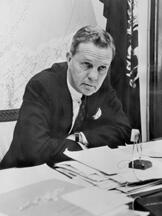
Here you will find contact information for Senator Joseph Sill Clark, including email address, phone number, and mailing address.
| Name | Joseph Sill Clark |
| Position | Senator |
| State | Pennsylvania |
| Party | Democratic |
| Status | Former Representative |
| Term Start | January 3, 1957 |
| Term End | January 3, 1969 |
| Terms Served | 2 |
| Born | October 21, 1901 |
| Gender | Male |
| Bioguide ID | C000444 |
About Senator Joseph Sill Clark
Joseph Sill Clark Jr. (October 21, 1901 – January 12, 1990) was an American writer, lawyer, and politician who became a leading figure in mid‑twentieth‑century urban reform and liberal Democratic politics. A member of the Democratic Party, he served as the 90th Mayor of Philadelphia from 1952 to 1956 and as a United States senator from Pennsylvania from 1957 to 1969. Clark was the only Unitarian Universalist elected to a major office in Pennsylvania in the modern era, and his public career spanned municipal reform, wartime military service, and national legislative leadership during a transformative period in American history.
Clark was born in Philadelphia, Pennsylvania, the son of attorney and noted tennis player Joseph Sill Clark Sr. and his wife, who came from a prominent local family. Raised in an upper‑middle‑class environment that emphasized public service and civic responsibility, he attended local preparatory schools before pursuing higher education. He went on to study at the University of Pennsylvania, where he completed his undergraduate work and then enrolled in the University of Pennsylvania Law School. After graduating from the law school, he was admitted to the bar and began a legal career in Philadelphia, joining the city’s professional and civic circles while developing an interest in governmental reform and good‑government advocacy.
In the 1930s and 1940s, Clark became increasingly active in efforts to challenge and ultimately dismantle the long‑entrenched Republican political machine that dominated Philadelphia. He aligned himself with a broad reform movement that sought to modernize city government, curb patronage, and introduce professional standards into municipal administration. His legal practice and reform activities were interrupted by World War II, during which he served in the United States Army Air Forces. His wartime service further enhanced his public profile and reinforced his commitment to public duty, preparing him for a more prominent role in postwar civic life.
Returning to Philadelphia after the war, Clark quickly emerged as a leading reform Democrat. In 1949 he won election as city controller, one of the first major victories for the reform coalition. In that capacity he used the powers of his office to investigate and publicize scandals in city government, exposing waste and corruption and helping to build public support for structural changes in municipal administration. His work as controller made him a central figure in the movement that culminated in the adoption of a new city charter and the weakening of the old machine, and it positioned him as the leading Democratic candidate for mayor.
In 1951, Clark won election as Mayor of Philadelphia, becoming the first Democrat to hold that office since 1884. Taking office in 1952, he served one term, from 1952 to 1956, as the city’s 90th mayor. As mayor, he sought to reduce corruption in city government, implement the new city charter, and professionalize the civil service. His administration emphasized urban renewal and social welfare, including the creation of low‑income housing projects and efforts to improve city planning and public services. Clark’s mayoralty became a model for postwar urban reform, and his success in breaking the Republican machine’s hold on Philadelphia helped reshape the city’s political landscape for decades.
After one term as mayor, Clark turned to national office. In the 1956 Senate election, he narrowly defeated incumbent Republican Senator James H. Duff, winning a seat in the United States Senate from Pennsylvania. He took office in January 1957 and served two consecutive terms, remaining in the Senate until January 1969. His service in Congress occurred during a significant period in American history, encompassing the civil rights movement, the early stages of U.S. involvement in Vietnam, and major debates over domestic social policy. As a senator, Clark participated fully in the legislative process and represented the interests of his Pennsylvania constituents while also becoming a prominent voice for national liberal causes.
During his Senate career, Clark earned a reputation as a strong supporter of civil rights and an advocate of an expanded federal role in promoting social justice. From his position on the Democratic Steering Committee, he worked to appoint liberal members to key committees, thereby influencing the ideological balance of the Senate’s legislative work. He supported landmark civil rights legislation and aligned himself with the reform wing of the Democratic Party on issues such as fair housing, voting rights, and anti‑poverty programs. Clark narrowly won re‑election in 1962, reflecting both his personal appeal and the competitiveness of Pennsylvania politics in that era. In the late 1960s, however, his outspoken support of gun control measures and his opposition to the Vietnam War became politically controversial. In the 1968 election he was defeated by Republican Congressman Richard Schweiker, with many observers attributing his loss in significant part to those positions.
After leaving office in January 1969, Clark remained active in public life as a writer, commentator, and educator. He became a professor at Temple University, where he taught and lectured on government, public policy, and urban affairs, drawing on his extensive experience in both municipal and national politics. He continued to write on political and social issues, contributing to the broader discourse on liberalism, urban governance, and the responsibilities of public officials. His papers, including reports, articles, news releases, and some correspondence, were eventually deposited at the Historical Society of Pennsylvania, where the Joseph Sill Clark Papers are available for research use and provide a detailed record of his career and thought.
Joseph Sill Clark Jr. died on January 12, 1990, closing a long life devoted to public service at the local, state, and national levels. His career as a reform mayor, two‑term United States senator from Pennsylvania from 1957 to 1969, and prominent Unitarian Universalist officeholder left a lasting imprint on Philadelphia’s political transformation and on the liberal wing of the Democratic Party in the mid‑twentieth century.