Representative Joseph J. DioGuardi
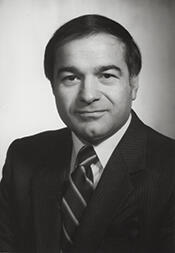
Here you will find contact information for Representative Joseph J. DioGuardi, including email address, phone number, and mailing address.
| Name | Joseph J. DioGuardi |
| Position | Representative |
| State | New York |
| District | 20 |
| Party | Republican |
| Status | Former Representative |
| Term Start | January 3, 1985 |
| Term End | January 3, 1989 |
| Terms Served | 2 |
| Born | September 20, 1940 |
| Gender | Male |
| Bioguide ID | D000359 |
About Representative Joseph J. DioGuardi
Joseph John DioGuardi (born September 20, 1940) is an American accountant and politician who served as a Republican U.S. Representative from New York from 1985 to 1989. Representing New York’s 20th congressional district for two terms, he was the first Albanian American voting member of the United States Congress. Over the course of his public career, he became known both for his work on federal financial management reform and for his advocacy on behalf of Albanian Americans and other ethnic communities. He later emerged as a recurring candidate for federal office in New York, including as the Republican nominee for the U.S. Senate in the 2010 special election, in which he was defeated by incumbent Senator Kirsten Gillibrand.
DioGuardi was born in New York to Joseph DioGuardi Sr., an immigrant from Greci, Italy, and Grace Paparella. His father was of Albanian descent, descended from an Albanian community that had settled in southern Italy centuries earlier. After arriving in the United States, Joseph Sr. eventually established a grocery and vegetable store in the East Bronx. On January 8, 1939, he married Grace Paparella, and the couple later settled in the Orchard Hills section of White Plains, New York. Joseph J., the eldest of their three children, spent his early years in the Bronx before the family moved to Westchester County in 1957. Following the move, he attended Fordham Preparatory School. That same year he took a summer job as a busboy at the Elmwood Country Club in Westchester County and was soon promoted to waiter, an early indication of the work ethic that would characterize his professional life.
After completing his preparatory education, DioGuardi enrolled at Fordham University in New York City, from which he graduated in 1962. Soon after college, he was hired by the international accounting firm Arthur Andersen & Co. He became a Certified Public Accountant and, after ten years with the firm, achieved partner status at the age of 31. At Arthur Andersen, he specialized in federal and state taxation for nonprofit organizations and the tax economics of charitable giving, gaining expertise in complex financial and regulatory issues. This background in accounting and fiscal policy later informed his legislative priorities and his interest in reforming federal financial management practices.
DioGuardi entered electoral politics in the 1980s. In 1984, when incumbent Democratic U.S. Representative Richard Ottinger retired from New York’s 20th congressional district—a Democratic-leaning district with sizable minority populations in Mount Vernon, Yonkers, and New Rochelle—DioGuardi ran as the Republican candidate. In a closely contested race, he defeated Democrat Oren Teicher by a margin of 50 percent to 48 percent. He took office in January 1985, contributing to the legislative process during a significant period in American political history and representing the interests of his suburban and urban constituents in Westchester County and the lower Hudson Valley. In 1986 he won re-election to a second term, defeating former U.S. Representative Bella Abzug, who had relocated from Greenwich Village in Manhattan to Mount Vernon, by a vote of 54 percent to 45 percent.
During his tenure in the House of Representatives, which lasted from 1985 to 1989, DioGuardi focused on fiscal accountability and government reform, drawing heavily on his professional experience as an accountant. He was the original author of the Chief Financial Officer and Federal Financial Reform Act (CFO Act), which was ultimately signed into law by President George H. W. Bush in 1990. The act mandated the assignment of a chief financial officer to each major department and agency of the U.S. government, with the aim of improving oversight, transparency, and efficiency in federal financial management. Former Comptroller General of the United States Charles Bowsher later testified before the U.S. Senate that, since the enactment of the bill, “We have seen important progress in directly confronting serious financial management weaknesses.” DioGuardi also worked on issues of historical recognition and racial justice in the armed forces. Noting that of the 1.55 million Black American military servicemen not one had received the Medal of Honor, he joined with Democratic Representative Mickey Leland to initiate legislation to confer the medal on Black World War I and World War II military heroes who had been recommended for, but had not received, the honor. As a result of this effort, nine Medals of Honor have since been awarded. Among his recorded votes in Congress, he opposed the Abandoned Shipwrecks Act of 1987, which asserted United States title to certain abandoned shipwrecks located on or embedded in submerged lands under state jurisdiction and transferred title to the respective states to help them manage these cultural and historical resources and prevent damage by treasure hunters and salvors. Despite his opposition, President Ronald Reagan signed the act into law on April 28, 1988.
DioGuardi’s 1988 bid for a third term in Congress was unsuccessful. He was defeated by Nita Lowey, then serving as Assistant Secretary of State of New York, by a margin of 50 percent to 47 percent. The campaign was marked by controversy over campaign finance practices. Gannett Suburban Newspapers, part of the Gannett chain, reported that Crabtree Automotive, one of the Westchester area’s largest car dealers, had allegedly skirted federal election laws by funneling $50,000 into DioGuardi’s campaign. According to The New York Times, several employees stated that they were given $2,000 each in company checks, asked to deposit them into their own accounts, and then write personal checks for the same amount to the DioGuardi campaign. Joseph Crabtree, the company’s chief executive, and his son Robert, the company’s president, both members of the campaign’s finance committee, were implicated. The Democratic Congressional Campaign Committee filed a complaint with the Federal Election Commission, and Joseph Crabtree resigned from the campaign. DioGuardi steadfastly denied wrongdoing, and his campaign filed its own complaint with the New York State Board of Elections, asserting that, contrary to his opponent’s advertising, the employees had placed funds in a separate “People for DioGuardi” campaign account as required by law.
After leaving Congress in 1989, DioGuardi remained active in electoral politics and public affairs. Following redistricting after the 1990 census, Nita Lowey chose to run in the newly drawn New York’s 18th congressional district. DioGuardi challenged her in a 1992 rematch, but she prevailed by a margin of 56 percent to 44 percent. In 1994, when Republican Representative Hamilton Fish IV retired from neighboring New York’s 19th congressional district, DioGuardi sought the Republican nomination in a six-candidate primary. He finished second with 20 percent of the vote, behind Sue W. Kelly, who won with 23 percent. DioGuardi then ran in the general election as the nominee of the Conservative Party of New York State. Kelly won the general election with 52 percent of the vote; Democratic nominee Hamilton Fish V received 37 percent, DioGuardi finished third with 10 percent, and Catherine Portman-Laux received 1 percent. In 1996 he again challenged Kelly, this time running in the general election on the Conservative Party and Right-to-Life Party lines. Kelly was re-elected with 46 percent of the vote, while DioGuardi, in third place, received 12 percent.
DioGuardi also pursued statewide office. In 2000 he launched a bid to run for the U.S. Senate from New York on the Conservative Party line. His effort arose in the context of then–New York City Mayor Rudy Giuliani’s Senate campaign; Conservative Party chairman Mike Long initiated DioGuardi’s candidacy after Giuliani declined to renounce his endorsement by the Liberal Party, a condition the Conservatives had sought. When Giuliani subsequently ended his Senate campaign, DioGuardi withdrew as well, and the Conservative Party line was given to Representative Rick Lazio, who became the Republican and Conservative nominee. DioGuardi continued to seek a return to Congress in the following decade. After Democrat John Hall defeated Sue Kelly in 2006, DioGuardi entered the 2008 race to challenge Hall. At a Republican convention held in May 2008 in Mahopac, New York, with delegates from five counties, Kieran Michael Lalor won the endorsement with 46 percent of the vote; DioGuardi finished last among the contenders with 13 percent. In 2010 he secured the Republican nomination in the special election for the U.S. Senate seat held by Kirsten Gillibrand, but he lost the general election to the incumbent senator.
Parallel to his electoral pursuits, DioGuardi developed a prominent role in ethnic advocacy and civic affairs. Drawing on his Albanian heritage, he became president of the Albanian American Civic League, an organization he runs with his wife, Shirley Cloyes DioGuardi. Through this organization, he has worked to promote the interests of Albanian Americans and to influence U.S. policy toward the Balkans, particularly during periods of conflict and political transition in the region. His leadership in this area has made him a notable figure within the Albanian diaspora community in the United States. In his personal life, he is the father of Kara DioGuardi, a songwriter and record producer who has achieved national recognition in the music industry.