Representative Joseph Barton Elam
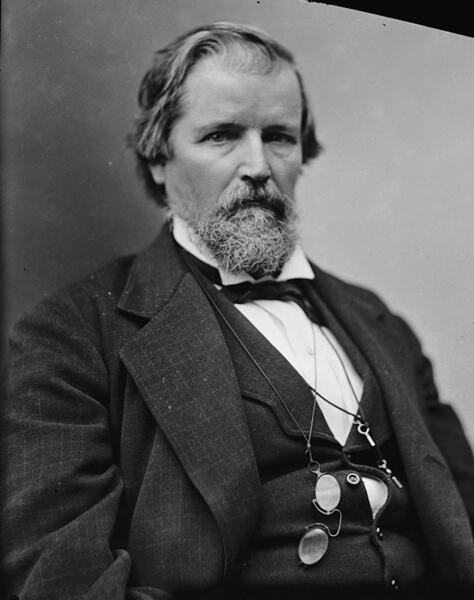
Here you will find contact information for Representative Joseph Barton Elam, including email address, phone number, and mailing address.
| Name | Joseph Barton Elam |
| Position | Representative |
| State | Louisiana |
| District | 4 |
| Party | Democratic |
| Status | Former Representative |
| Term Start | October 15, 1877 |
| Term End | March 3, 1881 |
| Terms Served | 2 |
| Born | June 12, 1821 |
| Gender | Male |
| Bioguide ID | E000100 |
About Representative Joseph Barton Elam
Joseph Barton Elam, Sr. (June 12, 1821 – July 4, 1885), was a Democratic lawyer, state legislator, Confederate political leader, and two-term U.S. Representative from Louisiana’s 4th congressional district, serving in the United States Congress from 1877 to 1881. His service in the House of Representatives corresponded with the administration of President Rutherford B. Hayes and occurred during a significant period in American history, as the nation emerged from Reconstruction and struggled over the political and civil legacy of the Civil War. A member of the Democratic Party, Elam contributed to the legislative process during two terms in office and represented the interests of his northwestern Louisiana constituents.
Elam was born near Hope in Hempstead County in southwestern Arkansas Territory, to William Jefferson Elam, a teacher, and his wife, the former Cynthia Wheaton, both originally from Virginia. In 1823, when he was still a small child, the family moved to Ayish Bayou near San Augustine in East Texas, where another son, Charles Wheaton Elam, was born. In 1826 the Elams relocated to Natchitoches, Louisiana, where a daughter, Mary Jane Elam, was born. By 1833, the family had moved again, this time to Fort Jessup (often spelled Fort Jesup), Louisiana, then the westernmost outpost of the United States. There William Elam tutored the sons of Army officers, and another son, John Waddill Elam, was born there in 1833. The family also included a daughter, Henrietta Elam. The Elam children received their early education at Fort Jessup, in a frontier environment that exposed Joseph Elam to both military life and the rapid expansion of the American Southwest.
After his early schooling, Elam pursued legal training in the traditional manner of the period by reading law. He studied under his cousin, attorney John Waddill, in Alexandria, Louisiana. Waddill later gained historical note for his role in 1853 in helping secure the freedom of Solomon Northup, a free Black man from New York who had been kidnapped and sold into slavery in Louisiana and whose ordeal was later recounted in the memoir and film “Twelve Years a Slave.” Under an 1841 New York law, the state commissioned an attorney to locate and free Northup, and Waddill assisted in that effort. Elam was admitted to the bar in October 1843 and began his legal practice in Alexandria. The same year, he made his first court appearance as an attorney on August 7, 1843, in DeSoto Parish, where he helped to establish the local court system. In 1844 he moved to Sabine Parish and settled in Many, the parish seat, where he continued to build his legal and political career.
Elam quickly became a prominent figure in local government and politics. In 1845 he was elected to the Sabine Parish Police Jury, the parish governing body, and he served as president of that body from 1846 to 1847. He also served as district attorney of Sabine Parish, further consolidating his reputation as a leading attorney in the region. In 1847 he drafted the articles of incorporation for the town of Mansfield in neighboring DeSoto Parish and was elected its first mayor. He served a second term as mayor in 1856 and also held office as a Mansfield alderman. As the region grew in population and economic importance, Elam’s legal work and municipal leadership helped shape the civic institutions of northwestern Louisiana.
Elam’s political career expanded to the state level in the 1850s and 1860s. He was elected to the Louisiana House of Representatives from DeSoto Parish and rose to a position of considerable influence as Speaker of the House, serving in that capacity from 1862 to 1864 during the Civil War. His brother, John Waddill Elam, was elected sheriff of DeSoto Parish, underscoring the family’s local prominence. In 1861, as sectional tensions culminated in secession, Joseph Elam was elected a delegate to the Louisiana Confederate Constitutional Convention and signed the Louisiana Ordinance of Secession on January 26, 1861, aligning himself with the secessionist cause. During the war years he remained active in Confederate political affairs while maintaining his standing as a leading Democratic figure in his region.
In the immediate aftermath of the Civil War, Elam resumed service in state government under the complex and shifting conditions of Reconstruction. In November 1865 he was elected as a state representative in the post–Civil War Reconstruction legislature, and he served until 1867, when Congress enacted the Reconstruction Acts that reorganized Southern governments. His 1865–1867 tenure is not reflected in some later compilations, such as the “Membership of the Louisiana House of Representatives, 1812–2016,” but contemporary records indicate that he did serve. In 1866 he attended the National Union Convention in Philadelphia as a delegate from Louisiana, participating in national efforts to shape postwar policy. During this period, Radical Republicans gained control of Louisiana’s state government, and under the Louisiana Constitution of 1868, former Confederate officers were temporarily disfranchised. As a former Confederate political leader, Elam was barred for a time from seeking office under these provisions.
The political environment in Louisiana during Reconstruction was marked by intense conflict, racial violence, and contested elections. In 1870, after section 99 of the 1868 state constitution was repealed, Elam was again legally eligible to run for office. However, because of widespread violence and intimidation associated with elections—including efforts by the Ku Klux Klan and later the White League to suppress Black and Republican voting—state authorities created “returning boards” in 1870 to review election returns and discard results where fraud or coercion was alleged. That same year, the U.S. Congress passed the Force Act to help curb Klan violence in the South. Elam was denied office by the returning boards in 1870, 1872, and 1874, despite his electoral support. On at least two occasions, in 1870 and again in 1872, he is credited with helping to avert serious violence by addressing and calming angry crowds after elections were taken from him. The Wheeler Adjustment, a political compromise passed by the Louisiana legislature in March 1875, did not permit Elam to take the Louisiana State Senate seat to which he claimed election in 1874. Throughout these years, elections in Louisiana were frequently marred by violence, particularly by the White League, a paramilitary organization that supported the Democratic Party, disrupted Republican gatherings, and worked systematically to suppress Black voting.
Against this backdrop, Elam finally secured federal office as national politics moved toward the end of Reconstruction. In 1876, he was elected as a Democrat to the Forty-fifth Congress from Louisiana’s 4th congressional district, a victory made possible in part by the broader national political compromise of that year. That arrangement, which resolved the disputed presidential election of 1876 in favor of Republican Rutherford B. Hayes, also entailed the withdrawal of federal troops from the South and effectively ended Reconstruction, allowing Democrats to consolidate power in Louisiana and other former Confederate states. Elam took his seat in the House of Representatives in March 1877 and was reelected to the Forty-sixth Congress, serving until March 3, 1881. During his two terms, he participated in the legislative process at a time when Congress grappled with issues of federal-state relations, the lingering effects of Reconstruction, economic recovery after the Panic of 1873, and the integration of the South back into the national political and economic system. As a member of the House, he represented the interests of his constituents in northwestern Louisiana and contributed to debates characteristic of the post-Reconstruction era.
Elam’s congressional career was interrupted by personal misfortune. During his reelection campaign of 1878, he was severely injured in a stagecoach accident, an event that affected his health but did not prevent him from completing his second term. After leaving Congress in 1881, he returned to Louisiana and resumed the practice of law in Mansfield, DeSoto Parish, where he had long been a central civic figure. He continued to be regarded as an elder statesman of the Democratic Party in his region until his death in Mansfield on July 4, 1885, at the age of sixty-three.
In his personal life, Elam was married three times and was twice widowed. He had eight children by his third wife, Harriet Spencer Elam. His family remained active in Louisiana public life after his death. His son Charles Wheaton Elam served in the Louisiana House of Representatives from 1892 to 1896, and another son, Joseph Barton Elam, Jr., served as mayor of Mansfield from 1914 to 1920. Through his long legal career, his roles in municipal and state government, his participation in secession and Reconstruction politics, and his two terms in the United States Congress, Joseph Barton Elam, Sr., left a lasting imprint on the political history of northwestern Louisiana in the nineteenth century.