Representative Joe L. Evins
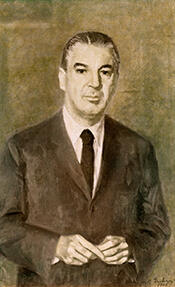
Here you will find contact information for Representative Joe L. Evins, including email address, phone number, and mailing address.
| Name | Joe L. Evins |
| Position | Representative |
| State | Tennessee |
| District | 4 |
| Party | Democratic |
| Status | Former Representative |
| Term Start | January 3, 1947 |
| Term End | January 3, 1977 |
| Terms Served | 15 |
| Born | October 24, 1910 |
| Gender | Male |
| Bioguide ID | E000273 |
About Representative Joe L. Evins
Joseph Landon Evins (October 24, 1910 – March 31, 1984) was an American lawyer and Democratic politician who served 15 consecutive terms as a U.S. Representative from Tennessee from 1947 to 1977. Over three decades in the House of Representatives, he became a powerful figure in Congress, playing a significant role in federal small business policy and appropriations while representing a largely rural district in Middle Tennessee.
Evins was born in the Blend community of DeKalb County, Tennessee, the son of James Edgar Evins and Myrtie Goodson Evins. His father was a Tennessee state senator and a successful local businessman, and later became the namesake of Edgar Evins State Park near Smithville. The Evins family was prominent in local civic and business affairs; one of his brothers’ children operated a local bank, and another nephew, Dan Evins, went on to found the Cracker Barrel Old Country Store restaurant chain. This family background in public service and entrepreneurship helped shape Joseph Evins’s later interest in both politics and economic development.
Evins pursued higher education in Tennessee and in the nation’s capital. He graduated from Vanderbilt University in Nashville, Tennessee, in 1933 and from the Cumberland School of Law in Lebanon, Tennessee, in 1934. He also undertook further study at The George Washington University in Washington, D.C. Admitted to the bar in 1934, he began the practice of law in Smithville, the county seat of DeKalb County. His early legal career in his home community laid the foundation for his later political base and his understanding of the needs of small-town and rural constituents.
In 1935 Evins entered federal service when he was appointed a staff attorney for the Federal Trade Commission (FTC). He served in that capacity until 1938, when he was named assistant secretary of the FTC, a position he held until 1940. His work at the FTC gave him experience in federal regulatory policy and the workings of the national government. Shortly after the United States entered World War II, Evins was commissioned in the United States Army Judge Advocate General’s Corps. He served on active duty in the JAG Corps until 1946, when he returned to Smithville, resumed his law practice, and became active in local politics. Upon his return, he was elected chairman of the DeKalb County Democratic Party, consolidating his leadership role in the local Democratic organization.
Later in 1946, Evins secured the Democratic nomination for the U.S. House of Representatives from Tennessee’s 5th Congressional District. In the general election he won easily in what was then a solidly Democratic area, beginning a congressional career that would span from January 3, 1947, to January 3, 1977. Following the 1950 Census, when Tennessee lost a congressional district, his district was renumbered as the 4th District, but he continued to be re-elected with little or no opposition, ultimately serving 15 terms in Congress. At the time of his retirement in January 1977, his continuous service in the U.S. House of Representatives was longer than that of any other House member from Tennessee. Throughout this period, he participated in the legislative process during a significant era in American history, representing the interests of his constituents and contributing to national debates.
During his long tenure, Evins became an influential member of the House. He served as chairman of the House Select Committee on Small Business for six years and then chaired the standing United States House Committee on Small Business in the following congressional session, helping to shape federal policy affecting small enterprises. He also held a seat on the powerful House Appropriations Committee, which oversees federal spending. Evins used his positions to direct federal resources to his largely rural district east and south of Nashville. Under his influence, Smithville became the smallest city in the nation selected for participation in the federal Model Cities Program, and its major thoroughfare was renamed “Congressional Boulevard” in recognition of his efforts. He also secured a $5 million federal grant, as a member of the Appropriations Committee, for the construction of the Tennessee Technological University Appalachian Center for Craft near Smithville, a project that promoted regional education and economic development.
Ideologically, Evins was regarded as a conservative Democrat, particularly on issues of race and civil rights. He was slow to accept racial desegregation and was among the Southern lawmakers who signed the 1956 Southern Manifesto, which opposed the Supreme Court’s decision in Brown v. Board of Education. In Congress he voted against the Civil Rights Acts of 1957, 1960, 1964, and 1968. He voted “present” on the proposed 24th Amendment to the U.S. Constitution, which abolished the poll tax in federal elections, but he did vote in favor of the Voting Rights Act of 1965, supporting a key measure to protect African American voting rights. These votes reflected both his conservative orientation and the political pressures of representing a Southern district during the civil rights era.
Evins chose not to seek re-election in 1976, bringing to a close three decades of congressional service. His retirement opened the way for a spirited Democratic primary to succeed him, in which Al Gore won the nomination and the seat, launching Gore’s subsequent national political career. After leaving Congress in January 1977, Evins returned to private life in Tennessee, remaining a respected figure in his home region.
In his personal life, Evins was married to Ann Smartt, the daughter of a judge from McMinnville, Tennessee. The couple had three daughters. Joseph Landon Evins died in Nashville, Tennessee, on March 31, 1984. He was buried in the Smithville Town Cemetery in Smithville, DeKalb County, close to the community where he had been born, practiced law, and built his political career.