Representative Joesph L. Fisher
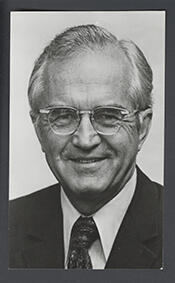
Here you will find contact information for Representative Joesph L. Fisher, including email address, phone number, and mailing address.
| Name | Joesph L. Fisher |
| Position | Representative |
| State | Virginia |
| District | 10 |
| Party | Democratic |
| Status | Former Representative |
| Term Start | January 14, 1975 |
| Term End | January 3, 1981 |
| Terms Served | 3 |
| Born | January 11, 1914 |
| Gender | Male |
| Bioguide ID | F000151 |
About Representative Joesph L. Fisher
Joseph Lyman (Joe) Fisher (January 11, 1914 – February 19, 1992) was a Democratic member of the United States House of Representatives from Virginia, serving three terms from 1975 to 1981, and was a founder of the public policy research organization Resources for the Future. A lifelong Unitarian, he was an active volunteer lay leader in the Unitarian Universalist Association, serving on its board of trustees and as moderator—the highest volunteer position in the UUA—from 1964 until 1977. Fisher was the last Democrat to represent his northern Virginia congressional district until 2019, when Jennifer Wexton was inaugurated.
Fisher was born in Pawtucket, Rhode Island, on January 11, 1914. He attended Bowdoin College in Brunswick, Maine, where he studied economics and graduated in 1935. He subsequently pursued graduate studies in economics at Harvard University. On January 1, 1941, while he was a graduate student at Harvard, he met Margaret “Peggy” Winslow on a blind date in her hometown of Indianapolis, Indiana; she was then a sophomore at Wellesley College. Fisher proposed to her in April 1941, and the couple married on June 27, 1942. They went on to have three daughters and four sons.
After several years working at an accounting firm following his graduation from Bowdoin, Fisher entered federal service in 1939 when he was hired by the National Resources Planning Board. In 1942 he was promoted to serve as an economist for the U.S. Department of State. His early professional work focused on economic analysis and planning at a time when the federal government was expanding its role in managing the national economy and preparing for global conflict. In 1943 he was drafted into the U.S. Army and served during World War II. Following the war, Fisher returned to the United States and resumed his academic and professional career, earning a Ph.D. in economics from Harvard University.
With his doctorate completed, Fisher joined the Council of Economic Advisers, where he advanced to become senior economist in 1951, after furthering his education at George Washington University. In 1953 he helped launch and then joined Resources for the Future, Inc., a pioneering non-profit think tank devoted to the study of natural resources and environmental policy. His work there contributed to the emerging field of environmental and resource economics, and he authored influential books including Resources for America’s Future (1963) and World Prospects for Natural Resources (1964). Parallel to his policy and academic work, Fisher deepened his engagement with the Unitarian Universalist Association, ultimately serving as moderator from 1964 to 1977, while also remaining active in local congregational life.
Fisher became increasingly involved in public affairs in the Washington, D.C., metropolitan region. He served as chairman of the Arlington County Board in Virginia, where he helped guide local governance during a period of rapid suburban growth. He also served as chairman of the Washington Metropolitan Area Transit Authority (WMATA), playing a role in the development and oversight of the region’s transit system, and as president and chairman of the Washington Metropolitan Council of Governments, working on regional planning and intergovernmental cooperation. These positions, combined with his national policy experience, helped establish his reputation as a knowledgeable and pragmatic public servant.
In 1974 Fisher was elected to Congress from Virginia’s 10th congressional district in what was widely regarded as an upset victory, defeating long-serving Republican incumbent Joel Broyhill. The district, based in the Washington, D.C., suburbs of northern Virginia, had been one of the first areas in the state to turn Republican, making his election particularly notable. As a member of the House of Representatives from 1975 to 1981, Fisher participated in the legislative process during a significant period in American history, representing the interests of his constituents while drawing on his expertise in economics, natural resources, and public policy. A member of the Democratic Party, he contributed to debates on economic and environmental issues and broader national policy questions over the course of his three terms. He lost his bid for a fourth term in November 1980 to Republican Frank Wolf, ending his congressional service in January 1981.
After leaving Congress, Fisher continued to work at the intersection of economics, conservation, and public policy. He established the Economic Policy Department at The Wilderness Society, a U.S. non-governmental organization, bringing a first-of-its-kind professional scientific and economic focus to the wildland conservation community. In 1982 he returned to state government when he was appointed Virginia Secretary of Human Resources, overseeing a broad portfolio of social and health services. In 1986 he joined the faculty of George Mason University as an economics professor, continuing to teach and write on public policy and resource issues. He also donated a collection of his records to the Special Collections Research Center at George Mason University, where the materials are open and accessible to the public.
In 1985 Fisher began experiencing back pain that was diagnosed as bone cancer. After treatment, the cancer went into remission, allowing him to continue his professional and civic activities for several more years. The disease returned in early 1991, and Fisher died on February 19, 1992, in Arlington, Virginia. His ashes were buried at Arlington National Cemetery beside two two-star generals, reflecting both his military service and his long public career.