Representative Joseph Warren Fordney
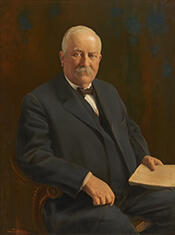
Here you will find contact information for Representative Joseph Warren Fordney, including email address, phone number, and mailing address.
| Name | Joseph Warren Fordney |
| Position | Representative |
| State | Michigan |
| District | 8 |
| Party | Republican |
| Status | Former Representative |
| Term Start | December 4, 1899 |
| Term End | March 3, 1923 |
| Terms Served | 12 |
| Born | November 5, 1853 |
| Gender | Male |
| Bioguide ID | F000271 |
About Representative Joseph Warren Fordney
Joseph Warren Fordney (November 5, 1853 – January 8, 1932) was an American Republican politician from Saginaw, Michigan, who served as a Representative from Michigan in the United States Congress from 1899 to 1923. Over the course of twelve consecutive terms, he represented Saginaw County and the surrounding area of Central Michigan in the U.S. House of Representatives for twenty-four years, contributing to the legislative process during a significant period in American history.
Fordney was born on a farm near Hartford City, Indiana, where he attended the common schools. His early life in a rural setting and his basic formal education reflected the experience of many Midwesterners of his generation. In June 1869, at the age of fifteen, he moved to Saginaw, Michigan, a center of the lumber trade, where he began working in the lumber industry. Through diligence and business acumen, he advanced from employee to owner, eventually becoming the proprietor of extensive lumber enterprises that made him a prominent figure in the region’s economic life.
In addition to his lumber interests, Fordney became active in local commercial and civic affairs. He served as vice president of the Saginaw Board of Trade, an organization that promoted business development in the city and surrounding area. He also entered municipal politics, serving as a member of the Saginaw Board of Aldermen from 1896 to 1900. During this period he maintained business ties to his native Indiana; the November 1903 Congressional Directory noted that he was “also interested in an artificial-ice plant at Hartford City, Ind.,” underscoring the breadth of his commercial activities.
Fordney’s rising profile in business and local government led to his election to national office. In November 1898, he defeated incumbent Democrat Ferdinand Brucker and was elected as a Republican from Michigan’s 8th congressional district to the Fifty-sixth United States Congress. He took his seat on March 4, 1899, and was subsequently re-elected to the eleven succeeding Congresses, serving continuously until March 3, 1923. As a member of the House of Representatives, he participated in the democratic process and represented the interests of his constituents in Saginaw County and Central Michigan during a period marked by industrial expansion, Progressive Era reforms, World War I, and the early 1920s economic adjustments.
During his long congressional career, Fordney held several influential committee positions and played a central role in shaping national fiscal and trade policy. He served as chairman of the Committee on Expenditures in the Department of the Navy in the Fifty-ninth Congress, overseeing aspects of federal spending related to naval affairs. Later, he rose to one of the most powerful posts in the House as chairman of the Committee on Ways and Means in the Sixty-sixth and Sixty-seventh Congresses. In that capacity, he was a principal architect of tariff legislation and co-sponsored the Fordney–McCumber Tariff of 1922, a major protective tariff measure designed to shield American industry and agriculture from foreign competition in the post–World War I era. He also participated in national party affairs as a delegate to the Republican National Conventions in 1908, 1924, and 1928. After more than two decades in office, he declined to be a candidate for renomination in 1922, bringing his congressional service to a close at the end of his twelfth term.
Following his retirement from Congress, Fordney returned to private life in Saginaw. He resumed active involvement in the lumber business and expanded his interests into banking and agricultural pursuits, continuing to play a role in the economic development of his community. He lived in Saginaw until his death on January 8, 1932. Joseph Warren Fordney died in the city that had been the center of his business and political career and was interred in St. Andrew’s Cemetery in Saginaw, Michigan.