Senator Joseph Smith Fowler
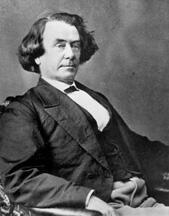
Here you will find contact information for Senator Joseph Smith Fowler, including email address, phone number, and mailing address.
| Name | Joseph Smith Fowler |
| Position | Senator |
| State | Tennessee |
| Party | Republican |
| Status | Former Representative |
| Term Start | January 1, 1866 |
| Term End | March 3, 1871 |
| Terms Served | 1 |
| Born | August 31, 1820 |
| Gender | Male |
| Bioguide ID | F000324 |
About Senator Joseph Smith Fowler
Joseph Smith Fowler (August 31, 1820 – April 1, 1902) was an American attorney, educator, and politician who represented Tennessee in the United States Senate from 1865 to 1871 as a member of the Republican Party. A resident of Tennessee for much of his adult life, he was notable for his steadfast support of the Union during the American Civil War and for his later role in the impeachment trial of President Andrew Johnson. Over the course of one term in Congress, he contributed to the legislative process during a significant period in American history, participating in the democratic process and representing the interests of his Tennessee constituents during Reconstruction.
Fowler was born in Steubenville, Ohio, on August 31, 1820, the son of James Fowler and Sarah (Atkinson) Fowler, who were natives of Maryland and Virginia, respectively. He received his early education at Grove Academy in Steubenville and then attended Franklin College in New Athens, Ohio, from which he graduated in 1843. Soon after completing his studies, Fowler began a career in education. In 1844 he taught school in Shelby County, Kentucky, and in 1845 he moved to Tennessee, where he became a professor of mathematics at Franklin College in Davidson County. He held this position from 1845 to 1849, establishing himself as a respected educator in the region.
While engaged in teaching, Fowler prepared for a career in law. He studied law in Bowling Green, Kentucky, was admitted to the bar, and subsequently commenced legal practice in Tennessee. From 1856 to 1861 he served as president of Howard Female College in Gallatin, Tennessee, combining his interests in education and administration. During this prewar period he practiced law in Tennessee until the outbreak of the Civil War in 1861, building a professional reputation that would later support his transition into public service.
An ardent Unionist, Fowler opposed secession and remained loyal to the United States when the Civil War began. Because of his Union sympathies, he moved his family to Springfield, Illinois, at the start of the conflict for safety and to distance himself from Confederate-controlled Tennessee. He returned to Tennessee after Union forces gained control and a pro-Union government was established under the military governorship of Andrew Johnson. From 1862 to 1865, Fowler served as Tennessee’s state comptroller, overseeing the state’s financial affairs during Johnson’s military governorship. His tenure as comptroller, during a time of military occupation and political reorganization, enhanced his prominence among Tennessee Unionists and aligned him closely with Johnson’s administration.
After the war, Tennessee became the first former Confederate state to be readmitted to the Union in 1866. That same year, the Tennessee General Assembly elected Fowler to the United States Senate. His service in the Senate began on July 24, 1866, and he served one full term, leaving office at the end of his term in 1871. As a Republican senator, Fowler joined the majority Republican caucus during the 39th, 40th, and 41st Congresses, participating in the legislative work of Reconstruction. In the 40th Congress he served as chairman of the Committee on Engrossed Bills, which was responsible for the final preparation of legislative measures before their passage. Throughout his Senate career, he contributed to the legislative process at a time when Congress was grappling with the reintegration of the former Confederate states and the definition of rights for newly freed African Americans.
Fowler’s most historically notable act in the Senate occurred during the impeachment trial of President Andrew Johnson in 1868. Although a Republican, Fowler broke with most of his party and voted for Johnson’s acquittal. He was one of a group of Republican senators—along with William Pitt Fessenden, James W. Grimes, John B. Henderson, Lyman Trumbull, Peter G. Van Winkle, and Edmund G. Ross—who were disturbed by what they viewed as procedural irregularities and a one-sided presentation of evidence in the impeachment proceedings. Together with three other Republican senators, James Dixon, James Rood Doolittle, and Daniel Sheldon Norton, they defied party leadership and much of public opinion by voting against conviction. Their votes, including the decisive vote cast by Ross, ensured Johnson’s acquittal by a single vote. In the aftermath, Congressman Benjamin Butler conducted hearings into allegations that some Republican senators had been bribed to support acquittal, investigating reports of promises of patronage and cash. These inquiries contributed to the enduring controversy surrounding the trial, though Fowler continued to maintain that his vote was based on constitutional and procedural concerns.
Fowler was not a candidate for reelection in 1870 and left the Senate when his term expired in 1871. He returned to Tennessee and resumed the practice of law in Nashville. In 1872 he became active in the Liberal Republican Party, a short-lived movement that opposed what it viewed as corruption and heavy-handed Reconstruction policies within the regular Republican organization. He served as a delegate to the Liberal Republican national convention that year. His continuing association with Andrew Johnson’s legacy was reflected in 1875, when he was selected by the committee planning the public memorial in Nashville for the late former president to deliver the funeral oration.
In 1878, Fowler moved to Washington, D.C., where he continued to practice law until shortly before his death. In addition to his legal work, he wrote on historical and political topics, contributing articles to The Magazine of American History and other publications, thereby remaining engaged in public affairs and historical reflection. A collection of his papers is preserved by the Tennessee State Library and Archives, providing researchers with insight into his legal, political, and personal life.
On November 12, 1846, Fowler married Maria Louisa Embry (1827–1866). The couple had two children: Louisa Fowler (1849–1889) and James Bowling Fowler (1859–1887). After the death of his wife and the premature deaths of both children, Fowler spent his later years largely in professional and intellectual pursuits in the nation’s capital. He died in Washington, D.C., on April 1, 1902, and was buried in Lexington Cemetery in Lexington, Kentucky.