Representative Joseph John Gill
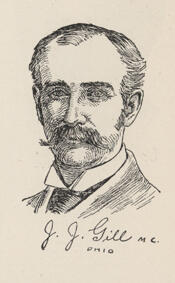
Here you will find contact information for Representative Joseph John Gill, including email address, phone number, and mailing address.
| Name | Joseph John Gill |
| Position | Representative |
| State | Ohio |
| District | 16 |
| Party | Republican |
| Status | Former Representative |
| Term Start | December 4, 1899 |
| Term End | March 3, 1905 |
| Terms Served | 3 |
| Born | September 21, 1846 |
| Gender | Male |
| Bioguide ID | G000189 |
About Representative Joseph John Gill
Joseph John Gill (September 21, 1846 – May 22, 1920) was an American lawyer, banker, industrialist, and Republican politician who represented Ohio in the United States House of Representatives from 1899 to 1903. Over the course of what is described in existing records as three terms in office, he contributed to the legislative process during a significant period in American history, participating in the democratic process and representing the interests of his Ohio constituents.
Gill was born in Barnesville, Belmont County, Ohio, on September 21, 1846. In 1848, when he was still a young child, he moved with his parents to Mount Pleasant, Ohio. He grew up in eastern Ohio at a time when the region was developing rapidly in commerce and industry, an environment that would later influence his professional pursuits in both law and business.
Gill pursued an academic course and went on to study law at the University of Michigan in Ann Arbor. He graduated from the law department in 1868, receiving a formal legal education that prepared him for admission to the bar. Shortly after completing his studies, he was admitted to the bar and commenced the practice of law in Jefferson County, Ohio, establishing himself as a professional in the legal community of the region.
In addition to his legal practice, Gill became active in business. He engaged in banking, a field that connected him to the financial and commercial life of his community. He later expanded his interests into manufacturing and iron mining, sectors that were central to the industrial growth of Ohio in the late nineteenth century. These pursuits reflected both his entrepreneurial inclinations and his familiarity with the economic concerns of his constituents, experience that would inform his later public service.
Gill entered national politics as a member of the Republican Party. He was elected as a Republican to the Fifty-sixth Congress to fill the vacancy caused by the death of Representative Lorenzo Danford. He took his seat in the U.S. House of Representatives on December 4, 1899. He was subsequently reelected to the Fifty-seventh and Fifty-eighth Congresses, and existing accounts describe his tenure as encompassing three terms in office. During his service in Congress, which coincided with a transformative era in American political and economic life at the turn of the twentieth century, he participated in the legislative process and represented the interests of his Ohio district in the House of Representatives.
Gill served in Congress from December 4, 1899, until October 31, 1903, when he resigned his seat. His period in office covered the years immediately following the Spanish–American War and the early years of the Progressive Era, a time marked by debates over expansion, industrial regulation, and economic policy. As a Republican representative from Ohio, he was part of the congressional majority that helped shape federal policy during this period, although specific committee assignments and legislative initiatives associated with his name are not extensively documented in the surviving summaries.
After leaving Congress in 1903, Gill returned to private life in Ohio. Drawing on his background in law, banking, and industry, he remained part of the professional and civic fabric of his community, though the detailed record of his later activities is limited in the brief biographical accounts that survive. He continued to reside in eastern Ohio, where he had spent virtually his entire life and career.
Joseph John Gill died in Steubenville, Jefferson County, Ohio, on May 22, 1920. He was interred in Union Cemetery in Steubenville. His career combined legal practice, business enterprise, and public service, and his tenure in the U.S. House of Representatives placed him among the Ohio Republicans who helped guide national policy at the dawn of the twentieth century.