Senator Joseph Ridgway Grundy
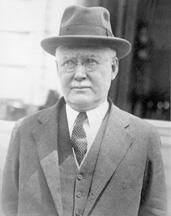
Here you will find contact information for Senator Joseph Ridgway Grundy, including email address, phone number, and mailing address.
| Name | Joseph Ridgway Grundy |
| Position | Senator |
| State | Pennsylvania |
| Party | Republican |
| Status | Former Representative |
| Term Start | December 11, 1929 |
| Term End | March 3, 1931 |
| Terms Served | 1 |
| Born | January 13, 1863 |
| Gender | Male |
| Bioguide ID | G000510 |
About Senator Joseph Ridgway Grundy
Joseph Ridgway Grundy (January 13, 1863 – March 3, 1961) was an American textile manufacturer, banking executive, and Republican Party politician from Bristol, Pennsylvania, who represented Pennsylvania in the United States Senate. Born during the Civil War era, he would later become, as of March 1, 1958, the oldest living former senator and the last living senator who had been alive during the Civil War. Over the course of his long life, Grundy became a prominent industrialist, a leading advocate of protectionist economic policies, and an influential figure in Pennsylvania Republican politics.
Grundy was educated at Swarthmore College, an experience that provided him with the formal training and social connections that would support his later business and political activities. He maintained deep roots in Bucks County, Pennsylvania, particularly in and around Bristol. Grundy kept a primary residence in Bristol Borough and owned a summer home on the nearby Neshaminy Creek known as Walnut Grove. He was also socially active in regional circles, including membership in the Five O’Clock Club of Philadelphia, a gathering place for business and civic leaders.
Grundy built his career in the textile industry, becoming a significant manufacturer in Bristol. His mills were an important part of the local industrial economy and helped establish him as a leading spokesman for manufacturing interests in Pennsylvania. He was the founder and president of the Pennsylvania Manufacturers Association, through which he became a strong and outspoken advocate of protectionism, favoring high tariffs and policies designed to shield American industry from foreign competition. His prominence in manufacturing and his vigorous defense of industrial interests made him a central figure in state and national debates over economic policy in the early twentieth century.
As his influence grew, Grundy became a longtime Republican activist and a close ally of powerful Pennsylvania Republican leaders, including U.S. Senator Boies Penrose and Secretary of the Treasury Andrew Mellon. He was widely regarded as one of the key conservative voices in the state’s political establishment. In his memoir, economist and social activist Scott Nearing alleged that Grundy’s textile mills employed workers as young as thirteen and that Grundy opposed reformers’ efforts to restrict child labor by raising the legal age for full-time employment. Nearing further claimed that Grundy was among the conservative industrial interests whose influence over the Pennsylvania legislature—then responsible for providing financial support to state universities—contributed to the decision by the trustees of the University of Pennsylvania to dismiss Nearing from his position at the Wharton School in 1915, an episode that became one of the early major academic freedom controversies in the United States.
Joseph Ridgway Grundy’s service in Congress occurred during a significant period in American history. A member of the Republican Party, he was appointed to the United States Senate on December 11, 1929, by Pennsylvania Governor John Stuchell Fisher to fill the vacancy created when the Senate refused to seat William S. Vare following a contested election. Grundy thus entered the Senate just weeks after the stock market crash of 1929, at the onset of the Great Depression. He served from December 11, 1929, to December 1, 1930, when his duly elected successor, James J. Davis, qualified and took office. During his single term in the Senate, Grundy participated in the legislative process and represented the interests of his Pennsylvania constituents, bringing to the chamber the perspective of a protectionist industrialist and Republican Party stalwart.
After leaving the Senate, Grundy returned to his business pursuits in Bristol. He resumed leadership in the textile industry and expanded his activities in finance, serving as president of the Farmer’s Bank in Bristol. He continued in these roles until 1947, maintaining his prominence in local economic affairs. In his later years, Grundy divided his time between his home in Bristol and a vacation residence in the Bahamas, reflecting both his enduring ties to his hometown and the personal wealth he had accumulated over decades in manufacturing and banking.
Grundy died in the Bahamas on March 3, 1961, leaving no heirs. In his will, he directed that his Bristol Borough home be preserved as a museum and memorial library in honor of his only sister, Margaret Ridgway Grundy, and their family. The Victorian residence, maintained as the Margaret R. Grundy Memorial Museum and Library, houses a collection of the Grundy family’s original possessions from both their Walnut Grove estate and their Bristol Borough home, and features notable woodwork and period furnishings. Open to the public free of charge, the museum stands as a lasting testament to Joseph Ridgway Grundy’s life, his family, and the industrial and political legacy he left in Bristol and the Commonwealth of Pennsylvania.