Representative Joseph Carlton Loser
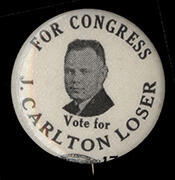
Here you will find contact information for Representative Joseph Carlton Loser, including email address, phone number, and mailing address.
| Name | Joseph Carlton Loser |
| Position | Representative |
| State | Tennessee |
| District | 5 |
| Party | Democratic |
| Status | Former Representative |
| Term Start | January 3, 1957 |
| Term End | January 3, 1963 |
| Terms Served | 3 |
| Born | October 1, 1892 |
| Gender | Male |
| Bioguide ID | L000446 |
About Representative Joseph Carlton Loser
Joseph Carlton Loser (October 1, 1892 – July 31, 1984) was an American politician and attorney who served as a United States Representative from Tennessee from 1957 to 1963. A member of the Democratic Party, he represented Tennessee’s 5th Congressional District for three terms during a significant period in American history, contributing to the legislative process and representing the interests of his Nashville-area constituents.
Loser (pronounced “low-ser”) was born in Davidson County, Tennessee, on October 1, 1892, the son of Henry James Loser and Willie May McConnico Loser. He was educated in the public schools of Davidson County and pursued legal studies at the former YMCA Law School in Nashville, an institution that later became the Nashville School of Law. He continued his legal education at Cumberland University in Lebanon, Tennessee, where he completed the requirements for the Bachelor of Laws (LL.B.) degree in 1923. He was admitted to the bar in 1922, beginning a long career in public service and the law.
Loser’s early career was closely tied to the municipal government of Nashville. From 1917 to 1920 he served as secretary to the mayor of Nashville, a role that introduced him to city administration and local politics. In 1923 he became assistant city attorney for Nashville, marking his formal entry into public legal service. He advanced to the position of assistant district attorney in 1929, and in 1934 he became district attorney for the former 10th Judicial Circuit of Tennessee. He held the office of district attorney from 1934 until 1956, gaining a reputation as a long-serving prosecutor. During World War II, in 1944, he was a member of the United States Coast Guard Reserve, reflecting his participation in the broader national war effort.
In addition to his legal and prosecutorial work, Loser was active in Democratic Party politics at the state and national levels. He served as a delegate to the Democratic National Conventions in 1944, 1956, and 1960, participating in the selection of presidential nominees and the formation of party platforms. From 1954 to 1958 he was secretary of the Democratic Executive Committee of Tennessee, a position that placed him at the center of party organization in the state. In 1956 he also served as a presidential elector, further underscoring his role in Democratic electoral politics.
Loser’s transition to congressional service came under unusual circumstances. In 1956, Percy Priest, the incumbent Democratic congressman from Tennessee’s 5th District, died a month before the general election. A special primary was held to choose a new Democratic nominee, and Loser won that primary. Given the political composition of the district—no Republican had been elected to Congress from Nashville since Reconstruction—securing the Democratic nomination was effectively tantamount to election. Loser was elected to the Eighty-fifth Congress and took office on January 3, 1957. He was subsequently re-elected in 1958 and 1960, serving in the Eighty-fifth, Eighty-sixth, and Eighty-seventh Congresses from January 3, 1957, to January 3, 1963. During his three terms in the House of Representatives, he participated in the legislative process and represented the interests of his Tennessee constituents during a period marked by the early stages of the civil rights movement and evolving national domestic and foreign policies.
Loser’s congressional career ended amid controversy surrounding the 1962 Democratic primary. In August 1962 he appeared to have secured renomination for a fourth term. However, an investigation into the primary election uncovered serious irregularities. His principal opponent was state legislator Richard Fulton, but it was the actions of a minor candidate, ironworker and labor union activist Raymond Love, that triggered a re-examination of the vote. The Nashville Tennessean conducted an inquiry and published front-page stories indicating a pattern of significant voter fraud. A lawsuit followed, and although the number of disputed votes would not have been sufficient to elect Love, they could have been enough to alter the outcome in Fulton’s favor. Love, stating that his only objective was to ensure a clean and honest election, withdrew from the race. A court ordered the primary to be rerun under close scrutiny, and in this second primary Fulton defeated Loser decisively. Fulton went on to win the general election that fall and subsequently served seven terms in Congress.
After his defeat in the 1962 primary and the conclusion of his service in the House of Representatives on January 3, 1963, Joseph Carlton Loser withdrew from public life. His family connections to Nashville politics extended beyond his own career; his father-in-law, William Gupton, served as mayor of Nashville from 1917 to 1921, overlapping with the period when Loser was secretary to the mayor. Loser lived quietly in Nashville during his later years. He died in Nashville on July 31, 1984, at the age of 91 years and 304 days, and was interred at Woodlawn Memorial Park in Nashville, Tennessee.