Senator Joseph Manuel Montoya
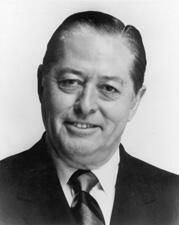
Here you will find contact information for Senator Joseph Manuel Montoya, including email address, phone number, and mailing address.
| Name | Joseph Manuel Montoya |
| Position | Senator |
| State | New Mexico |
| Party | Democratic |
| Status | Former Representative |
| Term Start | January 3, 1957 |
| Term End | January 3, 1977 |
| Terms Served | 7 |
| Born | September 24, 1915 |
| Gender | Male |
| Bioguide ID | M000876 |
About Senator Joseph Manuel Montoya
Joseph Manuel Montoya (September 24, 1915 – June 5, 1978) was an American politician and member of the Democratic Party who rose from local office in New Mexico to long service in the United States Congress. Over the course of his career he served as lieutenant governor of New Mexico (1947–1951 and 1955–1957), as a member of the U.S. House of Representatives (1957–1964), and as a U.S. senator from New Mexico (1964–1977). His congressional tenure, encompassing service in both chambers from 1957 to 1977, coincided with a significant period in American history, and he contributed to the legislative process during seven terms in office in the House and Senate combined.
Montoya was born in Peña Blanca, Sandoval County, New Mexico, to Thomas and Frances Montoya, Roman Catholic descendants of eighteenth‑century Spanish settlers in the region. He attended public schools in Sandoval County and graduated from Bernalillo High School in 1931. He pursued higher education at Regis College in Denver, Colorado, before moving to Washington, D.C., to study law at Georgetown University, which he entered in 1934. His early life in a rural, Hispanic community and his family’s deep roots in New Mexico shaped his later advocacy for his state’s interests and for Hispanic and Latino representation in public life.
While still a law student at Georgetown, Montoya began an unusually early and rapid ascent in politics. In 1936, at age 21, he was elected to the New Mexico House of Representatives, becoming the youngest person in the history of the state to serve in that body. He completed his legal studies and graduated from Georgetown University Law School in 1938, the same year he was re‑elected to the state House. In 1939, his colleagues chose him as Democratic majority floor leader, reflecting his growing influence in state politics even before the age of 25.
Montoya advanced to the New Mexico Senate in 1940, again setting a record as the youngest member ever elected to that chamber. During his tenure in the State Senate, he was twice re‑elected and rose to positions of substantial responsibility, serving as majority whip and chairman of the Judiciary Committee. He left the Senate in 1946, but his statewide profile continued to grow. From 1947 to 1951 and again from 1955 to 1957, he served as lieutenant governor of New Mexico, ultimately being elected to that office three times. During this period he also held two additional terms in the State Senate, solidifying his reputation as a capable legislator and party leader in New Mexico.
Montoya entered national office in 1957, when he was elected to the U.S. House of Representatives in a special election following the sudden death of Congressman Antonio M. Fernández, who had recently been re‑elected. Representing New Mexico in the House from 1957 to 1964, Montoya gained recognition as a political moderate, a dedicated Democrat, and a diligent legislator. These qualities earned him the esteem of his colleagues and contributed to his effectiveness as a congressman. He secured re‑election several times, including a 1962 victory over Republican challenger Jack C. Redman, M.D., and became increasingly involved in national legislative issues.
In 1963, Montoya joined the House Appropriations Committee, where he became a strong advocate for education and related social programs. He played a key role in authoring the Vocational Education Act, aimed at expanding and improving job training and technical education opportunities across the country. In 1964, he sponsored the Wilderness Act in the House, landmark conservation legislation that established a legal framework to protect designated wilderness areas from development and preserve them in their natural condition. These legislative initiatives reflected both his concern for human capital and his interest in environmental stewardship, particularly important to his largely rural home state.
Montoya moved to the United States Senate in 1964, when he won election to complete the term of Senator Dennis Chávez, who had died in office in 1962, and simultaneously secured election to a full term of his own. His election was notable in part because New Mexico’s governor, Edwin L. Mechem, had resigned the governorship in order to accept a temporary appointment to the vacant Senate seat, but Montoya prevailed at the polls. His Senate service, lasting until 1977, spanned a transformative era in American politics, including the civil rights movement, the Great Society, the Vietnam War, and the Watergate scandal. In the Senate he served on the Appropriations Committee, the Public Works Committee, the Joint Committee on Atomic Energy, and the Senate Watergate Committee, participating in oversight and funding decisions that affected national infrastructure, energy policy, and the investigation of executive misconduct. Throughout his time in Congress, he represented the interests of his New Mexico constituents while engaging in the broader democratic process at the national level.
In 1976, despite a generally favorable national climate for Democrats, Montoya was defeated for re‑election to the Senate by Republican Harrison Schmitt, who won by a margin of 57 percent to 42 percent. Montoya’s defeat ended a twelve‑year Senate career and two decades of continuous service in Congress. He remained an important figure in the history of Hispanic and Latino Americans in the United States Congress and among minority statewide officeholders, particularly for his long record of public service originating from a small New Mexico community. Joseph Manuel Montoya died in Washington, D.C., on June 5, 1978, at the age of 62.