Representative Joseph Patrick O’Hara
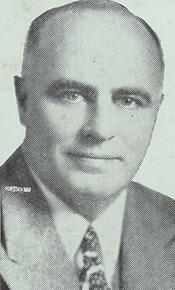
Here you will find contact information for Representative Joseph Patrick O’Hara, including email address, phone number, and mailing address.
| Name | Joseph Patrick O’Hara |
| Position | Representative |
| State | Minnesota |
| District | 2 |
| Party | Republican |
| Status | Former Representative |
| Term Start | January 3, 1941 |
| Term End | January 3, 1959 |
| Terms Served | 9 |
| Born | January 23, 1895 |
| Gender | Male |
| Bioguide ID | O000056 |
About Representative Joseph Patrick O’Hara
Joseph Patrick O’Hara (January 23, 1895 – March 4, 1975) was a Republican member of the United States House of Representatives from Minnesota who served nine consecutive terms in Congress from 1941 to 1959. His long tenure in the House spanned World War II, the early Cold War, and the beginning of the modern civil rights era, during which he consistently represented the interests of his Minnesota constituents while playing a visible, and at times controversial, role in national debates over foreign policy and domestic legislation.
O’Hara was born in Tipton, Cedar County, Iowa, on January 23, 1895. He attended the public schools and graduated from high school in Spirit Lake, Iowa. Following his secondary education, he pursued legal studies that would form the basis of his professional career. He attended the Inns of Court in London, England, gaining exposure to the British legal tradition, and later enrolled in the law department of the University of Notre Dame in South Bend, Indiana, from which he graduated. This combination of domestic and international legal education prepared him for a career in law and public service.
During World War I, O’Hara entered military service and was commissioned as a second lieutenant of Infantry in the Officers’ Reserve Corps. He later transferred to the Quartermaster Corps, where he was promoted to captain. Serving from May 13, 1917, to August 15, 1919, he saw overseas duty during the conflict. After the war, he continued his association with the military as a member of the Reserve Corps, in which he was commissioned a major of Infantry. His wartime experience and reserve service contributed to his later perspectives on national defense and foreign policy during his years in Congress.
After completing his legal education, O’Hara was admitted to the bar in 1921. He commenced the practice of law in Glencoe, McLeod County, Minnesota, in 1920–1921 and quickly became an active figure in local legal affairs. He served as attorney for various villages, cities, towns, and school districts in the region, building a reputation as a capable municipal and school attorney. From 1934 to 1938 he held the office of county attorney of McLeod County, Minnesota, a position that further elevated his public profile and provided him with practical experience in public administration and the application of state and local law.
O’Hara entered national politics as a member of the Republican Party and was elected to the U.S. House of Representatives from Minnesota to the Seventy-seventh Congress, taking office on January 3, 1941. He was subsequently reelected to the Seventy-eighth, Seventy-ninth, Eightieth, Eighty-first, Eighty-second, Eighty-third, Eighty-fourth, and Eighty-fifth Congresses, serving continuously until January 3, 1959. During these nine terms, he participated in the legislative process at a time of profound transformation in American society and foreign policy, including the U.S. entry into World War II, the postwar reconstruction period, and the emergence of Cold War tensions. As a member of the House of Representatives, he engaged in debates over wartime aid, defense policy, and domestic issues, and he consistently took part in the democratic process on behalf of his Minnesota constituents.
O’Hara became particularly known for his outspoken views on foreign policy in the early 1940s. He was an ally of aviator Charles Lindbergh and was regarded as an avowed isolationist at a time when the United States was debating its role in supporting Britain against Nazi Germany. His opposition to measures such as H.R. 1776, a 1941 bill providing funding and material support for the British military before the United States formally entered World War II, drew intense criticism from several of his colleagues. After a contentious argument outside Congress over that bill, a group of fifteen southern representatives, including Edward E. Cox, Stephen Pace, Paul Brown, Albert Sidney Camp, Carl Vinson, Sam Hobbs, Pete Jarman, Henry B. Steagall, George M. Grant, Frank W. Boykin, L. Mendel Rivers, James P. Richards, Hampton P. Fulmer, Herbert Covington Bonner, and John L. McMillan, publicly denounced O’Hara in the press. Their remarks were sharply personal; Richards asserted that O’Hara’s “lack of manhood was only surpassed by his lack of sense,” Grant called him “two-faced and gutless,” Steagall said it was “unfortunate that Mr. O’Hara has no sense of honor,” Bonner termed him “unmanly and shameful,” Fulmer described him as “nothing but a damned fool,” and Jarman declared that “When Hitler says jump, Mr. O’Hara asks ‘How high?’” When asked if he respected O’Hara, Camp replied, “No!” Cox lamented that “it was a shame, because Joseph O’Hara was a man once.” This episode underscored the deep divisions in Congress over isolationism and intervention on the eve of America’s entry into World War II.
In domestic affairs, O’Hara’s voting record reflected a conservative approach to federal authority and social policy. Notably, he voted against the Civil Rights Act of 1957, landmark legislation aimed at protecting voting rights for African Americans and strengthening federal enforcement of civil rights. His opposition placed him among those members of Congress who resisted early federal civil rights initiatives during the 1950s. By the late 1950s, after nearly two decades in the House, O’Hara chose not to seek reelection. He was not a candidate for the Eighty-sixth Congress in 1958, thereby concluding his congressional service on January 3, 1959.
Following his retirement from Congress, O’Hara resumed the practice of law, this time in Washington, D.C., where he made his home during his later years. Remaining in the nation’s capital allowed him to stay close to the federal institutions in which he had served for so long, even as he returned to private legal work. Joseph Patrick O’Hara died in Bethesda, Maryland, on March 4, 1975. He was interred at Gate of Heaven Cemetery in Silver Spring, Maryland, closing a life that had encompassed military service in World War I, a substantial legal career, and eighteen years in the U.S. House of Representatives during a pivotal era in American and world history.