Representative Joseph Marmaduke Pratt
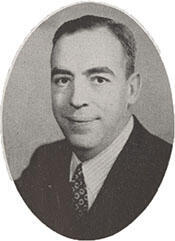
Here you will find contact information for Representative Joseph Marmaduke Pratt, including email address, phone number, and mailing address.
| Name | Joseph Marmaduke Pratt |
| Position | Representative |
| State | Pennsylvania |
| District | 2 |
| Party | Republican |
| Status | Former Representative |
| Term Start | January 6, 1943 |
| Term End | January 3, 1945 |
| Terms Served | 1 |
| Born | September 4, 1891 |
| Gender | Male |
| Bioguide ID | P000503 |
About Representative Joseph Marmaduke Pratt
Joseph Marmaduke Pratt (September 4, 1891 – July 19, 1946) was a Republican member of the U.S. House of Representatives from Pennsylvania who served one term in Congress during the later years of World War II. Born in Paterson, New Jersey, he moved with his parents to Philadelphia, Pennsylvania, in 1892, where he was raised and would spend the bulk of his professional and political life. His early years in Philadelphia placed him in one of the nation’s major industrial and commercial centers at a time of rapid urban growth, an environment that would later shape both his business career and his public service.
Pratt pursued higher education in Philadelphia and graduated from Temple University in 1919. His completion of college in the immediate aftermath of World War I coincided with a period of expanding industrial capacity and technological development in the United States. Following his graduation, he entered private enterprise, going into the business of manufacturing industrial and marine products. This work placed him in a sector closely tied to shipping, transportation, and wartime production, and it provided him with managerial and commercial experience that would later inform his approach to legislative issues, particularly those affecting industry and veterans of the armed services.
Over the next two decades, Pratt established himself as a businessman in Philadelphia while gradually becoming more active in Republican politics. By the late 1930s, as the nation grappled with the Great Depression and the New Deal, he had become a recognized figure within local party circles. From 1937 to 1946 he served as a member of the Republican City Committee of Philadelphia, participating in the organization and strategy of the party in one of Pennsylvania’s most important urban centers. His work on the City Committee helped build his political profile and laid the groundwork for his eventual candidacy for Congress.
Pratt’s congressional career arose from a midterm vacancy. He was elected as a Republican to the U.S. House of Representatives from Pennsylvania to fill the vacancy caused by the resignation of Representative James P. McGranery. In the special election, he defeated Democratic candidate William A. Barrett, who would himself later become a member of Congress. Pratt was inaugurated on February 8, 1944, and entered the 78th Congress at a critical moment in American history, as the United States was fully engaged in World War II. His service in Congress, which extended until January 3, 1945, constituted a single term in office, during which he contributed to the legislative process and represented the interests of his Pennsylvania constituents.
During his tenure in the House of Representatives, Pratt participated actively in roll call votes despite the brevity of his service. He cast 44 votes and missed 10.7 percent of roll call votes, a record that reflected steady participation in the work of the 78th Congress. His voting record was generally conservative, consistent with his Republican affiliation, but somewhat less conservative than that of the median Republican member at the time; he voted with his party 84 percent of the time, compared with a median Republican party-line score of 88 percent. One of his most notable legislative actions was his vote in favor of the Servicemen’s Readjustment Act of 1944, commonly known as the G.I. Bill, landmark legislation that provided educational and economic benefits to returning World War II veterans and was signed into law by President Franklin D. Roosevelt on June 22, 1944. During his service, Pratt was assigned to the House War Claims Committee, where he participated in the consideration of claims arising from wartime activities.
The 1944 election cycle brought significant changes to Pratt’s political circumstances. As a result of redistricting, he was shifted to Pennsylvania’s third congressional district, where he faced Democratic incumbent Michael J. Bradley in his bid for a full term. The contest took place in the context of wartime politics and shifting electoral boundaries, and Pratt was ultimately unsuccessful in his effort to retain the seat. He lost the election in November 1944 and concluded his service in Congress on January 3, 1945, at the close of the 78th Congress. Although his time in the House was brief—less than a full year—he participated in the democratic process during a pivotal period for both Pennsylvania and the nation.
After leaving Congress, Pratt returned to Philadelphia and resumed his former business pursuits in the manufacture of industrial and marine products. He remained engaged in public affairs and Republican politics, and by 1946 he had again sought elective office. That year he received the Republican nomination for State Senator in Pennsylvania’s second state senate district, reflecting continued confidence in his leadership within the party and his ongoing commitment to public service at the state level. His renewed candidacy indicated that he intended to build on his congressional experience in a legislative role closer to home.
Pratt did not live to see the outcome of his 1946 state senate campaign. While on a business trip to Washington, D.C., he suffered a heart attack and died there on July 19, 1946. His death occurred before the election was held, bringing an abrupt end to both his business activities and his plans for further political service. Joseph Marmaduke Pratt was interred in Arlington Cemetery in Upper Darby Township, Pennsylvania, a suburban community near Philadelphia, thus returning him in death to the region where he had spent nearly his entire life and career.