Representative Joseph Hayne Rainey
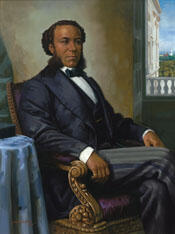
Here you will find contact information for Representative Joseph Hayne Rainey, including email address, phone number, and mailing address.
| Name | Joseph Hayne Rainey |
| Position | Representative |
| State | South Carolina |
| District | 1 |
| Party | Republican |
| Status | Former Representative |
| Term Start | March 4, 1869 |
| Term End | March 3, 1879 |
| Terms Served | 5 |
| Born | June 21, 1832 |
| Gender | Male |
| Bioguide ID | R000016 |
About Representative Joseph Hayne Rainey
Joseph Hayne Rainey (June 21, 1832 – August 1, 1887) was an American politician and a member of the Republican Party who served as a Representative from South Carolina in the United States Congress from 1869 to 1879. He was the first Black person to serve in the United States House of Representatives and the second Black person, after Hiram Revels, to serve in the United States Congress. Over the course of five terms in office, he contributed to the legislative process during a pivotal era in American history, and his service included time as a presiding officer of the House of Representatives, when he served as Speaker pro tempore.
Rainey was born on June 21, 1832, in Georgetown, South Carolina, into a family connected to the region’s agricultural economy of farmers and planters. His mother, Grace, was of African and French descent. His father, Edward Rainey, was enslaved but was permitted by his master to work independently as a barber, paying a portion of his income as required by law. Through this arrangement, Edward developed a successful business and, by the 1840s, had saved enough to purchase his own freedom and that of his wife and two sons, including Joseph. Opportunities for formal education were severely limited for Black people in South Carolina at the time, and Joseph Rainey followed his father into the barber’s trade. The profession was relatively independent and respected, and it enabled him to build a wide social network in his community. By 1850, Edward Rainey had acquired at least one enslaved person, and by 1860 he had purchased more, most likely to work in his barbershop alongside Joseph, reflecting the complex and often contradictory position of some free people of color in the antebellum South.
In 1859, Rainey traveled to Philadelphia, Pennsylvania, where he met and married Susan, a free woman of color from the West Indies who, like his mother, was of African-French descent. The couple returned to South Carolina, where their three children—Joseph II, Herbert, and Olivia—were born. With the outbreak of the American Civil War in 1861, Rainey, though a free Black man, was conscripted by Confederate authorities to work on fortifications in Charleston, South Carolina. He also served as a cook and laborer on Confederate blockade runner ships operating along the Atlantic coast. In 1862, seeking greater safety and opportunity, Rainey and his family escaped to the British imperial fortress colony of Bermuda, about 640 miles off Cape Hatteras, North Carolina.
In Bermuda, the Raineys settled first in the town of St. George’s, from which Charleston and South Carolina had been founded in the seventeenth century. Joseph Rainey resumed work as a barber, operating a shop accessed from Barber’s Alley in the cellar of the Tucker House, a building that had once been the home of Council President and acting Governor Henry Tucker. His wife Susan became a successful dressmaker with her own shop. The couple prospered and became respected members of the community. In 1865, when an outbreak of yellow fever threatened St. George’s, they moved to Hamilton, Bermuda, where Rainey worked as a barber and bartender at the Hamilton Hotel, serving a largely white clientele. Bermuda itself was deeply entangled in the Civil War economy, serving as a major trans-shipment point for British and European arms and supplies carried by Confederate blockade runners into Southern ports, even as many Black and white Bermudians sided with the Union and some served in the U.S. Navy and U.S. Colored Troops. After the end of the Civil War, in 1866, Rainey and his family returned to the United States and settled in Charleston, South Carolina.
Upon his return to South Carolina, Rainey quickly emerged as a political leader in the Reconstruction era. Charleston in 1870 had a large African American population—about 43 percent of the city’s residents were Black—and many, like Rainey, had been free and held skilled occupations before the war. His experience, relative wealth, and connections helped establish him as a prominent figure in the Republican Party. He joined the executive committee of the state Republican Party and, in 1868, served as a delegate to the South Carolina constitutional convention, which helped reshape the state’s legal and political framework during Reconstruction. In 1870, he was elected to the South Carolina Senate, where he became chair of the Finance Committee. His tenure in the state senate was brief, however, because that same year he won a special election as a Republican to fill a vacancy in the 41st United States Congress after the House of Representatives refused to seat Benjamin F. Whittemore, who had been censured for corruption but re-elected by his constituents.
Rainey was seated in the U.S. House of Representatives on December 12, 1870, representing South Carolina’s 1st Congressional District, and he was subsequently re-elected, serving until March 3, 1879. Over his five terms in Congress, he established a record for length of service by a Black congressman that was not surpassed until the tenure of William L. Dawson of Chicago in the 1950s. As a member of the House of Representatives during a significant period in American history, he participated actively in the democratic process and represented the interests of his constituents in South Carolina. Rainey supported key Reconstruction legislation, including measures that became known as the Enforcement Acts, designed to suppress the violent activities of the Ku Klux Klan and protect the civil and political rights of African Americans in the South. Although these laws had some effect, white insurgents soon developed other paramilitary organizations, such as the White League and the Red Shirts, to intimidate Black voters and restore Democratic control.
Rainey was also a strong advocate for civil rights on the House floor. He delivered three notable speeches in support of what became the Civil Rights Act of 1875. In a speech in 1873, he emphasized that he was not seeking “social equality” but demanded that Black Americans be recognized in law as other citizens were. He asked why Black members of Congress could not enjoy the same immunities as white members—why they could not stay in hotels or dine in restaurants in the capital without insult or exclusion—while they were entrusted with making laws for the nation. His arguments highlighted the contradiction between formal political rights and the social discrimination that persisted even in Washington, D.C. In May 1874, Rainey became the first African American to preside over the House of Representatives when he served as Speaker pro tempore, underscoring his stature among his colleagues. In the closing hours of Congress in 1878, when many members were absent or inebriated, he played a decisive role in ensuring the passage of an $18 million civil service appropriation bill, using his firm presence in the chair to secure its enactment.
Throughout his congressional career, Rainey also worked to promote the Southern economy and to encourage investment and development in the postwar South. At the same time, he was acutely aware of the growing campaign of violence and intimidation directed against Black voters and Republican officeholders. Beginning in 1874, paramilitary groups such as the Red Shirts in North and South Carolina and Louisiana operated openly as the armed wing of the Democratic Party, suppressing Black political participation. In South Carolina, events such as the Hamburg Massacre in July 1876, in which six Black men were murdered, and the Ellenton violence in October 1876, in which between 25 and 100 Black people were killed, illustrated the scale of the terror campaign. Despite this, Rainey won re-election in 1876 from the Charleston district against Democratic candidate John Smythe Richardson. Richardson challenged the result, alleging that federal soldiers and Black militias had intimidated Democratic voters at the polls, but Rainey ultimately retained his seat. The 1876 elections in South Carolina were marred by widespread fraud; in Edgefield County, for example, the votes counted for Democratic gubernatorial candidate Wade Hampton III exceeded the number of registered voters by about 2,000, and similar irregularities appeared in Laurens County. Democrats nevertheless secured control of the state government, and in 1877, as part of a national political compromise, the federal government withdrew its troops from the South, effectively ending Reconstruction.
As conditions deteriorated, Rainey took steps to protect his family and continued to warn national leaders about the situation in the South. In mid-1878, he cautioned President Rutherford B. Hayes about the escalating violence and rhetoric aimed at limiting African American voting rights in South Carolina. With violence against Black people increasing, in 1874 he had purchased a “summer home” in Windsor, Connecticut, where he moved his family for their safety, though he continued to represent South Carolina in Congress and could not claim Windsor as his primary residence. While in Windsor, he became an active member of the First Church of Windsor. The house he owned there, a Greek Revival structure built around 1830 and located at 299 Palisado Avenue, later became known as the Joseph H. Rainey House. It is used as a private residence but has been designated as one of the 130 stops on the Connecticut Freedom Trail, established in 1996 to highlight the achievements of African Americans in gaining freedom and civil rights. In the 1878 election, Rainey was defeated in a rematch with John Smythe Richardson. Although Black men continued to be elected to some local offices in South Carolina into the late nineteenth century, white Democrats used their dominance of the state legislature to enact segregationist Jim Crow laws and to make voter registration increasingly difficult. These efforts culminated in the South Carolina constitution of 1895, which effectively disenfranchised most Black citizens and excluded them from meaningful political participation for decades.
After leaving Congress, Rainey remained in public service for a time before turning to private enterprise. He was appointed a federal agent of the U.S. Treasury Department for internal revenue in South Carolina, a position he held for two years. He then moved to Washington, D.C., where he spent about five years working in brokerage and banking, drawing on the connections and experience he had gained during his years in national politics. In 1886, Rainey retired from active business and returned to his native South Carolina. At the age of 55, he contracted malaria and died less than a year later, on August 1, 1887, in Georgetown, the city of his birth. His life and career, marked by his status as the first Black member of the U.S. House of Representatives and his decade of service during Reconstruction, left a lasting imprint on American political history. In 2018, his legacy was further recognized with the founding of the Joseph Rainey Center for Public Policy, a 501(c)(3) think tank established by Sarah E. Hunt and Bishop Garrison, dedicated to empowering the voices of women, minorities, and mavericks in public policy.