Representative Joseph Showalter Smith
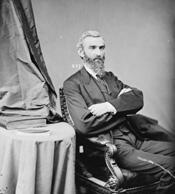
Here you will find contact information for Representative Joseph Showalter Smith, including email address, phone number, and mailing address.
| Name | Joseph Showalter Smith |
| Position | Representative |
| State | Oregon |
| District | 1 |
| Party | Democratic |
| Status | Former Representative |
| Term Start | March 4, 1869 |
| Term End | March 3, 1871 |
| Terms Served | 1 |
| Born | June 20, 1824 |
| Gender | Male |
| Bioguide ID | S000581 |
About Representative Joseph Showalter Smith
Joseph Showalter Smith (June 20, 1824 – September 28, 1884) was an American lawyer and Democratic politician who served one term as a Representative from the U.S. state of Oregon in the United States Congress from 1869 to 1871. During his single term in the House of Representatives, he participated in the legislative process at a significant period in American history, representing the interests of his Oregon constituents during the post–Civil War era.
Smith was born on June 20, 1824, in Connellsville, Pennsylvania. During his childhood he moved with his parents, who were farmers, first to Ohio and then to Indiana. He attended the common schools in these states, receiving a basic formal education typical of the period. In 1844, at the age of 20, he joined the early stream of American migrants traveling west on the Oregon Trail. He arrived in the Oregon Country in the spring of 1845 and settled in Salem. There he taught school while studying law, and he was eventually admitted to the bar, beginning a legal career that would underpin his later political life.
By the early 1850s, Smith had become active in civic affairs in the growing communities of the Pacific Northwest. In 1851, he sought election as Portland’s first mayor, narrowly losing the contest by four votes to Hugh O’Bryant. In 1853, he moved north to Olympia in Washington Territory, where his political career advanced more decisively. He was elected to the Washington territorial house of representatives in 1856 and served as speaker of that body. On March 12, 1857, President James Buchanan appointed him United States attorney for Washington Territory, a position that placed him at the center of federal legal affairs in the region.
Smith returned to Salem, Oregon, in 1858 and resumed the practice of law, maintaining his legal career there for approximately twelve years. His prominence within the Democratic Party in Oregon grew steadily. In 1862, he was selected by the Democratic convention as their candidate for associate justice of the Oregon Supreme Court, but he declined the nomination. Four years later, in 1866, he was the Democratic candidate for the United States Senate from Oregon. In that closely contested race, he was defeated in the state legislature by Republican Henry W. Corbett by a margin of three votes, underscoring both his influence and the competitive partisan climate of the period.
In 1868, Smith was elected as a Democrat to the United States House of Representatives from Oregon. He served one term in Congress from March 4, 1869, to March 4, 1871. His tenure coincided with Reconstruction and the continuing national debates over the political and economic direction of the reunited country. As a member of the House of Representatives, he contributed to the legislative process and participated in the democratic governance of the nation while representing the interests of his Oregon constituents in Washington, D.C.
After completing his term in Congress, Smith returned to private life and the practice of law. He moved to Portland, Oregon, where he resumed his legal career and remained active in state politics. In 1882, he was the Democratic candidate for Governor of Oregon, but he was defeated by Republican Zenas Ferry Moody. Despite this loss, his candidacy reflected his continued prominence within the Democratic Party and his long-standing involvement in public affairs in both Oregon and Washington Territory.
Joseph Showalter Smith died in Portland, Oregon, on September 28, 1884. He was interred in River View Cemetery in Portland. His career spanned the formative decades of the Pacific Northwest, encompassing roles as educator, lawyer, territorial legislator and speaker, federal attorney, and United States Representative, and he remained a notable Democratic figure in Oregon politics through the late nineteenth century.