Representative Joseph Bryan Thompson
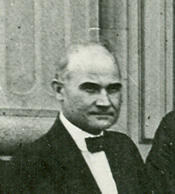
Here you will find contact information for Representative Joseph Bryan Thompson, including email address, phone number, and mailing address.
| Name | Joseph Bryan Thompson |
| Position | Representative |
| State | Oklahoma |
| District | 5 |
| Party | Democratic |
| Status | Former Representative |
| Term Start | April 7, 1913 |
| Term End | March 3, 1921 |
| Terms Served | 4 |
| Born | April 29, 1871 |
| Gender | Male |
| Bioguide ID | T000210 |
About Representative Joseph Bryan Thompson
Joseph Bryan Thompson (April 29, 1871 – September 18, 1919) was an American politician and a U.S. Representative from Oklahoma. A member of the Democratic Party, he served in the United States House of Representatives from 1913 until his death in 1919, contributing to the legislative process during four terms in office and representing the interests of his Oklahoma constituents during a significant period in American history.
Thompson was born near Sherman, Grayson County, Texas, on April 29, 1871. He attended the public schools and pursued higher education at Savoy College in Fannin County, Texas, from which he was graduated in 1890. After completing his collegiate studies, he read law and prepared for a legal career. In 1892 he was admitted to the bar and soon thereafter commenced the practice of law in Purcell, Indian Territory, reflecting the westward expansion and development of the region that would later become the state of Oklahoma.
Early in his professional life, Thompson moved within the Indian Territory as legal and political opportunities arose. After beginning his practice in Purcell, he relocated to Ardmore, Indian Territory, continuing his legal work. In 1893 he was appointed commissioner for the United States court, a federal judicial position in the Indian Territory, and in connection with this appointment he returned to Purcell. He resigned this post in 1897 and moved to Pauls Valley, Indian Territory, where he resumed the practice of law. During these years he also established a family life; he married Mary Miller, and the couple had two sons, James Miller Thompson and Joseph B. Thompson Jr.
Thompson quickly became active in Democratic Party politics in the territory. He served as a member of the Democratic Territorial Committee from 1896 to 1904, helping to shape party organization and strategy in the years leading up to Oklahoma statehood. He was a delegate to the Democratic National Conventions in 1900, 1904, and 1908, participating in the selection of national party nominees and platforms. Following the admission of Oklahoma as a state in 1907, Thompson continued to hold key party leadership roles, serving as chairman of the Democratic State Committee in 1906 and again in 1908, positions that placed him at the center of early state-level political organization.
Building on his party leadership, Thompson entered elective office in the new state government. He served in the Oklahoma State Senate from 1910 to 1914, representing his district during the formative years of the state’s legislative institutions. His tenure in the State Senate overlapped with his rise to national office and helped establish his reputation as a capable legislator and advocate for his region.
Thompson was elected as a Democrat to the Sixty-third Congress and to the three succeeding Congresses, serving as a Representative from Oklahoma from March 4, 1913, until his death on September 18, 1919. His service in Congress thus spanned the Sixty-third through the Sixty-sixth Congresses, a period that included the administration of President Woodrow Wilson, the enactment of major Progressive Era legislation, and the First World War. As a member of the House of Representatives, Joseph Bryan Thompson participated in the democratic process and represented the interests of his Oklahoma constituents, contributing to the legislative work of the nation during a time of significant domestic and international change.
Thompson died in office on September 18, 1919. He succumbed to heart failure induced by Bright’s disease while traveling by train near Martinsburg, West Virginia, en route to his home in Pauls Valley, Oklahoma. His death placed him among the members of the United States Congress who died in office in the early twentieth century. He was interred at Mount Olivet Cemetery in Pauls Valley, Oklahoma, where he was laid to rest in the community that had long been his home and the base of his legal and political career.