Representative Joshua Reed Giddings
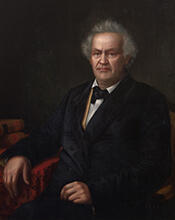
Here you will find contact information for Representative Joshua Reed Giddings, including email address, phone number, and mailing address.
| Name | Joshua Reed Giddings |
| Position | Representative |
| State | Ohio |
| District | 20 |
| Party | Republican |
| Status | Former Representative |
| Term Start | September 4, 1837 |
| Term End | March 3, 1859 |
| Terms Served | 11 |
| Born | October 6, 1795 |
| Gender | Male |
| Bioguide ID | G000167 |
About Representative Joshua Reed Giddings
Joshua Reed Giddings (October 6, 1795 – May 27, 1864) was an American attorney, politician, and abolitionist who served as a Representative from Ohio in the United States Congress from 1837 to 1859. Over the course of 11 terms in office, he represented Northeast Ohio in the U.S. House of Representatives from December 1838 until March 1859, first as a member of the Whig Party and later as a Free Soiler, Opposition Party member, and finally as a Republican, helping to found the Republican Party. A leading antislavery figure in Congress, he became one of the principal reasons that Ohio’s Western Reserve was, before the Civil War, one of the most strongly anti-slavery regions in the country.
Giddings was born at Tioga Point, now Athens, in Bradford County, Pennsylvania, on October 6, 1795, to Joshua Giddings and Elizabeth (née Pease) Giddings. In the year of his birth, the family moved to Canandaigua, New York, where they lived for about a decade. In 1806 his parents moved again, this time to Ashtabula County, on Ohio’s Western Reserve, then a sparsely settled frontier region heavily influenced by New England migrants and known for its religious and political radicalism. Growing up in this environment, Giddings worked on his father’s farm and, despite having no systematic formal education, devoted considerable time to study and reading. At age 17 he joined a militia regiment during the War of 1812 and served for about five months, taking part in engagements against Native American allies of the British.
After the war Giddings supported himself as a schoolteacher and continued his self-education. In 1819 he married Laura Waters, the daughter of a Connecticut emigrant to Ohio. The couple had several children; one son, Grotius Reed Giddings (1834–1867), later served as a major in the 14th United States Infantry during the Civil War. Seeking a professional career, Giddings read law in the office of Elisha Whittlesey, a prominent Ohio lawyer and politician, and supplemented his income through land speculation. In February 1821 he was admitted to the Ohio bar and soon built up a substantial practice, particularly in criminal law. From 1831 to 1837 he was in partnership with Benjamin F. Wade, who would later become a U.S. senator and president pro tempore of the Senate during the Andrew Johnson administration. Influenced by abolitionist organizer Theodore Dwight Weld, Giddings and Wade helped form a local antislavery society, an early institutional expression of Giddings’s growing opposition to slavery.
Giddings’s public career began in state politics. He was elected to the Ohio House of Representatives and served one term from 1826 to 1827. The financial upheaval of the Panic of 1837, in which he lost a significant portion of his fortune, led him to curtail his law practice and turn more fully to national politics. He ran for Congress with the explicit backing of antislavery forces and, according to contemporary accounts, with “instructions to bring abolition into national focus in any way possible.” He was elected to the U.S. House of Representatives and took his seat in December 1838. Over the next two decades he was consistently re-elected, representing first Ohio’s 16th Congressional District until 1843 and then the 20th District until 1859. His district boundaries shifted over time: from 1838 to 1843 it included Youngstown; from 1843 to 1853 the lines moved northwest to include Cleveland while excluding Youngstown; and from 1853 Cleveland was again removed and Youngstown restored to his constituency.
During his long congressional service, Giddings became one of the most outspoken and uncompromising opponents of slavery in the House of Representatives. For the 1841 session he joined with Seth M. Gates of New York, William Slade of Vermont, Sherlock J. Andrews of Ohio, and others in forming an informal “Select Committee on Slavery,” an unofficial group dedicated to attacking slavery by every parliamentary and political means available. Operating without formal recognition, they paid their own expenses, including the support of Theodore Dwight Weld, who researched and helped draft their antislavery speeches. Their headquarters were at Mrs. Sprigg’s boarding house opposite the Capitol, where Giddings, Gates, Slade, Weld, and the abolitionist minister Joshua Leavitt lodged during sessions; former President John Quincy Adams, though not a member of the group, acted as a powerful ally on the House floor. Giddings quickly seized opportunities to challenge slavery, notably in a February 9, 1841 speech on the Seminole War in Florida, in which he argued that the conflict was being waged primarily in the interest of slaveholders.
Giddings’s most famous confrontation with proslavery forces in Congress arose from the Creole case of 1841, in which enslaved people aboard the American brig Creole revolted and forced the ship to Nassau in the British Bahamas, where they obtained freedom under British law. While Southern slaveholders pressed the federal government to demand the return of the enslaved or compensation, Giddings advanced a constitutional argument that slavery was strictly a state institution, existing only by virtue of specific state enactments. He maintained that the federal government had no authority to uphold slavery on the high seas, in the territories, or in the District of Columbia, all under federal jurisdiction, and that the coastwise slave trade in vessels flying the U.S. flag was unconstitutional and should be suppressed, just as the international slave trade had been. On March 21, 1842, he introduced a series of resolutions asserting that the enslaved people aboard the Creole had violated no U.S. law in reclaiming their natural rights to liberty and that the United States should not seek their return. For offering these resolutions in defiance of the House’s “gag rule” against antislavery discussion, Giddings was formally censured and denied the right to defend himself on the floor. He immediately resigned his seat and appealed to his constituents, who overwhelmingly re-elected him in a special election by a margin of 7,469 to 383, then the largest recorded majority in a House contest. When he returned to Congress, the House abandoned any further attempt to discipline him, and his success emboldened his antislavery colleagues. Mounting public agitation against slavery contributed to the House’s repeal of the gag rule on December 3, 1844.
Over the remainder of his congressional career, Giddings continued to press an aggressive antislavery agenda. Encouraged by his daughter Lura Maria, an active Garrisonian abolitionist, he attended meetings of William Lloyd Garrison’s followers and increasingly grounded his politics in a doctrine of higher natural law rather than in constitutional argument alone. In the 1850s he embraced a range of progressive and religiously radical ideas, including perfectionism and spiritualism, and he became known for his willingness to employ forceful rhetoric. He denounced the Fugitive Slave Act of 1850, urged escaping slaves to resist capture, and spoke openly of the justice of slave insurrections and the duty of Northerners to support them. He condemned the annexation of Texas, the Mexican-American War, the Compromise of 1850, and the Kansas–Nebraska Act as measures designed to expand slavery into the West, and he cast the lone vote in the House against a resolution of thanks to General Zachary Taylor following the war with Mexico. He also reacted strongly to the 1856 caning of Senator Charles Sumner, calling it a crime “against the most vital principles of the Constitution, against the Government itself, against the sovereignty of Massachusetts, against the people of the United States, against Christianity and civilization,” themes he elaborated in his notable 1858 speech “American Infidelity.” His uncompromising stance made him a target in the South; on the eve of the Civil War, a Virginia newspaper reportedly offered $10,000 for his capture and delivery to Richmond, or $5,000 for his head alone.
Politically, Giddings’s evolution mirrored the fragmentation and realignment of parties over the slavery issue. Initially elected as a Whig, he later broke with that party over its equivocal stance on slavery and joined the Free Soil Party, a move that, according to contemporaries, “undoubtedly cost him a seat in the United States Senate,” as Ohio Whigs opposed his advancement. He subsequently associated with the short-lived Opposition Party before becoming one of the leading founders of the Republican Party in 1854–55. He campaigned vigorously for Republican presidential candidates John C. Frémont in 1856 and Abraham Lincoln in 1860, though he and Lincoln differed over the role of radical tactics in the antislavery movement. Throughout these years he also supported the Underground Railroad in Ohio, aiding fugitive slaves in their efforts to reach freedom, and he became widely known—admired by some and condemned by others—for his egalitarian views on race and his practical assistance to African Americans. His long tenure in the House, from 1837 to 1859, coincided with a critical period in the nation’s sectional crisis, and he consistently used his position to bring antislavery issues before Congress and the public.
In 1859 Giddings was not renominated by the Republican Party and retired from Congress after more than two decades of continuous service. With the outbreak of the Civil War and the advent of the Lincoln administration, he was called again to public service. In 1861 President Abraham Lincoln appointed him U.S. consul general in Canada, a strategically important diplomatic post during the conflict, and he served there until his death. Joshua Reed Giddings died in Montreal, Canada, on May 27, 1864. His body was returned to Ohio, and he was buried in Oakdale Cemetery in Jefferson, Ashtabula County, where his preserved law office has since been designated a National Historic Landmark. His legacy as an antislavery radical and congressional leader has been commemorated in various ways: a Washington, D.C., public school built in 1887 was named Joshua R. Giddings Elementary School (later closed in the 1990s and converted to a sports club and gym), and a life-size bronze depiction of him stands inside the Cuyahoga County Soldiers’ and Sailors’ Monument in Cleveland. His extensive writings, including Pacificus: The Rights and Privileges of the Several States in Regard to Slavery (c. 1842), An Expose of the Circumstances Which Led to the Resignation… (1842), The Rights of the Free States Subverted (c. 1844), his collected Speeches in Congress (1853), The Exiles of Florida (1858), and History of the Rebellion: Its Authors and Causes (1864), along with his correspondence and memoirs preserved in collections such as that of the Indiana State Library, continue to inform historical understanding of his role in the antislavery movement and the politics of the antebellum United States.