Representative Josiah Williams Begole
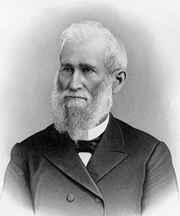
Here you will find contact information for Representative Josiah Williams Begole, including email address, phone number, and mailing address.
| Name | Josiah Williams Begole |
| Position | Representative |
| State | Michigan |
| District | 6 |
| Party | Republican |
| Status | Former Representative |
| Term Start | December 1, 1873 |
| Term End | March 3, 1875 |
| Terms Served | 1 |
| Born | January 20, 1815 |
| Gender | Male |
| Bioguide ID | B000316 |
About Representative Josiah Williams Begole
Josiah Williams Begole (January 20, 1815 – June 5, 1896) was an American politician who served one term as a U.S. Representative from Michigan from 1873 to 1875 and later as the nineteenth governor of Michigan from 1883 to 1885. A prominent figure in Michigan’s political and business life in the mid- to late nineteenth century, he was associated first with the emerging Republican Party and later with the Greenback and Democratic parties, and he participated actively in the legislative process during a significant period in American history.
Begole was born in Groveland, Livingston County, New York, on January 20, 1815. His family background reflected the religious and political upheavals of the eighteenth century: his ancestors were French Huguenots who emigrated to the United States in the last quarter of that century to escape religious persecution and settled in Hagerstown, Maryland. His father, William Begole (1788–1862), was born in Hagerstown and moved to Livingston County, New York, in 1802. William served in the War of 1812 and married the daughter of an American Revolutionary War veteran, linking the family to two generations of American military service. Josiah was the eldest of William’s sons, three of whom eventually moved to Genesee County, Michigan. He attended the public schools in Mount Morris and continued his education at Temple Hill Academy in Geneseo, New York, receiving the basic classical and practical training typical of the period.
In August 1836, Begole moved west to Flint, in what was then a developing region of Michigan. He taught school there in 1837 and 1838, an early indication of his interest in public service and local affairs. In the spring of 1839 he married Harriet A. Miles, and shortly thereafter he turned to agricultural pursuits, farming from 1839 to 1856. During these years he became deeply involved in township governance, serving successively as school inspector, justice of the peace, and township treasurer. An opponent of slavery, he aligned himself with the anti-slavery movement and became a member of the Republican Party at its organization in the 1850s. He was elected county treasurer of Genesee County, holding that office from 1856 to 1864. In 1863 he was briefly engaged in the lumber business, an industry that would later become central to his post-congressional career. The Civil War brought personal tragedy: his eldest son was killed in action near Atlanta, Georgia, in 1864, an event he regarded as the greatest sorrow of his life.
Begole’s state and local political career expanded in the years following the Civil War. He served as a member of the Michigan Senate in 1870 and 1871, where he participated in shaping state legislation during the Reconstruction era. In Flint, he was a member of the city council for three years, during which time he served on the Committees of Finance and Railroads and was chairman of the Committee on the Institute for the Deaf and Dumb and Blind, reflecting a concern with both economic development and public institutions. In 1872 he was chosen as a delegate to the Republican National Convention in Philadelphia, which re-nominated President Ulysses S. Grant and nominated Henry Wilson for vice president, placing Begole in the midst of national party politics.
Begole was elected as a Republican from Michigan’s 6th congressional district to the United States House of Representatives for the Forty-third Congress, serving from March 4, 1873, to March 3, 1875. As a member of Congress, he represented his Michigan constituents during a period marked by Reconstruction’s final phases and growing national economic concerns. He served on the Committee on Agriculture and the Committee on Public Expenditures, contributing to legislative deliberations on farming interests and federal spending. His service in Congress, though limited to a single term, reflected his broader commitment to the democratic process and to representing the interests of his district. He was an unsuccessful candidate for re-election in 1874, after which he returned to private enterprise.
Following his congressional service, Begole resumed and expanded his business activities in Flint. He re-entered the lumber trade as a partner in Begole, Fox & Co., and later diversified into manufacturing and finance. He helped found Flint Wagon Works, a firm engaged in the manufacture of wagons, which contributed to the city’s growing reputation as a center of carriage and, later, automotive-related industries. He also engaged in banking, further cementing his role as a leading figure in the economic development of Flint and the surrounding region.
In 1882, Begole reemerged on the statewide political stage as the gubernatorial candidate of a fusion ticket supported by the Greenback and Democratic parties. Running as a former Republican against the Republican incumbent, Governor David Jerome, he capitalized on agrarian and labor discontent and defeated Jerome by more than 7,000 votes. He served one term as governor of Michigan from 1883 to 1885. Because he had ousted a Republican incumbent yet faced a legislature dominated by Republicans, his administration encountered significant partisan resistance. As a result, relatively few of his proposals were enacted, though he did secure the establishment of a state bureau of labor statistics, an important step in the systematic collection of information on working conditions and employment. He sought re-election in 1884 but was defeated by Republican Russell Alger, after which he returned once more to his business interests.
In his later years, Begole remained active in reform causes, notably the movement for women’s suffrage. An early advocate of women’s voting rights in Michigan, he became vice president of the first statewide suffrage organization, the Michigan Equal Suffrage Association, in 1884, aligning himself with efforts to expand democratic participation beyond the male electorate. He continued to reside in Flint, where he was regarded as both a political elder statesman and a successful businessman. Josiah Williams Begole died in Flint on June 5, 1896, at the age of eighty-one, and was interred in Glenwood Cemetery in that city.