Representative Josiah Bushnell Grinnell
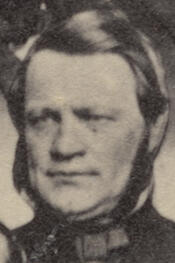
Here you will find contact information for Representative Josiah Bushnell Grinnell, including email address, phone number, and mailing address.
| Name | Josiah Bushnell Grinnell |
| Position | Representative |
| State | Iowa |
| District | 4 |
| Party | Republican |
| Status | Former Representative |
| Term Start | December 7, 1863 |
| Term End | March 3, 1867 |
| Terms Served | 2 |
| Born | December 22, 1821 |
| Gender | Male |
| Bioguide ID | G000478 |
About Representative Josiah Bushnell Grinnell
Josiah Bushnell Grinnell (December 22, 1821 – March 31, 1891) was a U.S. Congressman from Iowa’s 4th congressional district, an ordained Congregational minister, radical abolitionist, one of the founders of Grinnell, Iowa, and a benefactor of Grinnell College. He was born in New Haven, Addison County, Vermont, on December 22, 1821. Raised in rural Vermont, he received his early education in local schools before pursuing higher studies. In 1841 he entered the Oneida Institute in New York, an institution known for its reformist and abolitionist leanings, which helped shape his strong antislavery convictions.
After his preparatory studies, Grinnell attended Auburn Theological Seminary in New York, from which he graduated in 1847. He was ordained a Congregational minister and soon took up pastorates in Washington, D.C., and New York City. His ministry in these major urban centers coincided with a period of intense national debate over slavery, and he became known for his radical abolitionist views. During these years he also became acquainted with prominent reformers and political figures. Grinnell later claimed to have been the young man to whom newspaper editor Horace Greeley gave the famous advice, “Go West, young man,” though Greeley consistently denied ever having used that exact phrase or having directed it personally to Grinnell.
On February 4, 1852, Grinnell married Julia Ann Chapin. The couple had four children: Catharine Hastings Grinnell, George Chapin Grinnell, Mary Chapin Grinnell, and Carrie Holmes Grinnell. In the early 1850s Grinnell moved west to Iowa, where he combined his religious, reform, and entrepreneurial interests. He was one of the founders of the town that would bear his name, Grinnell, Iowa, established as a community with strong educational and moral aspirations. He played a central role in persuading Iowa College, later renamed Grinnell College, to relocate from Davenport to the new town of Grinnell, becoming a significant benefactor and shaping the institution’s early development.
Grinnell quickly entered public life in his adopted state. In 1856 he was elected to the Iowa Senate, where he served until 1860. While serving in the state legislature, he studied law and was admitted to the bar in 1858, thereafter establishing a legal practice in Grinnell. As a state senator and lawyer, he was an early and firm supporter of the Republican Party. In 1860 he served as a delegate to the Republican National Convention in Chicago, which nominated Abraham Lincoln for President. His political activities were closely intertwined with his abolitionist work. Grinnell was an active “conductor” on the Underground Railroad, using his home and resources to assist enslaved people seeking freedom. He was associated with the militant abolitionist John Brown and provided Brown shelter in 1859 after Brown’s anti-slavery raids in Kansas and Missouri. In recognition of his role in the antislavery movement, the gravesite of J. B. Grinnell in Grinnell, Iowa, is listed on the National Underground Railroad Network to Freedom.
Following the 1860 census, which increased Iowa’s representation in the U.S. House of Representatives from two to six seats, a new 4th congressional district was created. In 1862 Grinnell sought and won the Republican nomination for this newly formed district, a diamond-shaped configuration of twelve counties that included Newton and Iowa City and extended from the Missouri border to the southern edge of Waterloo. He was elected to the Thirty-eighth Congress and took his seat on March 4, 1863. In 1864 he was re-elected, serving in the Thirty-ninth Congress from March 4, 1865, to March 3, 1867. During his congressional service in the Civil War and early Reconstruction era, he aligned with the more radical wing of the Republican Party, advocating strong measures against slavery and for the rights of formerly enslaved people. On June 14, 1866, he was physically assaulted in the Capitol by fellow Congressman Lovell H. Rousseau of Kentucky, who struck him with a cane after Grinnell had, in debate on the House floor, sharply criticized Rousseau and the state of Kentucky. The incident drew national attention and underscored the intensity of sectional and political animosities in the immediate postwar period.
In June 1866 Grinnell sought a third term in the House but lost the Republican nomination by thirteen votes to Judge William Loughridge, ending his congressional career. After leaving Congress in 1867, he returned to Grinnell, Iowa, and resumed the practice of law. He also expanded his involvement in business and civic affairs, particularly in railroad development, which he viewed as essential to the growth of Iowa and the Midwest. He became a director of the Chicago, Rock Island and Pacific Railroad (often known as the Rock Island Railroad) and served as receiver of the Iowa Central Railroad, which later became part of the St. Louis & St. Paul Railroad. In addition to his railroad interests, he was active in agriculture and finance, serving as president of the Iowa State Horticultural Society and as president of the First National Bank in Grinnell.
In his later years Grinnell remained a prominent figure in his community and continued to support educational and reform causes, especially those connected with Grinnell College and the town he had helped to found. He suffered from chronic throat disease, complicated by asthma, and his health gradually declined. Josiah Bushnell Grinnell died at his home in Grinnell, Iowa, on March 31, 1891. He was interred in Hazelwood Cemetery in Grinnell, where his gravesite is recognized for its association with the Underground Railroad. Articles on his life, abolitionist activities, and his obituary are preserved at the Drake Community Library in Grinnell, Iowa, whose archives and local history collections contain extensive additional materials documenting his career and legacy.