Representative Josiah Thomas Walls
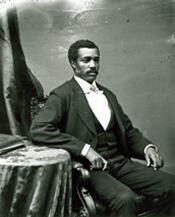
Here you will find contact information for Representative Josiah Thomas Walls, including email address, phone number, and mailing address.
| Name | Josiah Thomas Walls |
| Position | Representative |
| State | Florida |
| District | 2 |
| Party | Republican |
| Status | Former Representative |
| Term Start | March 4, 1871 |
| Term End | March 3, 1877 |
| Terms Served | 3 |
| Born | December 30, 1842 |
| Gender | Male |
| Bioguide ID | W000093 |
About Representative Josiah Thomas Walls
Josiah Thomas Walls (December 30, 1842 – May 15, 1905) was an American farmer, lawyer, and politician who served all or some of three terms in the United States House of Representatives between 1871 and 1876. A member of the Republican Party, he was one of the first African Americans in the United States Congress elected during the Reconstruction Era, and the first Black person to be elected to Congress from Florida. Twice his election to the U.S. Congress was overturned. He also served four terms in the Florida Senate and was a prominent African American officeholder in the post–Civil War South.
Walls was born into slavery in 1842 near Winchester, Virginia, to parents whose names are not recorded. As an enslaved youth, he received only limited early education, but he managed to acquire basic literacy that later proved crucial to his advancement. During the American Civil War, he was forced to work without pay as a slave laborer for the Confederate army. In 1862, during the Peninsula Campaign, he was captured by Union forces at Yorktown, Virginia. In 1863 he voluntarily enlisted in the United States Colored Troops, where he rose to the rank of first sergeant. During his wartime service he continued to educate himself, laying the foundation for his later work as a teacher and public official.
At the close of his military service, Walls was discharged in Florida and chose to settle in Alachua County. Drawing on the education and self-tutoring he had pursued during the war, he secured work as a teacher in the nearby community of Archer, Florida, instructing newly freed African Americans. His leadership in local Black communities quickly brought him into Republican politics during Reconstruction. In 1868 he was elected as a delegate to the Florida constitutional convention, representing Alachua County in the body that framed the state’s first Reconstruction constitution and expanded civil and political rights for freedmen.
Later in 1868, Walls was elected to the Florida House of Representatives from Alachua County, serving in Florida’s first Reconstruction Legislature alongside his friend Henry Harmon. When State Senator Horatio Jenkins was appointed to a county judgeship, Walls ran in the special election to succeed him. On December 29, 1868, he was elected to represent the Alachua and Levy County district in the Florida Senate and took office in January 1869. He served as a state senator in the 1869 and 1870 legislative sessions and, over the course of his service in both the Florida House and Senate, actively promoted public education for freedmen and supported civil rights legislation designed to secure political and social equality for African Americans.
In 1870, Walls emerged as a leading Republican contender for Florida’s sole at-large seat in the U.S. House of Representatives. At a contentious party convention, a moderate faction of mostly white “carpetbagger” Republicans, led by U.S. Senator Thomas W. Osborn, backed freedman Robert Meacham, while most Black delegates were divided among several more radical Black candidates, including Walls. After multiple ballots, the other Black candidates withdrew to prevent Meacham’s nomination, and Walls secured the Republican nomination on the eleventh ballot. He won the 1870 general election and entered the 42nd Congress in 1871, representing Florida as a Republican and participating in the legislative process during a critical phase of Reconstruction. His victory made him the first Black member of Congress from Florida. However, Democrat Silas L. Niblack contested the election, and the House Committee on Elections eventually unseated Walls after finding irregularities in the vote.
Walls ran again for the at-large congressional seat in 1872 and was returned to Congress, serving in the 43rd Congress. During his time in the U.S. House of Representatives, he introduced bills to establish a national education fund and to provide pensions for veterans, including those who had fought in the Seminole Wars, as well as measures to aid other pensioners. After Florida was redistricted, Walls sought reelection in 1874 from the newly created 2nd congressional district. He won the election, but his Democratic opponent, former Confederate colonel Jesse J. Finley, contested the result. In 1876 the Democratic-controlled House of Representatives declared Finley the winner and unseated Walls. Over the course of his congressional career, spanning service between 1871 and 1877, he served all or parts of three terms, though twice his elections were overturned by the House after Democratic challenges.
Following his removal from Congress, Walls continued to play an active role in Florida politics. In 1876 he again sought the Republican nomination for the 2nd congressional district, but a split among Black delegates between Walls and another Black candidate enabled a white Republican, Horatio Bisbee, to secure the nomination. Walls then turned back to state politics and successfully ran for his former Florida Senate seat, serving a four-year term before losing reelection in 1880. In addition to his legislative work, he was admitted to the bar in Alachua County in April 1873 and entered the legal profession. He served as mayor of Gainesville, Florida, although the precise dates of his mayoral tenure are uncertain; he resigned the office on September 1, 1873, and was succeeded by a white Republican, Watson Porter. In June 1874, Walls formed a law partnership in Gainesville with Henry S. Harmon—who had been the first African American admitted to the bar in Florida—and William U. Saunders. The following year Harmon and Saunders moved their legal practice to Tallahassee, while Walls remained a prominent Black attorney and political figure in Gainesville.
In his later years, Walls gradually withdrew from elective politics and devoted himself to agriculture and education. He operated a successful farm in Alachua County, becoming a relatively prosperous Black farmer during the waning years of Reconstruction and the rise of Jim Crow. His agricultural enterprise was devastated by the catastrophic freezes of 1894–1895, which destroyed citrus and other crops across much of Florida. After this setback, Walls accepted a position as Farm Director at the State Normal and Industrial College for Colored Students in Tallahassee, an institution that would later become Florida A&M University. In that role he helped train African American youth in agriculture and vocational skills, continuing his long-standing commitment to education and racial uplift. He remained associated with the college for nearly a decade, until shortly before his death in Tallahassee on May 15, 1905.