Senator Judd A. Gregg
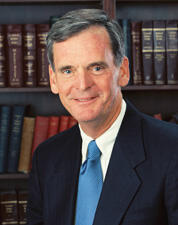
Here you will find contact information for Senator Judd A. Gregg, including email address, phone number, and mailing address.
| Name | Judd A. Gregg |
| Position | Senator |
| State | New Hampshire |
| Party | Republican |
| Status | Former Representative |
| Term Start | January 5, 1981 |
| Term End | January 3, 2011 |
| Terms Served | 7 |
| Born | February 14, 1947 |
| Gender | Male |
| Bioguide ID | G000445 |
About Senator Judd A. Gregg
Judd Alan Gregg (born February 14, 1947) is an American politician, attorney, and businessman who served as the 76th governor of New Hampshire from 1989 to 1993 and as a United States senator from New Hampshire from 1993 to 2011. A member of the Republican Party, he emerged from a family long active in New Hampshire civic life—his father, Hugh Gregg, served as governor of New Hampshire in the 1950s. Gregg was raised in Nashua, New Hampshire, where he developed an early interest in public affairs and the law that would shape his subsequent professional and political career.
Gregg attended public schools in Nashua before enrolling at Columbia University, where he received his Bachelor of Arts degree in 1969. He went on to earn a Juris Doctor from Boston University School of Law in 1972 and later obtained a Master of Laws (LL.M.) in tax law from the same institution. After completing his legal education, he returned to Nashua to practice law and engage in business. As a businessman and attorney in Nashua, he built a professional base that provided both the financial expertise and community connections that would underpin his entry into elective office.
Gregg’s first elective office was a seat on the Executive Council of New Hampshire, to which he was elected in 1978; he served on the Council from 1979 to 1981. In 1980, he successfully ran for the United States House of Representatives from New Hampshire, beginning his federal legislative career. He was reelected to the House in 1982, 1984, and 1986, serving four consecutive terms. During this period, he developed a reputation as a fiscally conservative Republican and participated in the legislative process during a significant period in American history, including the Reagan administration and the end of the Cold War. He declined to run for re-election to the House in 1988 and instead sought the governorship of New Hampshire.
In 1988, Gregg was elected governor of New Hampshire and took office in January 1989. New Hampshire is one of two states, along with Vermont, that continues to elect its governors to two-year terms, and Gregg was reelected in 1990. As governor, he emphasized fiscal discipline, and his administration balanced the state budget, leaving office in 1993 with a reported $21 million surplus. His tenure, however, was not without controversy; political opponents in the 1990s criticized him over what they characterized as a weak state economy during his governorship and raised issues related to his Vietnam War-era draft deferments. Nonetheless, his record as a budget-conscious executive helped position him for higher office.
In 1992, Gregg ran for the United States Senate and was elected, taking office on January 3, 1993. He served in the Senate until January 3, 2011, completing three full terms. (His overall congressional service, including his four terms in the House, spanned from 1981 to 2011.) As a senator, he represented New Hampshire during a period marked by the end of the Cold War, the post–September 11 era, and major debates over federal spending, health care, and financial regulation. Over the course of his Senate career, he held several key leadership roles, including serving as chairman of the Senate Committee on Health, Education, Labor, and Pensions (often referred to as the Health Committee) and as chairman of the Senate Budget Committee. In these capacities, he was a prominent voice on fiscal policy, budgetary restraint, and entitlement reform, and he played a central role in negotiations over federal spending and deficit reduction.
Gregg’s Senate service also intersected with the financial crisis of 2008. On November 14, 2008, Senate Minority Leader Mitch McConnell appointed him to the five-member Congressional Oversight Panel created to oversee implementation of the Emergency Economic Stabilization Act, which established the Troubled Asset Relief Program (TARP). On December 1, 2008, Gregg “stepped aside” from this oversight role, citing the impending Senate schedule and the demands of dealing with a potentially large economic stimulus package, ongoing fiscal policy work on the federal budget, the continuing economic downturn, and his responsibilities for foreign operations appropriations. In April 2009, he was sent to accompany an American diplomat in discussions with Spanish diplomat Luis Felipe Fernández de la Peña after a war crimes case was filed in Spain’s Audiencia Nacional by the Association for the Dignity of Spanish Prisoners. That case targeted six former U.S. government officials—Alberto Gonzales, David Addington, William Haynes, Douglas Feith, Jay Bybee, and John Yoo—over alleged violations of the Geneva Conventions, the 1984 Convention Against Torture, and the 1998 Rome Statute related to Iraq and Guantánamo Bay.
During the early months of the Obama administration, Gregg briefly became a focal point of bipartisan outreach. Senator Gregg reached out to President Barack Obama and offered his name for the position of Secretary of Commerce. He was nominated to the Cabinet post but withdrew his name on February 12, 2009. The Obama administration later stated that, although Gregg had indicated he would support and advance the President’s agenda despite past policy disagreements, it became clear after his nomination that he would not support some of the administration’s key economic priorities, making it necessary for both sides to part ways. Speaking to the press afterward, Gregg accepted responsibility for first accepting and then rejecting the nomination, explaining in an interview with the Associated Press that, after 30 years of being his own person in charge of his own views, he had not fully focused on the implications of working for someone else and carrying their views. In February 2009, the Associated Press also reported that Gregg and his family had profited personally from federal earmarks he had secured for the redevelopment of the former Pease Air Force Base into an industrial park, noting that Senate records showed he had collected between $240,017 and $651,801 from investments there while helping to arrange at least $66 million in federal aid for the project. Gregg stated that his withdrawal from consideration for the Commerce post was unrelated to the White House’s discovery during vetting of his family’s real estate investments in Pease.
Gregg chose not to run for reelection to the Senate in 2010, and he left office on January 3, 2011. Former New Hampshire Attorney General Kelly Ayotte, also a Republican, was elected to succeed him. After departing the Senate, he moved into the private sector and policy advisory roles. On May 27, 2011, Goldman Sachs announced that Gregg had been named an international advisor to the firm, drawing on his experience in fiscal policy and international economic issues. In May 2013, he was appointed chief executive officer of the Securities Industry and Financial Markets Association (SIFMA), a major Wall Street lobbying organization. He stepped down as CEO in December 2013 and continued with SIFMA as a senior adviser.
In addition to his work in finance and advocacy, Gregg has remained active in public policy and political affairs. He serves as the chair of the Public Advisory Board at the New Hampshire Institute of Politics at Saint Anselm College, a role that keeps him engaged in civic education and the state’s prominent presidential primary process. Reflecting New Hampshire’s tradition of intensive presidential politics, he has indicated that he expects to remain actively involved in the presidential primary and has remarked on the state’s preference for a variety of candidates. In the 2016 presidential election cycle, he endorsed former Florida Governor Jeb Bush, and after Bush suspended his campaign, Gregg endorsed Ohio Governor John Kasich. In the 2024 Republican Party presidential primary, he endorsed former South Carolina Governor and United Nations Ambassador Nikki Haley. Throughout his post-congressional years, he has continued to comment on national fiscal policy and party politics while maintaining a presence in both the political and financial sectors.