Representative Julia Butler Hansen
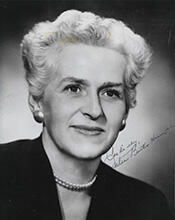
Here you will find contact information for Representative Julia Butler Hansen, including email address, phone number, and mailing address.
| Name | Julia Butler Hansen |
| Position | Representative |
| State | Washington |
| District | 3 |
| Party | Democratic |
| Status | Former Representative |
| Term Start | January 7, 1959 |
| Term End | January 3, 1975 |
| Terms Served | 8 |
| Born | June 14, 1907 |
| Gender | Female |
| Bioguide ID | H000174 |
About Representative Julia Butler Hansen
Julia Butler Hansen (June 14, 1907 – May 3, 1988) was an American politician who served as a member of the United States House of Representatives from Washington’s Third Congressional District and was a prominent figure in state and national politics for more than three decades. A Democrat, she served in Congress from November 8, 1960, to December 31, 1974, encompassing eight terms in office and a significant period in American history. She was the second woman, and the first Democratic woman, elected to Congress from the state of Washington, and she played an active role in the legislative process and in representing the interests of her constituents.
Hansen was born Julia Caroline Butler in Portland, Oregon, on June 14, 1907, and grew up in Cathlamet, Wahkiakum County, Washington. Her father, Donald C. Butler, served as sheriff of Wahkiakum County, and her mother, Maude Eliza (Kimball) Butler, was recognized as Washington’s “Mother of the Year” in 1960, reflecting the family’s prominence in local civic life. Hansen attended public schools in Washington before pursuing higher education in the Pacific Northwest. She studied at Oregon State College from 1924 to 1926, and later enrolled at the University of Washington in Seattle, where she earned a Bachelor of Arts degree in home economics in 1930.
Before entering elective office, Hansen combined literary, business, and civic pursuits. In 1935 she authored a children’s book, “Singing Paddles,” published by Binfords and Mort, which won the Julia Ellsworth Ford Foundation Award for Juvenile Literature. She became manager of the Wahkiakum County Abstract Company and the G. Henry Hanigan Insurance Company in Cathlamet, gaining experience in business and local affairs. On July 15, 1939, she married Henry A. Hansen, a logger; they had one natural son, David, and she was also stepmother to Henry’s adopted son, Richard. Her growing engagement in civic and cultural life laid the groundwork for her subsequent political career.
Hansen’s formal political career began at the local level. She served on the Cathlamet, Washington, city council from 1938 to 1946, marking her entry into public office. In January 1939 she was elected to the Washington State House of Representatives, where she served continuously until November 1960. During her long tenure in the state legislature she rose to positions of significant influence, becoming the first woman to serve as speaker pro tempore of the Washington House of Representatives, a post she held from 1955 to 1960. She also played a regional leadership role as chairman of the Western Interstate Committee on Highway Policies for 11 western states from 1951 to 1961, reflecting her early and sustained interest in transportation and infrastructure policy. Beginning in 1958, she served as chairman and member of the board of trustees of Century 21, State of Washington, associated with the planning for the Seattle World’s Fair.
Hansen was elected to the U.S. House of Representatives as a Democrat in a special election held on November 8, 1960, simultaneously winning election to fill the vacancy caused by the death of Representative Russell V. Mack in the Eighty-sixth Congress and to the full term in the Eighty-seventh Congress. She was subsequently re-elected to six succeeding Congresses, serving until December 31, 1974. Her congressional service coincided with major national developments, including the civil rights movement, the Great Society era, and the Vietnam War. Over the course of her House career she served on several key committees, including the Committees on Education and Labor, Veterans’ Affairs, and Interior and Insular Affairs, before attaining a seat on the powerful House Appropriations Committee. In these roles she contributed to federal policy on education, labor, veterans’ benefits, public lands, and federal spending priorities.
During her years in Congress, Hansen took notable positions on landmark civil rights legislation. She voted in favor of the Civil Rights Act of 1964, the Voting Rights Act of 1965, and the Civil Rights Act of 1968, aligning herself with the major federal efforts to end segregation and protect voting and housing rights. Within the Democratic caucus she also became involved in internal institutional reform. From 1970 to 1974 she chaired the House Democratic Caucus’s Committee on Organization, Study and Review, commonly known as the Reform Committee, which led to a series of changes in House rules and procedures aimed at modernizing and democratizing the chamber’s operations. Her tenure was not without controversy; then-Representative Edward I. Koch later recounted overhearing her make disparaging remarks about Jews during a 1973 House floor discussion over funding arms replenishment to Israel during the Yom Kippur War, an episode that has been cited in assessments of her congressional career.
Hansen chose not to run for re-election in 1974, concluding her service in Congress at the end of that year. In 1975 she was appointed to a six-year term on the Washington State Toll Bridge Authority and State Highway Commission, continuing her long-standing involvement in transportation policy. When the state reorganized its transportation agencies, she became a member of the Washington State Transportation Commission and served as its chair from 1979 to 1981. In these roles she helped oversee the development and management of Washington’s highways, bridges, and related infrastructure, extending her influence over regional transportation well beyond her years in elective office.
In her later years, Hansen remained closely associated with Cathlamet, where she had long made her home. She lived there until her death on May 3, 1988. Her legacy in Washington State is reflected in several public honors. The Julia Butler Hansen Refuge for the Columbian White-Tailed Deer, a National Wildlife Refuge established in 1972 near Cathlamet, bears her name and recognizes her support for conservation and local interests. The Julia Butler Hansen Bridge, connecting Cathlamet to Puget Island, Washington, also commemorates her contributions to transportation and regional development. In 1994, the Julia Butler Hansen Elementary School opened in the Olympia School District in Olympia, Washington, further memorializing her impact on public life. Her papers from 1930 to 1984 are preserved at the Labor Archives of Washington, University of Washington Libraries Special Collections, providing a substantial record of her role in state and national politics.