Senator Julius Caesar Burrows
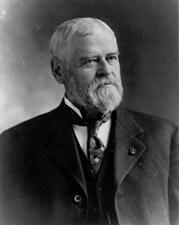
Here you will find contact information for Senator Julius Caesar Burrows, including email address, phone number, and mailing address.
| Name | Julius Caesar Burrows |
| Position | Senator |
| State | Michigan |
| Party | Republican |
| Status | Former Representative |
| Term Start | December 1, 1873 |
| Term End | March 3, 1911 |
| Terms Served | 11 |
| Born | January 9, 1837 |
| Gender | Male |
| Bioguide ID | B001142 |
About Senator Julius Caesar Burrows
Julius Caesar Burrows (January 9, 1837 – November 16, 1915) was an American politician and member of the Republican Party who served as both a U.S. Representative and a U.S. Senator from Michigan. Over the course of a long national career that extended from the early 1870s to 1911, he contributed to the legislative process during eleven terms in Congress and participated in major debates of the post–Civil War and Progressive eras.
Burrows was born in North East, Erie County, Pennsylvania, on January 9, 1837. During his childhood he moved with his parents to Ashtabula County, Ohio, where he attended the local district schools. He pursued further education at Kingsville Academy and the Grand River Institute in Austinburg, Ohio, institutions that prepared many young men for professional careers in the mid-nineteenth century. In 1853 and 1854 he taught at Madison Seminary in Ohio, supporting himself while continuing his studies. He subsequently read law and was admitted to the bar at Jefferson, Ohio, in 1859, marking the formal beginning of his legal career.
In 1860 Burrows moved to Richland, Michigan, reflecting the broader westward movement of many professionals in the antebellum period. He became principal of the Richland Seminary and, in 1861, commenced the practice of law in nearby Kalamazoo, Michigan. With the outbreak of the American Civil War, he took an active role in the Union cause. In 1862 he raised an infantry company that became part of the 17th Michigan Infantry Regiment, in which he served as captain until the fall of 1863. After leaving active military service, he resumed his legal and public career. He was elected circuit court commissioner in 1864 and served as prosecuting attorney for Kalamazoo County from 1866 to 1870. In 1868 he declined an appointment as supervisor of internal revenue for Michigan and Wisconsin, choosing instead to remain in state and local legal practice and Republican politics.
Burrows entered national office in the early 1870s. In 1872 he was elected as a Republican from Michigan’s 4th congressional district to the U.S. House of Representatives for the 43rd Congress, serving from March 4, 1873, to March 3, 1875. During this initial term he was chairman of the Committee on Expenditures in the Department of the Navy. Although he was an unsuccessful candidate for reelection in 1874, he returned to the House when he was elected to the 46th and 47th Congresses, serving from March 4, 1879, to March 3, 1883. In the 47th Congress he chaired the Committee on Territories, a position that placed him at the center of debates over the governance and prospective statehood of the western territories. Burrows was regarded as an admired orator, and in an 1876 debate he spoke forcefully in favor of a bill intended to protect the civil rights of freed Black slaves. In a widely noted episode, Stephen B. Elkins, the New Mexico Territory delegate to Congress, arrived late as Burrows was finishing, and, unaware of the full import of the speech, congratulated him with a handshake. Many southern congressmen interpreted Elkins’s gesture as support for the civil rights legislation, and Elkins’s handshake with Burrows has been cited as a factor in costing New Mexico several Southern Democratic votes needed for statehood. While Colorado achieved statehood in 1876, New Mexico remained a territory for another thirty-six years. Burrows was again an unsuccessful candidate for reelection in 1882.
Burrows reestablished his position in the House when he won election in 1884 to the 49th Congress and was subsequently reelected to the five succeeding Congresses. He represented Michigan’s 4th congressional district from March 4, 1885, until March 3, 1893, and then represented the 3rd congressional district from March 4, 1893, until his resignation on January 23, 1895, following his election to the U.S. Senate. During this extended House service he was chairman of the Committee on Levees and Improvements of the Mississippi River in the 51st Congress, participating in legislative oversight of one of the nation’s most important waterways. His long tenure in the House, spanning nonconsecutive periods between 1873 and 1895, made him a prominent figure in Republican congressional leadership and in the representation of Michigan’s interests in Washington.
Burrows’s service in the United States Senate marked the culmination of his national career. He was elected as a Republican to the Senate to fill the vacancy caused by the death of Senator Francis B. Stockbridge and took his seat on January 24, 1895. He was reelected in 1899 and 1905, serving continuously from January 24, 1895, to March 3, 1911. His Senate service occurred during a significant period in American history, encompassing the Spanish–American War, the Philippine–American War, and the early Progressive Era. As a member of the Senate, Julius Caesar Burrows participated in the democratic process and represented the interests of his Michigan constituents while also engaging in national questions of expansion, finance, and electoral integrity. He was chairman of the Committee on Revision of the Laws of the United States in the 54th through 56th Congresses, overseeing efforts to systematize and clarify federal statutes, and later chaired the Committee on Privileges and Elections in the 57th through 61st Congresses, a key body in adjudicating contested elections and questions of senatorial qualifications.
During his Senate years Burrows was involved in several notable national issues. He served on the so‑called Lodge Committee, which investigated war crimes and conduct in the Philippine–American War, and aligned himself with the imperialist faction led by Senator Henry Cabot Lodge in support of the war and the broader policy of American expansion overseas. He was also appointed to the National Monetary Commission, created in the wake of the Panic of 1907 to study banking and currency reform, and served as its vice chairman from 1908 to 1912. His work on the commission contributed to the body of analysis that eventually informed the creation of the Federal Reserve System. Within the Senate he was also known for his role in the Republican Party’s internal struggles, including his participation in efforts against Mormon influence in federal offices and in debates over the seating of senators from Utah, topics later examined in studies of his opposition to Mormonism between 1903 and 1907. In 1910 he was an unsuccessful candidate for renomination, bringing his long Senate career to a close at the end of his term in March 1911.
After leaving the Senate, Burrows retired from active business pursuits and political life. He remained in Kalamazoo, Michigan, where he had long maintained his home and legal practice. Julius Caesar Burrows died in Kalamazoo on November 16, 1915. He was interred in Mountain Home Cemetery in that city, closing a public career that had spanned the Civil War era through the early twentieth century and had included service as a Union Army officer, local prosecutor, long‑time U.S. Representative, and three‑term U.S. Senator from Michigan.