Representative Justin De Witt Bowersock
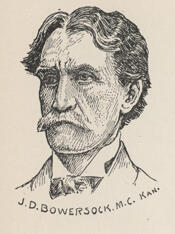
Here you will find contact information for Representative Justin De Witt Bowersock, including email address, phone number, and mailing address.
| Name | Justin De Witt Bowersock |
| Position | Representative |
| State | Kansas |
| District | 2 |
| Party | Republican |
| Status | Former Representative |
| Term Start | December 4, 1899 |
| Term End | March 3, 1907 |
| Terms Served | 4 |
| Born | September 19, 1842 |
| Gender | Male |
| Bioguide ID | B000693 |
About Representative Justin De Witt Bowersock
Justin De Witt Bowersock (September 19, 1842 – October 27, 1922) was a Republican businessman, civic leader, and United States Representative from Kansas who served four consecutive terms in Congress from 1899 to 1907. Over the course of his public career he represented the interests of his Kansas constituents during a significant period in American political and economic development at the turn of the twentieth century.
Bowersock was born on September 19, 1842, near Columbiana, Columbiana County, Ohio. Little is recorded about his early childhood, but he came of age in the antebellum Midwest, a region undergoing rapid agricultural and commercial expansion. In 1860, as a young man, he moved west to Iowa City, Iowa, where he began to build the business experience that would shape much of his later career in both industry and public life.
In Iowa City, Bowersock engaged in mercantile pursuits and grain shipping, occupations that placed him at the center of the agricultural trade of the region. Seeking further opportunity, he later moved to Lawrence, Kansas, where he continued in business as a grain merchant. By the mid-1870s he had become a prominent figure in the commercial life of Lawrence, and in 1877 he focused his attention on the industrial potential of the Kansas River. Recognizing the water power possibilities at Lawrence, he built a dam across the river and established several manufacturing plants powered by the energy thus developed, helping to transform the city into a regional industrial center.
Bowersock’s success as an entrepreneur led to leadership roles in a range of enterprises. He was made president of the Kansas Water Power Company, which managed the water power resources he had helped to develop. In 1878 he organized the Douglas County Bank, which later became the Lawrence National Bank, and in 1888 he was elected its president. Over time he served as president of multiple concerns, including the Bowersock Mills & Power Company, the Kansas Water Power Company, the Griffin Ice Company, the Lawrence Iron Works, the Lawrence Paper Manufacturing Company, and the Kansas & Colorado Railroad Company. Through these positions he played a central role in the economic growth and diversification of Lawrence and the surrounding region.
Building on his prominence in business and local affairs, Bowersock entered national politics as a member of the Republican Party. He was elected as a Republican to the Fifty-sixth Congress and to the three succeeding Congresses, serving in the U.S. House of Representatives from March 4, 1899, to March 3, 1907. During his four terms in office he contributed to the legislative process and participated in the democratic governance of the nation, representing the interests of his Kansas constituents during an era marked by industrial expansion, debates over regulation and trade, and the early stirrings of the Progressive movement. He chose not to be a candidate for renomination in 1906, thereby concluding his congressional service at the end of the Fifty-ninth Congress.
After leaving Congress, Bowersock returned to Lawrence, where he remained closely involved in the banking and manufacturing enterprises he had helped to establish. He continued to be interested in and active in these fields, maintaining his influence in the city’s commercial and industrial development well into the early twentieth century. He lived in Lawrence until his death there on October 27, 1922. Justin De Witt Bowersock was interred in Oak Hill Cemetery in Lawrence, Kansas, leaving a legacy as both a successful industrialist and a four-term representative in the United States Congress.