Representative Katherine Gudger Langley
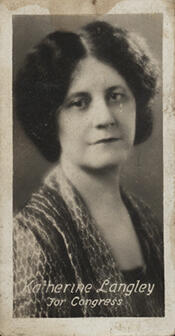
Here you will find contact information for Representative Katherine Gudger Langley, including email address, phone number, and mailing address.
| Name | Katherine Gudger Langley |
| Position | Representative |
| State | Kentucky |
| District | 10 |
| Party | Republican |
| Status | Former Representative |
| Term Start | December 5, 1927 |
| Term End | March 3, 1931 |
| Terms Served | 2 |
| Born | February 14, 1888 |
| Gender | Female |
| Bioguide ID | L000073 |
About Representative Katherine Gudger Langley
Katherine Emeline Langley (née Gudger; February 14, 1888 – August 15, 1948) was an American politician and a Republican member of the United States House of Representatives from Kentucky, serving from March 4, 1927, through March 3, 1931, in the Seventieth and Seventy-first Congresses. She was the first woman elected to Congress from Kentucky. Langley was the wife of Kentucky politician John W. Langley, a long-serving Representative from Kentucky’s 10th District, and the daughter of James M. Gudger Jr., a four-term Congressman from North Carolina.
Langley was born near Marshall in Madison County, North Carolina, on February 14, 1888, to James Madison Gudger and Katherine Hawkins. Her upbringing was shaped by her father’s active political career, which introduced her early to public life and the workings of Congress. She graduated in 1901 from the Woman’s College in Richmond, Virginia, and later attended Emerson College of Oratory, where she developed the public speaking skills that would become a hallmark of her political style.
Before her marriage, Langley taught at the Virginia Institute at Bristol, Tennessee, and worked as a secretary for her father, gaining administrative and political experience. In 1905 she married John W. Langley and moved to Pikeville, Kentucky, where the couple established their home and raised three children: Katherine Langley Bentley, John Jr., and Susanna. In 1907 the Langleys moved to Washington, D.C., following John Langley’s election to Congress. For the eighteen years he served as the Republican representative for Kentucky’s 10th District, she worked as his secretary, clerked for the House Committee on Public Buildings and Grounds, which he chaired, and became deeply familiar with congressional procedure and legislative affairs.
During World War I, Katherine Langley served as chairman of the Pike County Red Cross Society, reflecting her growing prominence in civic and community affairs. She quickly emerged as a leader within the Republican Party in Kentucky. From 1920 to 1922 she served as vice chairman of the Republican State Central Committee of Kentucky, becoming the first woman member of that committee. She founded the Kentucky Woman’s Republican State Committee and chaired it in 1920, and she participated in national party politics as an alternate delegate to the Republican National Convention in 1920 and as a delegate in 1924. These roles, combined with her long experience in Washington, positioned her as a significant figure in both state and national Republican circles.
Her path to elective office was shaped by the downfall of her husband. John W. Langley was convicted of violating the Volstead Act by selling alcohol illegally and attempting to bribe a federal officer. After his appeal was denied by the U.S. Supreme Court, he resigned from Congress in 1926 as Kentucky’s representative for the 10th District. In the wake of his conviction and resignation, Katherine Langley sought the Republican nomination for his former seat. Running on a platform that portrayed her husband’s prosecution as part of a government conspiracy, she soundly defeated his successor, Andrew J. Kirk, in the primary and went on to win the general election by a healthy majority. She was reelected for a second term, serving two full terms in the House from 1927 to 1931, during a significant period in American history marked by the late 1920s economic boom and the onset of the Great Depression.
As a member of the House of Representatives, Langley participated actively in the legislative process and represented the interests of her Kentucky constituents. She received committee assignments on Claims, Invalid Pensions, Immigration and Naturalization, and the Committee on Education. In Congress she supported women’s issues and was an advocate for the creation of a cabinet-level Department of Education, reflecting her interest in national educational policy. In 1930 she became the first woman to serve on the Republican Committee on Committees in the U.S. House of Representatives, a key party body that influenced committee assignments. Despite these achievements, her tenure was marked by social and political challenges in Washington. Because of her husband’s conviction and “disgraceful” resignation, she was marginalized in social circles that had once welcomed her, and contemporary observers sometimes mocked her flamboyant dress—one reporter referred to “her unstinted display of gypsy colors on the floor”—as well as her Kentucky-style oratory. During her service she missed 52 of 174 roll-call votes, approximately one-third of those taken during her tenure.
Langley’s political fortunes declined at the end of her second term. Once her husband announced that he would attempt to run for office again, much of the support among constituents that had initially propelled her into Congress began to erode. Although there is no record that the two ran directly against each other in the primaries, the political connection that had once benefited her became a liability. At the same time, the rise of the Democratic Party in Kentucky, fueled in part by President Herbert Hoover’s inability to reverse the agricultural depression or to alleviate the severe downturn in the coal industry, weakened Republican prospects statewide. In the 1930 election, Katherine Langley narrowly lost her bid for a third term to the Democratic candidate, Andrew Jackson May.
After leaving Congress, Langley remained active in public service in Kentucky. She served as a postmistress and later was elected district railroad commissioner twice, representing the Third Kentucky District from 1939 to 1942. She was also a member of the Daughters of the American Revolution, maintaining her involvement in civic and patriotic organizations. Katherine Gudger Langley died in Pikeville, Kentucky, on August 15, 1948, and was buried in Johnson Memorial Cemetery in Pikeville.