Representative Keith George Sebelius
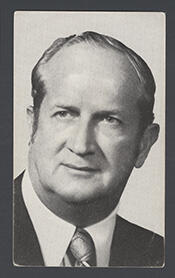
Here you will find contact information for Representative Keith George Sebelius, including email address, phone number, and mailing address.
| Name | Keith George Sebelius |
| Position | Representative |
| State | Kansas |
| District | 1 |
| Party | Republican |
| Status | Former Representative |
| Term Start | January 3, 1969 |
| Term End | January 3, 1981 |
| Terms Served | 6 |
| Born | September 10, 1916 |
| Gender | Male |
| Bioguide ID | S000217 |
About Representative Keith George Sebelius
Keith George Sebelius (September 10, 1916 – August 5, 1982) was an American politician and attorney who represented Kansas in the United States House of Representatives as a Republican from 1969 to 1981. Over six terms in Congress, he contributed to the legislative process during a significant period in American history, participating in debates on issues ranging from the Vietnam War and presidential impeachment proceedings to agricultural policy and constitutional amendments. His congressional service capped a long career in Kansas public life that began at the local level and extended through the state legislature.
Sebelius was born on September 10, 1916, in Norton, Kansas, to Carl and Minnie Sebelius. His father died when Keith was seven years old, and he grew up in nearby Almena, Kansas, where he attended local schools and graduated from Almena High School. He went on to attend Fort Hays State University, graduating in 1939, and then moved to Washington, D.C., to study law. He earned his law degree from George Washington University in 1942. After completing his legal education, Sebelius returned to Norton, Kansas, to practice law, establishing the professional base from which he would enter public service.
During World War II, Sebelius served in the United States Army. In the course of his military service, he worked with intelligence agencies engaged in efforts to detect German U-boats in the Caribbean, contributing to the broader Allied anti-submarine campaign. Following the end of the war, he resumed his law practice in Norton and quickly became active in local civic and political affairs. He served on the Almena city council and was later elected mayor of Almena, marking his first formal roles in elected office and introducing him to the organizational structures of Kansas Republican politics.
Sebelius’s early political career was closely tied to Republican Party and veterans’ organizations in Kansas. In 1947, he was elected secretary of the Kansas Young Republicans Club and later sought the presidency of the organization, though he was defeated by Paul Lackie. He became active in the American Legion, being selected on April 26, 1953, as Junior American Legion Commander for the 6th district in Kansas and advancing to senior commander in 1954. On September 5, 1955, he was elected Commander of the Kansas American Legion by a vote of 494 to 422, defeating John K. Wells. He also played a leading role in local business affairs, serving as president of the Norton Chamber of Commerce in 1957. These positions helped build his statewide profile and network within the Republican Party.
Sebelius twice sought election to the United States House of Representatives before ultimately winning a seat. On January 8, 1958, he announced his candidacy for the Republican nomination in Kansas’s 6th Congressional District, but he was narrowly defeated in the primary by incumbent Representative Wint Smith by 51 votes. He ran again in 1960 and was again narrowly defeated, this time by county attorney Bob Dole by 982 votes. Despite these setbacks, Sebelius remained active in state politics. On December 10, 1962, he was selected to replace state Senator William B. Ryan, who had stepped down to become a district judge, and was appointed to the Kansas Senate by Governor John Anderson Jr. In the Kansas Senate, he introduced a bill in 1963 that would have placed the entirety of Kansas in the Central Time Zone, though the measure failed. During the 1964 elections he served as a delegate to the Republican district convention, announced his bid for reelection to the state Senate on April 1, 1964, faced no opposition in the Republican primary, and defeated Democratic nominee Vance Templeton in the general election.
Sebelius’s opportunity to enter Congress came in 1968, when Bob Dole left the U.S. House of Representatives to run for the United States Senate. Sebelius ran for and won the open seat, succeeding Dole and entering the House in January 1969. He served six consecutive terms, remaining in office until 1981. In June 1969, he briefly served in place of House Minority Whip Leslie C. Arends during Arends’s absence, assisting House Minority Leader Gerald Ford for one week in managing Republican floor activities. His tenure in Congress coincided with the Vietnam War, the Watergate scandal, and major shifts in domestic and foreign policy. In May 1973, the National Federation of Independent Business named him Man of the Year for Kansas, recognizing his work on behalf of small business interests.
During his years in the House of Representatives, Sebelius took positions on a range of prominent national issues. In 1971, he introduced a proposed constitutional amendment to legalize voluntary prayer in public buildings, though no action was taken on the measure. He supported efforts to expand the franchise to younger voters, backing an April 1971 Kansas voter referendum to lower the voting age and later voting in favor of the Twenty-sixth Amendment to the United States Constitution, which reduced the voting age nationwide to eighteen. He was critical of aspects of the Nixon administration’s agricultural and trade policies, opposing the decision to sell 10 million tons of United States grain to the Soviet Union at subsidized prices and later calling for the resignation of Secretary of Agriculture Earl Butz. On foreign policy and military issues, he showed a mixed record: in October 1969 he asked that his name be removed from a letter drafted by Representative Sam Steiger to President Richard Nixon that urged the administration to signal to North Vietnam that no military option was ruled out, objecting to language he believed promoted escalation of the war. On July 18, 1973, he voted against the War Powers Resolution, and after President Nixon vetoed the bill he again voted against overriding the veto on November 7, though the House and Senate ultimately overrode it. On July 31, 1973, he supported a bill to reduce the United States’ overseas military presence by 100,000 troops and cap total troop levels abroad at 400,000, but that measure was defeated by a vote of 243 to 163. When the House later considered establishing a federal holiday in honor of Martin Luther King Jr., Sebelius was among forty-eight representatives who abstained from the vote.
Sebelius was also deeply involved in the congressional response to the Watergate scandal. On November 15, 1973, after listening to President Richard Nixon speak for more than an hour about Watergate, he stated, “I frankly believe the man is telling the truth.” On December 4, 1973, he voted in favor of confirming House Minority Leader Gerald Ford as vice president following the resignation of Vice President Spiro Agnew. However, after the release of transcripts of the Nixon White House tapes, Sebelius remarked that they “are depressing to read and give an unfavorable view of the President.” When asked about the possibility that Nixon might refuse to comply with the Supreme Court’s ruling in United States v. Nixon, he stated that such defiance “would be damn close to an impeachable offense.” He voted in favor of a resolution allowing live radio and television coverage of the House Judiciary Committee’s impeachment inquiry. After Nixon’s resignation in August 1974 and Ford’s accession to the presidency, Sebelius voted to confirm Nelson Rockefeller as vice president. During the 1976 presidential election, when Senator Bob Dole was selected as President Gerald Ford’s vice-presidential running mate, there was speculation that Sebelius might be appointed to Dole’s Senate seat in the event of a Ford–Dole victory and Dole’s resignation from the Senate. However, Democrat Jimmy Carter won the presidency, and Dole remained in the Senate, so no such appointment occurred.
On April 25, 1980, Sebelius announced that he would not seek reelection to the House of Representatives, bringing his twelve-year congressional career to a close at the end of the 96th Congress in January 1981. He was succeeded by his longtime administrative aide, Pat Roberts, who would later become a U.S. senator from Kansas. On January 11, 1981, a banquet was held in his honor, at which he received telegrams from former President Gerald Ford and President-elect Ronald Reagan recognizing his service. In conjunction with these honors, the Norton reservoir was renamed Keith Sebelius Lake in his honor, and on January 16, 1981, he was named a Distinguished Kansan of the Year, reflecting his prominence in state public life.
Sebelius married Elizabeth Adeline Roberts, and the couple had two children, R. Douglas Sebelius and K. Gary Sebelius. In 1974, his son K. Gary Sebelius married Kathleen Gilligan, the daughter of former Ohio Governor John J. Gilligan. Kathleen Sebelius would later serve as governor of Kansas from 2003 to 2009 and as United States Secretary of Health and Human Services in the administration of President Barack Obama, extending the Sebelius family’s influence in state and national politics. In 1979, Keith Sebelius was diagnosed with prostate cancer. He continued to be honored in Kansas during his final years, but his health declined, and on August 5, 1982, he died at Norton County Hospital in Norton, Kansas, from complications of prostate cancer. He was buried in Norton, Kansas, leaving a legacy of service that spanned local government, the Kansas Senate, and six terms in the United States House of Representatives.