Representative Kelly Armstrong
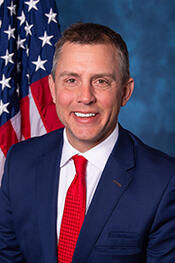
Here you will find contact information for Representative Kelly Armstrong, including email address, phone number, and mailing address.
| Name | Kelly Armstrong |
| Position | Representative |
| State | North Dakota |
| District | At-Large |
| Party | Republican |
| Status | Former Representative |
| Term Start | January 3, 2019 |
| Term End | December 14, 2024 |
| Terms Served | 3 |
| Born | October 8, 1976 |
| Gender | Male |
| Bioguide ID | A000377 |
About Representative Kelly Armstrong
Kelly Michael Armstrong (born October 8, 1976) is an American lawyer and Republican politician who has served since December 15, 2024, as the 34th governor of North Dakota. He previously represented North Dakota’s at-large congressional district in the United States House of Representatives for three terms from January 3, 2019, to December 14, 2024, and earlier served in the North Dakota State Senate. Over the course of his career, he has also held significant party leadership roles, including chair of the North Dakota Republican Party.
Armstrong was born on October 8, 1976, and was raised in North Dakota. He graduated from Dickinson High School in Dickinson, North Dakota, in 1995. He went on to attend the University of North Dakota, where he earned a Bachelor of Arts degree in psychology in 2001. Armstrong then pursued legal studies, beginning his law education at the College of William & Mary before transferring to the University of North Dakota School of Law, where he received his Juris Doctor in 2003. During his undergraduate years, he became a member of the Sigma Chi fraternity, an affiliation that reflected his early engagement in campus and community life.
Following law school, Armstrong entered private practice and built a career as an attorney and businessman in North Dakota. He became a partner at the law firm Reichert Armstrong, which maintained offices in Grand Forks and Dickinson, and he served as vice president of Armstrong Corp., a family business enterprise. These roles in law and business provided him with experience in commercial affairs, regulatory issues, and the practical concerns of North Dakota’s communities, experience that would later inform his legislative and executive work.
Armstrong’s formal political career began in the North Dakota Legislature. He was elected to the North Dakota State Senate from the 36th district and served from 2013 to 2018, representing a largely rural, energy-producing region of the state. During this period, he became increasingly active in party leadership and was elected chair of the North Dakota Republican Party, a position he held from 2015 to 2018. In that capacity, he played a central role in party organization, candidate recruitment, and statewide campaign efforts during a period of continued Republican dominance in North Dakota politics. (Some sources note his state Senate service beginning in 2012, but his tenure is generally recorded as 2013–2018.) He resigned his legislative seat on November 7, 2018, after winning election to Congress.
In February 2018, Armstrong announced his candidacy for the United States House of Representatives from North Dakota’s at-large congressional district, seeking to succeed Representative Kevin Cramer, who was running for the United States Senate. He secured the endorsement of the North Dakota Republican Party at its state convention in April 2018 and went on to win the general election on November 6, 2018, with 60.2 percent of the vote. Armstrong took office in the 116th Congress on January 3, 2019. He was reelected to the House with 68.96 percent of the vote in one subsequent election and with 62.2 percent of the vote in another, serving three terms in total from 2019 to 2024. His tenure in Congress coincided with a period of significant national political polarization and major events in American public life, and he participated in the legislative process while representing the interests of his North Dakota constituents.
During his service in the House of Representatives, Armstrong held assignments on several key committees. He served on the Committee on Energy and Commerce, where he was vice chair, and sat on the Subcommittee on Energy, Climate, and Grid Security; the Subcommittee on Innovation, Data, and Commerce; and the Subcommittee on Oversight and Investigations. He also served on the Committee on the Judiciary, including the Subcommittee on the Constitution, Civil Rights, and Civil Liberties; the Subcommittee on Immigration and Citizenship; and the Subcommittee on Antitrust, Commercial, and Administrative Law. In addition, he was a member of the Judiciary Select Subcommittee on the Weaponization of the Federal Government. Armstrong participated in numerous caucuses, reflecting a range of policy interests, including the Republican Governance Group, the Friends of Norway Caucus (as co-chair), the Fire Services Caucus, the Bipartisan Mental Health & Substance Use Disorder Task Force, the Air Force Caucus, the Coal Caucus, the Rural Broadband Caucus, the Northern Border Caucus, the Northern Border Security Caucus, the National Guard and Reserve Caucus, the Caucus on Youth Sports, the Sportsmen’s Caucus, and the Republican Study Committee.
Armstrong’s voting record and public positions in Congress placed him generally within the Republican mainstream while at times distinguishing him on specific issues. On January 6, 2021, he was one of a coalition of seven House Republicans who declined to support efforts by some colleagues to challenge the results of the 2020 presidential election. The group signed a letter that, while giving credence to certain election fraud allegations advanced by President Donald Trump, concluded that Congress did not have the constitutional authority to alter the outcome of the election. On July 19, 2022, Armstrong was among 47 Republican representatives who voted in favor of the Respect for Marriage Act, which sought to codify federal recognition of same-sex marriage; this vote prompted a nearly successful effort to censure him at a state party meeting, which failed by a 26–28 margin. In September 2022, he was one of 39 Republicans to support the Merger Filing Fee Modernization Act of 2022, an antitrust measure aimed at strengthening enforcement against anti-competitive corporate behavior. On June 14, 2023, Armstrong voted to shelve an initial censure resolution against Representative Adam Schiff, objecting to a proposed $16 million fine as excessive; after former President Trump called for primary challenges against Republicans who opposed the measure, Armstrong later supported a revised censure resolution once the fine was removed.
Armstrong’s later congressional tenure included notable votes and assignments related to foreign policy and ethics. He voted to provide support to Israel following the 2023 Hamas attack, but in November 2023 he opposed a resolution to censure Representative Rashida Tlaib over accusations of antisemitism arising from her criticism of Israel. Later that month, he was selected to fill a vacancy on the House Judiciary Committee created when Representative Mike Johnson was elected Speaker of the House. In December 2023, Armstrong joined 105 House Republicans in voting to expel Representative George Santos after a House Ethics Committee report concluded that Santos had violated federal law. Throughout his time in the House, Armstrong articulated conservative positions on social issues; during a 2022 debate against Democratic challenger Cara Mund, he stated that he supported the Supreme Court’s decision in Dobbs v. Jackson Women’s Health Organization, which overturned Roe v. Wade, and said that he favored a ban on abortion but did not support enacting a federal abortion ban, preferring that the issue be left to the states.
On January 23, 2024, Armstrong announced that he would not seek reelection to the House of Representatives and would instead run for governor of North Dakota in the 2024 election, following Governor Doug Burgum’s decision not to pursue a third term. He framed his gubernatorial campaign around themes of lowering taxes, reducing regulations, and strengthening the state’s workforce. In the Republican primary, Armstrong faced Lieutenant Governor Tammy Miller in a competitive and often contentious contest for the party’s endorsement and nomination. Armstrong was the first to release attack advertisements, and he later faced criticism for an ad that labeled Miller “Tall-Tale Tammy” and relied on artificial intelligence–generated material. He received endorsements from North Dakota Secretary of State Michael Howe and U.S. Senator John Hoeven, while Governor Burgum endorsed Miller, remarking that North Dakota did not need a lawyer in the governor’s office. Armstrong ultimately won the Republican primary and selected State Representative Michelle Strinden as his running mate for lieutenant governor. In the general election, he defeated Democratic–NPL nominee Merrill Piepkorn and independent candidate Michael Coachman, receiving 68.3 percent of the vote to Piepkorn’s 26 percent and Coachman’s 5.6 percent.
Armstrong’s transition from Congress to the governorship required him to relinquish his House seat shortly before taking office in Bismarck. On December 14, 2024, he submitted his resignation from the House of Representatives, effective at midnight that day, in order to assume the governorship the following morning. In his resignation letter, he wrote, “It’s been an honor. Time to go home.” In accordance with the North Dakota Constitution, Armstrong and Michelle Strinden were sworn in as governor and lieutenant governor on December 15, 2024. One of his first official acts as governor was to fill a vacancy on the North Dakota Public Service Commission created when his congressional successor, Julie Fedorchak, left the commission to take the at-large House seat. Armstrong appointed commission staffer Jill Kringstad to the position, signaling continuity in regulatory oversight of the state’s energy and utility sectors.
As governor, Armstrong advanced an ambitious agenda focused heavily on tax policy, fiscal management, and state services. Before the beginning of the 2025 legislative session, he proposed a plan aimed at eliminating or substantially reducing property taxes in North Dakota, building on debates that had surfaced publicly in connection with the failed Measure 4 ballot initiative in 2024. His proposal called for using earnings from the state’s Legacy Fund to offset primary-residence property taxes, expanding tax credits for seniors and individuals with disabilities, and imposing a 3 percent cap on annual increases in any property tax. Armstrong personally testified before the House Finance and Taxation Committee in support of the plan, which was introduced in the legislature by Representative Mike Nathe. On February 18, 2025, he signed into law the portion of the plan addressing primary residences, sponsored in the Senate by Senator Mark Weber, and on May 3, 2025, he signed the remaining elements of his property tax package into law.
Armstrong’s early tenure as governor also involved a series of high-profile decisions and controversies. On his inauguration day, he ordered flags in North Dakota to be flown at full staff despite a proclamation by President Joe Biden directing that flags be lowered to half staff nationwide in observance of former President Jimmy Carter’s death. Armstrong stated that flags in the state would return to half staff following the inauguration ceremonies, a decision that drew both criticism and support. On April 7, 2025, he and South Dakota Governor Larry Rhoden met with leaders of the Standing Rock Sioux Reservation to discuss concerns about federal funding and economic development. At the meeting, Armstrong emphasized the importance of communication with tribal authorities, saying, “When disruption happens, we need to know.” Later that month, he vetoed a controversial bill that would have required public libraries to ban materials deemed explicit. Explaining his veto, he remarked, “I don’t pretend to know what the next literary masterpiece is going to be, but I know that I want it available in a library.” The veto prompted a backlash within his own party, and on June 14, 2025, the North Dakota Republican Party formally censured him over the decision.
In mid-2025, Armstrong’s administration was tested by severe weather and a federal budget impasse. On June 21, 2025, after numerous tornadoes struck North Dakota, he declared a state of emergency and initiated recovery efforts, highlighting in particular the extensive damage in the city of Enderlin, where three people were killed. He subsequently requested a presidential disaster declaration to secure federal assistance for the affected areas. In August 2025, following additional storms that damaged infrastructure across the state, Armstrong submitted another disaster declaration request, which was approved in October. During the 2025 United States federal government shutdown, he unveiled a plan to provide low-interest loans to federal employees in North Dakota in lieu of their regular paychecks, a measure that was approved by the State Industrial Commission. He also advanced a proposal to direct approximately $1.5 million toward food assistance programs when the shutdown threatened Supplemental Nutrition Assistance Program (SNAP) benefits. These actions drew praise for addressing the immediate needs of residents affected by the shutdown. During the same period, Armstrong appointed Levi Bachmeier as Superintendent of Public Instruction after the incumbent, Kirsten Baesler, was confirmed by the United States Senate to a federal position, thereby reshaping leadership in the state’s education system.