Representative Kenneth Allison Roberts
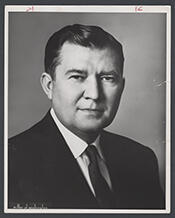
Here you will find contact information for Representative Kenneth Allison Roberts, including email address, phone number, and mailing address.
| Name | Kenneth Allison Roberts |
| Position | Representative |
| State | Alabama |
| District | At-Large |
| Party | Democratic |
| Status | Former Representative |
| Term Start | January 3, 1951 |
| Term End | January 3, 1965 |
| Terms Served | 7 |
| Born | November 1, 1912 |
| Gender | Male |
| Bioguide ID | R000314 |
About Representative Kenneth Allison Roberts
Kenneth Allison Roberts (November 1, 1912 – May 9, 1989) was an American lawyer, World War II veteran, and Democratic politician who served seven terms as a U.S. Representative from Alabama from 1951 to 1965. His service in Congress occurred during a significant period in American history, and as a member of the House of Representatives he participated in the legislative process and represented the interests of his Alabama constituents during the early Cold War, the civil rights era, and the expansion of federal regulatory and safety programs.
Roberts was born in Piedmont, Calhoun County, Alabama, on November 1, 1912. He attended the public schools of Piedmont and went on to study at Howard College in Birmingham, Alabama (later renamed Samford University). He subsequently enrolled at the University of Alabama School of Law, from which he was graduated in 1935. The following year, in 1936, he was admitted to the Alabama bar, beginning a legal career that would underpin his later work in public office.
After his admission to the bar, Roberts practiced law in Anniston, Alabama, in 1936, and then in Talladega, Alabama, from 1937 to 1942. His early professional years coincided with the end of the Great Depression and the onset of World War II, a context that shaped both his legal practice and his entry into public life. In 1942 he was elected to the Alabama State Senate, marking his first successful bid for elective office. That same year, however, he resigned his state senate seat to enter military service during World War II.
Roberts joined the United States Navy in 1942 and served as a naval officer in both the Atlantic and Pacific Theaters during World War II. He remained on active duty until 1945, when he was discharged with the rank of lieutenant. Returning to civilian life after the war, he became president of the Piedmont Development Company, serving in that capacity from 1945 to 1950, reflecting his ongoing ties to his hometown and his interest in local economic development. From 1948 to 1950 he also served as a member of the Alabama State Board of Veterans Affairs and as city attorney of Piedmont, Alabama, positions that drew on both his legal training and his experience as a veteran.
Roberts was elected as a Democrat to the Eighty-second Congress and to the six succeeding Congresses, serving from January 3, 1951, to January 3, 1965, as a U.S. Representative from Alabama. Over the course of his seven terms in office, he contributed to the legislative process on a wide range of issues and participated actively in the democratic governance of the nation. On March 1, 1954, he was wounded in the 1954 United States Capitol shooting, in which Puerto Rican nationalists opened fire from the visitors’ gallery of the House chamber, making him one of the members of Congress injured in that attack. During the mid-1950s he joined many of his Southern colleagues in opposing federal desegregation efforts: he was a signatory to the 1956 Southern Manifesto, which condemned the Supreme Court’s decision in Brown v. Board of Education and opposed the desegregation of public schools, and he voted against H.R. 6127, the Civil Rights Act of 1957.
Within the House of Representatives, Roberts became particularly identified with highway, traffic, and public safety issues. In 1956 he led the establishment of federal safety legislation through the House subcommittee on traffic safety, over which he exercised substantial influence. Through this work he helped shape emerging federal standards for vehicle and highway safety at a time of rapidly expanding automobile use in the United States. In 1963 he introduced the U.S. Clean Air Act, an important early federal legislative effort to address air pollution and regulate emissions, which contributed to the development of the modern framework of environmental and public health protections. Despite his long tenure, he was an unsuccessful candidate for reelection in 1964 to the Eighty-ninth Congress and left office at the conclusion of his term on January 3, 1965.
After leaving Congress, Roberts resumed the practice of law, continuing his legal career until his retirement in 1979. He remained closely involved in transportation and highway safety policy. From 1965 to 1972 he served as counsel for the Vehicle Equipment Safety Commission, a multi-state and federal body concerned with the development and coordination of vehicle safety standards. He also served as a member of the National Highway Safety Advisory Committee from 1966 to 1970, advising on federal highway safety programs during a period when traffic fatalities and automobile safety were major national concerns.
In his later years, Roberts resided in Anniston, Alabama, maintaining his longstanding connection to the region he had represented and served throughout his career. He died of congestive heart failure in Potomac, Maryland, on May 9, 1989. In recognition of his military service and public career, he was interred at Arlington National Cemetery.