Senator Kenneth Spicer Wherry
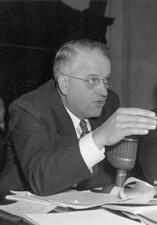
Here you will find contact information for Senator Kenneth Spicer Wherry, including email address, phone number, and mailing address.
| Name | Kenneth Spicer Wherry |
| Position | Senator |
| State | Nebraska |
| Party | Republican |
| Status | Former Representative |
| Term Start | January 6, 1943 |
| Term End | December 31, 1951 |
| Terms Served | 2 |
| Born | February 28, 1892 |
| Gender | Male |
| Bioguide ID | W000344 |
About Senator Kenneth Spicer Wherry
Kenneth Spicer Wherry (February 28, 1892 – November 29, 1951) was an American businessman, attorney, and Republican politician who represented Nebraska in the United States Senate from 1943 until his death in 1951. Over the course of two terms in office, he rose to the top ranks of Senate Republican leadership, serving as Republican whip from 1944 to 1949 and as Senate minority leader from 1949 to 1951. His congressional service spanned World War II and the early Cold War, a significant period in American history, during which he participated actively in the legislative process and represented the interests of his Nebraska constituents.
Wherry was born in Liberty, Nebraska, the third of five children of David Emery Wherry and Jessie (Comstock) Wherry. He grew up in Pawnee County and received his early education in the public schools of Pawnee City. He attended the University of Nebraska, where he was a member of the Beta Theta Pi fraternity, and graduated in 1914. Seeking further training in commerce, he studied business administration at Harvard Business School from 1915 to 1916. During World War I, Wherry served in the U.S. Navy Flying Corps from 1917 to 1918, an experience that introduced him to national service and the broader issues of American military and foreign policy.
After his military service, Wherry embarked on a varied business career in Nebraska and Kansas. He sold automobiles, furniture, and livestock, and he also became a licensed undertaker, maintaining funeral service offices in both states. At the same time, he pursued legal studies and, after admission to the bar, entered private law practice in Pawnee City. His combined experience as a businessman, attorney, and undertaker gave him a broad familiarity with the economic and social concerns of small-town and rural Nebraskans, which later informed his political positions and legislative priorities.
Wherry’s formal political career began at the local and state levels. He served on the Pawnee City council in 1927 and 1929, and was elected mayor of Pawnee City from 1929 to 1931. During this same period, he served in the Nebraska state senate from 1929 to 1932, giving him early experience in legislative work. He sought higher office during the Great Depression, running unsuccessfully for the Republican nomination for governor of Nebraska in 1932 and for the U.S. Senate in 1934. Returning to local leadership, he was again elected mayor of Pawnee City in 1938 and served in that capacity until he left for Washington after winning a Senate seat. At the state and national party level, he became an influential Republican organizer, serving as chairman of the Nebraska Republican Party from 1939 to 1942 and as Western Director for the Republican National Committee from 1941 to 1942.
In 1942, Wherry was elected to the United States Senate from Nebraska, defeating incumbent Senator George W. Norris. He took office in January 1943 and was reelected in 1948, serving continuously until his death in 1951. Within the Senate Republican Conference, he advanced quickly, becoming Republican whip in 1944, a post he held until 1949, and then serving as Senate minority leader from 1949 to 1951. As a member of the Senate during World War II and the immediate postwar years, Wherry participated in debates over wartime policy, postwar reconstruction, and the emerging Cold War. In 1945, he was among seven senators who opposed full U.S. entry into the United Nations, reflecting his skepticism toward international organizations and multilateral commitments. He was also one of the few postwar politicians to publicly highlight the plight of defeated Germans under Allied occupation, declaring that “the American people should know once and for all that as a result of this government’s official policy they are being made… accomplices in the crime of mass starvation… Germany is the only nation subjected to a deliberate starvation policy.”
Wherry’s Senate career was marked by a strongly isolationist outlook that aligned with many of his large German-American constituents in Nebraska. He consistently opposed extensive international engagement by the federal government, including U.S. entry into World War II before Pearl Harbor, and later opposed key elements of the Cold War framework, such as the Truman Doctrine and the North Atlantic Treaty Organization (NATO). He argued against loans and aid to Europe, contending that it made little sense to oppose communism by supporting what he regarded as socialist-leaning governments in Western Europe, and warning that American goods might ultimately reach the Soviet Union and increase its war potential. In early 1948 he emerged as the principal Senate leader of the conservative isolationist bloc that tried unsuccessfully to block the Marshall Plan, deriding it as an “operation rat-hole.” He was outmaneuvered by the internationalist wing of the Republican Party, led by Senator Arthur H. Vandenberg, and the plan passed with only 17 senators voting against it on March 13, 1948. Throughout the Truman administration, Wherry could generally be counted on as a strong and vocal opponent of President Harry S. Truman’s foreign and domestic policies.
Alongside his foreign policy positions, Wherry engaged in a range of domestic legislative issues. He supported, with Senator Homer Capehart of Indiana, legislation to build military family housing in the post–World War II era, responding to acute shortages of such housing as the armed forces demobilized and reorganized. In 1950, when Senator Robert A. Taft’s Fair Employment Practice Committee bill was subjected to a filibuster in the Senate, Wherry joined most Republicans in voting for cloture, although the motion failed and cloture was not invoked. His legislative record also reflected the era’s intense concerns about internal security and loyalty. He was strongly opposed to homosexuals serving in the U.S. government, linking homosexuality with subversion in the context of the early Cold War. In 1950 he asked his Senate colleagues whether they could “think of a person who could be more dangerous to the United States of America than a pervert?” and told journalist Max Lerner, “You can’t hardly separate homosexuals from subversives” and “let’s get these fellows out of the government.” He publicized a fear that Adolf Hitler had given Joseph Stalin a list of closeted homosexuals in government, which he believed could be used for blackmail and espionage. In the spring of 1950, he joined Senator Lister Hill of Alabama in a congressional investigation of homosexuals in government, particularly in the Department of State, asserting that “only the most naive could believe that the Communists’ fifth column in the United States would neglect to propagate and use homosexuals to gain their treacherous ends.”
Wherry’s tenure also brought him into direct contact with the aftermath of Nazi atrocities in Europe. On April 11, 1945, U.S. forces liberated the Buchenwald concentration camp, established in 1937 and the site of at least 56,545 deaths. General Dwight D. Eisenhower ordered that the rotting corpses remain unburied so visiting American legislators and journalists could fully grasp the horror of the camp. Wherry was among the group that visited Buchenwald to inspect the camp and learn firsthand about the enormity of the Nazi Final Solution and the treatment of prisoners. The delegation included Senators Alben W. Barkley, Ed Izac, John M. Vorys, Dewey Short, and C. Wayland Brooks, along with General Omar N. Bradley and journalists Joseph Pulitzer, Norman Chandler, William I. Nichols, and Julius Ochs Adler.
Kenneth Spicer Wherry died in office in Washington, D.C., on November 29, 1951, at the age of 59, while serving as Republican floor leader in the Senate. He had undergone abdominal surgery a few weeks earlier and, after feeling ill, was admitted to George Washington University Hospital, where he died of pneumonia several hours later. His death contributed to an unusual sequence of appointments and elections to Nebraska’s Class 2 Senate seat: during the fifteenth Senate term for that seat, from January 3, 1949, to January 3, 1955, six different senators ultimately occupied the position. Wherry’s papers are preserved at the Nebraska State Historical Society, and he is interred in Nebraska, where his career as a businessman, local official, state legislator, party leader, and U.S. senator left a lasting imprint on the state’s political history.