Senator Kent Conrad
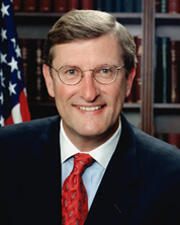
Here you will find contact information for Senator Kent Conrad, including email address, phone number, and mailing address.
| Name | Kent Conrad |
| Position | Senator |
| State | North Dakota |
| Party | Democratic |
| Status | Former Representative |
| Term Start | January 6, 1987 |
| Term End | January 3, 2013 |
| Terms Served | 5 |
| Born | March 12, 1948 |
| Gender | Male |
| Bioguide ID | C000705 |
About Senator Kent Conrad
Gaylord Kent Conrad (born March 12, 1948) is a former American politician who represented North Dakota in the United States Senate from 1987 to 2013. A member of the Democratic Party, he was first elected to the Senate in 1986 and went on to serve five terms in office, a period that spanned significant developments in American domestic and foreign policy. Over the course of his Senate career, Conrad became particularly known for his expertise in budgetary and fiscal matters, serving as chairman or ranking member of the Senate Budget Committee for a total of 12 years and earning a reputation as a leading “deficit hawk.”
Conrad was born in Bismarck, North Dakota, the son of Abigail and Gaylord E. Conrad. Orphaned at a young age, he was raised by his grandparents in Bismarck and attended Roosevelt Elementary School and Hughes Junior High School. During part of his youth he lived abroad, attending Wheelus Air Base High School in Tripoli, Libya. He later returned to the United States and graduated from Phillips Exeter Academy in New Hampshire. Conrad went on to study at Stanford University and subsequently earned a Master of Business Administration degree from The George Washington University in Washington, D.C., training that would later underpin his focus on economic and budgetary issues in public office.
After completing his education, Conrad began his career in public service as a civil servant in North Dakota. He worked as an assistant to North Dakota State Tax Commissioner Byron Dorgan, who would later serve alongside him in the U.S. Senate. Conrad made his first bid for elective office in 1976, when he ran unsuccessfully for the office of North Dakota State Auditor. In 1980 he was elected North Dakota Tax Commissioner, succeeding Dorgan. As state tax commissioner, a position he held until 1986, Conrad developed a detailed understanding of tax policy and public finance that helped establish his credentials as a fiscal expert and laid the groundwork for his subsequent federal legislative career.
Conrad entered the United States Senate in the 1986 election, when he defeated Republican incumbent Mark Andrews by 2,120 votes. Andrews had represented North Dakota at the federal level since 1963, first in the House of Representatives and then in the Senate beginning in 1981. During the campaign, Conrad pledged that he would not run for reelection if the federal budget deficit had not fallen substantially by the end of his term. By 1992 it was clear that the deficit had not been significantly reduced. Although public opinion polls indicated that voters would have accepted his reconsideration of that pledge, Conrad regarded his promise as binding and chose not to run for reelection to his original seat. Byron Dorgan won the Democratic primary to succeed him. Later that year, however, Conrad received an opportunity to remain in the Senate when North Dakota’s other senator, Quentin Burdick, died on September 8, 1992. Burdick’s widow, Jocelyn Birch Burdick, was appointed to the seat temporarily, pending a special election. Viewing a run for this separate seat as consistent with his earlier pledge, Conrad sought and won the Democratic–NPL nomination and then the special election. He was sworn into the new seat on December 14, 1992, resigning his original Senate seat the same day; the following day, December 15, 1992, Dorgan was appointed by the governor to fill Conrad’s original seat until he would have been sworn in under normal circumstances. Despite North Dakota’s Republican leanings, Conrad was comfortably reelected in 1994, a year in which Republicans made sweeping gains in Congress, and he continued to win reelection in subsequent cycles, ultimately serving in the Senate until January 3, 2013.
During his congressional service, Conrad played a central role in federal fiscal policy. As chairman of the Senate Budget Committee, he was known for his deep understanding of monetary and budget issues and for his extensive use of charts and visual aids on the Senate floor, a practice that earned him the nickname “Godfather of Charts.” He identified as a “deficit hawk,” consistently advocating for a balanced federal budget while also supporting farm subsidies important to North Dakota’s agricultural economy. Conrad opposed Republican efforts to repeal the estate tax and the alternative minimum tax, supported lower taxes for the middle class, and favored higher taxes for individuals earning more than $1 million per year. In 2010 he supported extending the expiring Bush-era tax cuts at least until the economy had clearly recovered from the Great Recession. He was a strong supporter of the Simpson–Bowles deficit reduction framework and, on April 17, 2012, announced his intention to offer a version of that plan—developed during his service on the National Commission on Fiscal Responsibility and Reform—for consideration by the Senate Budget Committee.
Conrad’s committee assignments reflected both his fiscal focus and his state’s economic base. In addition to chairing the Committee on the Budget, he served on the Committee on Finance, where he chaired the Subcommittee on Taxation, IRS Oversight, and Long-Term Growth and sat on the Subcommittees on Energy, Natural Resources, and Infrastructure; and on Fiscal Responsibility and Economic Growth. He also served on the Committee on Agriculture, Nutrition, and Forestry, including its Subcommittees on Energy, Science and Technology; Domestic and Foreign Marketing, Inspection, and Plant and Animal Health; and Production, Income Protection and Price Support. His other assignments included the Committee on Indian Affairs and the Joint Committee on Taxation. In April 2006 Time magazine named him one of “America’s 10 Best Senators,” and that same year The American praised his command of economic issues. Conrad endorsed Barack Obama in the 2008 Democratic presidential primary and was a leading member of the so‑called “Gang of 10,” a bipartisan group that advocated expanded offshore oil drilling, including in environmentally sensitive areas, as part of a broader energy compromise.
On social and foreign policy issues, Conrad often took positions more conservative than those of many Democrats. He consistently voted in favor of banning the medical procedure commonly referred to as partial-birth abortion and opposed public funding of abortion, while supporting the lifting of the ban on abortions on U.S. military bases. He backed the Stupak–Pitts Amendment, which placed limits on taxpayer-funded abortions in the context of the November 2009 Affordable Health Care for America Act. Conrad had a mixed record on gay rights: he personally opposed same-sex marriage but voted against a proposed constitutional amendment to ban it and supported legislation to prevent discrimination based on sexual orientation. In 2006 he was one of four Democratic senators to vote to confirm Samuel A. Alito Jr. to the Supreme Court. In foreign policy, Conrad voted against authorizing the use of military force in Iraq in 1991 and was one of only 23 senators to oppose the 2002 resolution authorizing the Iraq War. Although he initially supported the USA PATRIOT Act, he later opposed warrantless wiretapping and criticized the continued use of the Guantánamo Bay detention facility. He was also a vocal critic of the fiscal policies of the George W. Bush administration, arguing that they significantly worsened the national debt. Conrad opposed most free-trade agreements and was a strong advocate of subsidies and other support for family farmers, reflecting the priorities of his largely rural constituency.
Conrad’s role in the 2009–2010 health care reform debate further underscored his centrist and fiscally cautious approach. During negotiations over what became the Affordable Care Act, he strongly opposed the creation of a government-run “public option” insurance plan, arguing that it would not be fiscally sustainable and would not command sufficient support in the Senate. On September 29, 2009, he voted with Republicans on the Senate Finance Committee against an amendment that would have added a public option to the committee’s health care bill. His stance drew criticism from some labor and progressive groups, and the AFL–CIO publicly threatened to fund a primary challenge against him in 2012 if he continued to oppose a public option. Nonetheless, Conrad maintained his position, emphasizing the need for bipartisan, fiscally responsible reform.
Conrad’s long Senate tenure was not without controversy. In June 2008 reports emerged that he had received mortgages on favorable terms from Countrywide Financial for a second home and an apartment building, allegedly due to his relationship with Countrywide CEO Angelo R. Mozilo. An internal Countrywide email from April 23, 2004, suggested that an exception be made for Conrad “due to the fact that the borrower is a senator.” Conrad acknowledged speaking with Mozilo by phone but denied any knowledge that he was receiving preferential treatment and subsequently donated the value of the mortgage discount to charity. Citizens for Responsibility and Ethics in Washington (CREW) called for a Senate Ethics Committee investigation. After a yearlong inquiry, the Ethics Committee announced in August 2009 that it had found no evidence of unethical conduct by Conrad in connection with the Countrywide loans and exonerated him of wrongdoing.
On January 18, 2011, Conrad announced that he would retire from the Senate and not seek reelection in 2012. In his statement, he said that it was more important for him to “spend my time and energy trying to focus on solving the nation’s budget woes than be distracted by another campaign.” His decision opened the way for a competitive race in North Dakota, and fellow Democrat Heidi Heitkamp was elected to succeed him. Conrad left office at the conclusion of his term on January 3, 2013, after more than a quarter-century in the Senate, during which he participated extensively in the legislative process and represented the interests of North Dakotans through periods of economic expansion, war, and financial crisis.
In his later life, Conrad has remained active in public policy, particularly in the areas of fiscal responsibility and retirement security. He co-chairs the Bipartisan Policy Center’s Commission on Retirement Security and Personal Savings, working to develop bipartisan solutions to challenges facing the nation’s retirement system. He is a member of the ReFormers Caucus of Issue One, a group of former elected officials advocating for political and campaign finance reforms, and serves on the board of directors of the Committee for a Responsible Federal Budget, a nonpartisan organization focused on long-term fiscal policy. In his personal life, Conrad has been married twice. His first wife, Pam, is the sister of former U.S. Secretary of Agriculture and North Dakota Governor Ed Schafer; they have a daughter, Jessamyn, who is the author of the book What You Should Know About Politics … But Don’t, a nonpartisan guide to American politics that has been praised by figures including Barack Obama and Bob Dole. On February 14, 1987, Conrad married Lucy Calautti, his 1986 Senate campaign manager, who later became a lobbyist for Major League Baseball.