Representative Kevin Brady
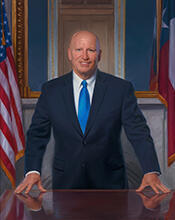
Here you will find contact information for Representative Kevin Brady, including email address, phone number, and mailing address.
| Name | Kevin Brady |
| Position | Representative |
| State | Texas |
| District | 8 |
| Party | Republican |
| Status | Former Representative |
| Term Start | January 7, 1997 |
| Term End | January 3, 2023 |
| Terms Served | 13 |
| Born | April 11, 1955 |
| Gender | Male |
| Bioguide ID | B000755 |
About Representative Kevin Brady
Kevin Patrick Brady (born April 11, 1955) is an American politician who served as the U.S. representative for Texas’s 8th congressional district from 1997 to 2023. A member of the Republican Party, he represented a district that includes northern Houston, including The Woodlands, and served 13 consecutive terms in the House of Representatives before retiring after the 2022 election cycle. Over more than a quarter-century in Congress, Brady played a prominent role in tax, trade, and economic policy and was widely recognized for his work on the House Committee on Ways and Means.
Brady was born in Vermillion, South Dakota, one of five children of William F. and Nancy A. Brady. His father, a lawyer, was killed in 1967 in a courtroom shooting in Rapid City when Brady was 12 years old and his mother was in her early 30s, an event that had a lasting impact on his early life. He grew up in South Dakota and attended public schools, graduating from Central High School in 1973. Brady went on to attend the University of South Dakota in Vermillion, where he earned a degree in mass communications, preparing for a career that would combine public affairs, business advocacy, and politics.
After college, Brady began his professional career in the private sector and local government-related work. He worked for the Rapid City area Chamber of Commerce and, at age 26, was elected to the Rapid City common council, marking his entry into elective office. In 1982, he moved to Texas to continue his work in business and community development, joining the Beaumont, Texas Chamber of Commerce. In 1985, he became associated with the South Montgomery County Woodlands Chamber of Commerce, deepening his ties to The Woodlands and the surrounding region that he would later represent in the Texas Legislature and in Congress.
Brady’s state-level political career began in 1990, when he was elected to the Texas House of Representatives from District 15, representing The Woodlands, parts of Montgomery County, and five other counties west and north of Houston. He succeeded Mike McKinney and took office on January 10, 1991. During his tenure in the Texas House, Brady built a reputation as a pro-business, fiscally conservative legislator and developed the political base in Montgomery County that would support his later bids for federal office.
Brady was first elected to Congress in 1996 after incumbent U.S. Representative Jack Fields of Texas’s 8th congressional district decided to retire. In the initial Republican primary, Brady placed second in a six-candidate field with 22 percent of the vote, behind Gene Fontenot, who received 36 percent, short of the 50 percent needed to avoid a runoff. Brady defeated Fontenot in the runoff, 53–47 percent. The race was then affected by the Supreme Court’s decision in Bush v. Vera, which held three Texas congressional districts unconstitutional and led the court to order a “jungle primary” in the November general election, with all candidates from both parties listed on a single ballot. In that November contest, Brady finished first with 41 percent of the vote, and in a December 10, 1996 runoff he again defeated Fontenot, 59–41 percent, securing his first term in the U.S. House. From that point forward, Brady was consistently reelected and, during this period, never received less than 67 percent of the vote in general elections.
Over the course of his congressional career, Brady repeatedly turned back primary and general election challenges. For the first time since 1998, he faced opposition in a Republican primary when three candidates filed against him; he defeated them in the March primary with 79 percent of the vote and then won reelection with 80 percent in the general election. In a subsequent cycle, in a newly redrawn district, he prevailed in the May Republican primary with 76 percent of the vote and defeated the Democratic nominee in the November 6 general election with over 77 percent. In another primary, he won with 41,549 votes (68 percent) to challenger Craig McMichael’s 19,508 (32 percent), and in the November 4 general election he was reelected with 124,897 votes (89.32 percent) to Libertarian nominee Ken Petty’s 14,930 (10.67 percent). In November 2015, former Texas state representative Steve Toth of The Woodlands announced a primary challenge, criticizing Brady for what he characterized as excessive compromise with President Barack Obama, including Brady’s support for an omnibus federal budget bill and his vote to revive the U.S. Export-Import Bank. Brady narrowly won the March 1, 2016 primary with 53 percent of the vote, his lowest share in 18 years, after spending more than $1.5 million compared with Toth’s $89,325. In the 2018 cycle, Brady and Democratic nominee Steven David were both unopposed in their respective primaries; Brady won the general election with 198,241 votes (73.5 percent) to David’s 67,027 (24.8 percent), while Libertarian Chris Duncan received 4,597 votes. As of September 30, 2018, Brady had outraised David $4,899,672 to $31,664. In the 2020 election, Brady defeated Kirk Osborn in the Republican primary, 80.73 to 16.19 percent, and in the general election he prevailed over Democratic nominee Elizabeth Hernandez and Libertarian Chris Duncan with 72.5 percent of the vote to their combined 27.5 percent. The 2020 election was Brady’s last campaign for Congress.
During his long tenure in the House of Representatives, Brady became particularly influential on issues of tax, trade, and fiscal policy. In 2002, he voted for the Authorization for Use of Military Force Against Iraq, supporting the U.S. invasion of Iraq the following year. In 2005, he was a chief supporter of the Dominican Republic–Central America Free Trade Agreement (DR‑CAFTA), working closely with the George W. Bush administration to secure its passage. He later supported additional free-trade agreements, voting in 2011 for accords with South Korea, Colombia, and Panama. Brady was also known as the author of a proposed federal “sunset law” that would require every federal program not specifically written into the Constitution to justify its existence to taxpayers within 12 years or face elimination. In March 2012, he introduced the Sound Dollar Act, which would have required the Federal Reserve to monitor gold and the foreign-exchange value of the U.S. dollar, and would have repealed the Federal Reserve’s dual mandate of managing both unemployment and inflation, replacing it with a single mandate focused on U.S. dollar price stability. In 2017, he supported President Donald Trump’s proposed border adjustment tax, arguing that taxing imports would place the United States on a level playing field with countries that already employed such taxes and could raise an estimated $1 trillion in revenue.
Brady’s most prominent institutional role came on the House Committee on Ways and Means, the chamber’s chief tax-writing committee. In November 2015, he was elected the 65th chair of the committee, a position he held until 2019. As chair, he was a principal architect and public advocate for the Tax Cuts and Jobs Act of 2017. He asserted that the legislation would provide “tax relief at every level” and claimed that 70 percent of the tax cuts would go to households making below $200,000. Independent analyses later found that about 7 percent of households would pay more in taxes in 2018 and that by 2022 roughly one-quarter of households would see tax increases; FactCheck.org described his 70 percent figure as “misleading,” noting that 57.7 percent of tax relief in 2019 would go to families making less than $200,000, and that by 2027 half of the tax relief from business and individual income tax changes would go to those earning more than $200,000. PolitiFact characterized his claim as “cherry-picked.” Brady also introduced an amendment to the American Health Care Act in March 2017 that would have allowed health insurance providers to fully deduct all forms of compensation to their highest-paid executives without limit, repealing the existing $500,000 cap per executive; the amendment drew criticism from commentators, including a Los Angeles Times columnist who described it as a “secret payoff” to the health insurance industry. On May 4, 2017, Brady joined other Republican leaders and President Trump at the White House in a celebratory event after House passage of the bill to repeal the Affordable Care Act, although the measure was later rejected in the Senate. In 2017, the American Conservative Union gave him a 94 percent evaluation.
Brady’s committee leadership also extended to oversight and retirement policy. As chair of the Ways and Means Committee, he opposed a resolution seeking ten years of President Trump’s personal and business tax returns, calling the effort an abuse undertaken for “obvious political purposes.” After The New York Times published an extensive report on Trump’s tax records and business dealings in September 2020, Brady called for an investigation into the newspaper and the sources of the report. In 2019, he and Representative Richard Neal coauthored the bipartisan Setting Every Community Up for Retirement Enhancement (SECURE) Act, which expanded access to retirement planning options and encouraged employers to establish retirement plans for workers. Originally introduced in March 2019, the SECURE Act was enacted in December 2019 as part of the fiscal year 2020 federal appropriations bill. During the COVID‑19 pandemic, Brady participated in negotiations over major relief legislation, including the Coronavirus Aid, Relief, and Economic Security (CARES) Act, and in December 2020 he indicated his support for a second round of Paycheck Protection Program funds to assist small businesses affected by the economic downturn.
In the later years of his congressional service, Brady remained aligned with most Republican positions while occasionally taking distinctive stances. In 2008, he was among a group of 24 Republicans who joined 227 Democrats in voting to impeach President George W. Bush for allegedly misleading the country into war in Iraq, a vote that distinguished him from most members of his party. Following the January 6, 2021 attack on the U.S. Capitol by supporters of President Trump, Brady argued that calls to impeach Trump or to invoke the 25th Amendment were themselves inflammatory and could incite further violence. On April 14, 2021, he announced that he would not seek a 14th term in the House of Representatives and would retire at the end of the 117th Congress. His service concluded in January 2023, marking the end of a 26-year tenure in Congress during a significant period in American political and economic history, during which he consistently participated in the legislative process and represented the interests of his Texas constituents.