Representative Knute Hill
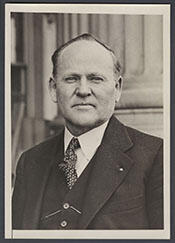
Here you will find contact information for Representative Knute Hill, including email address, phone number, and mailing address.
| Name | Knute Hill |
| Position | Representative |
| State | Washington |
| District | 4 |
| Party | Democratic |
| Status | Former Representative |
| Term Start | March 9, 1933 |
| Term End | January 3, 1943 |
| Terms Served | 5 |
| Born | July 31, 1876 |
| Gender | Male |
| Bioguide ID | H000600 |
About Representative Knute Hill
Knute Hill (July 31, 1876 – December 3, 1963) was a U.S. Representative from the state of Washington and a member of the Democratic Party who served five consecutive terms in Congress from 1933 to 1943. Known by the nickname “the Little Giant,” he was active in agrarian, progressive, and New Deal–era politics and represented Washington’s 4th congressional district during a significant period in American history.
Hill was born on a farm near Creston, Ogle County, Illinois, on July 31, 1876, to Norwegian immigrant parents. In 1877 his family moved to De Forest, Wisconsin, and in 1889 they relocated again to Red Wing, Minnesota. Raised in the Upper Midwest in a rural, immigrant community, Hill’s early life was shaped by farming and the social and economic concerns of small agricultural towns, influences that would later inform his political commitments and legislative interests.
Hill pursued his education in Minnesota and Wisconsin. He attended Red Wing Seminary in Red Wing, Minnesota, and later studied at the University of Minnesota in Minneapolis. Seeking a professional career, he enrolled in the law department of the University of Wisconsin–Madison, from which he graduated in 1906. That same year he was admitted to the bar and began practicing law. From 1908 to 1910 he practiced in Milwaukee and Eau Claire, Wisconsin, gaining experience in legal work that complemented his growing interest in public affairs and reform politics.
In 1911 Hill moved west to Prosser, in Benton County, Washington, where he shifted his focus from law to education and agriculture. From 1911 to 1922 he taught in the public and high schools of Benton County, Washington, and also engaged in agricultural pursuits. Deeply involved in the concerns of farmers and rural communities, he became a founding member of the Washington State Grange, an influential farmers’ organization that advocated for cooperative action, rural development, and political reform. His work as a teacher, farmer, and organizer helped establish his reputation as a spokesman for agricultural and progressive causes in central Washington.
Hill’s first attempts at national office came as a candidate of the Farmer-Labor Party, reflecting his alignment with progressive and agrarian movements of the early twentieth century. In 1920 and again in 1924 he ran unsuccessfully for Washington’s 4th congressional district, receiving over 17 percent of the vote in the first race and roughly 13 percent in the second. Although he did not win, these campaigns increased his visibility and laid the groundwork for his later political career. He subsequently entered state politics and served as a member of the Washington State House of Representatives from 1927 until 1933, where he continued to advocate for farmers, workers, and rural communities.
In 1932 Hill was elected as a Democrat to the Seventy-third Congress and was reelected to the four succeeding Congresses, serving from March 4, 1933, to January 3, 1943, as the representative of Washington’s 4th congressional district. His decade in the U.S. House of Representatives coincided with the Great Depression, the New Deal, and the early years of World War II. As a member of the House of Representatives, Knute Hill participated in the democratic process and represented the interests of his constituents during this transformative era in American history, contributing to the legislative process over five terms in office. In 1942 he was an unsuccessful candidate for reelection to the Seventy-eighth Congress, ending his continuous service in the House.
After leaving Congress, Hill continued in public service and public affairs. He was appointed Superintendent of the Uintah-Ouray Indian Agency at Fort Duchesne, Utah, serving from 1943 until his resignation on March 31, 1944. Returning to Washington State, he worked as a radio commentator in Spokane from 1944 to 1946, using the medium to discuss political and social issues. In 1946 he ran unsuccessfully as an Independent Progressive candidate for election to the Eightieth Congress, reflecting his continued identification with progressive politics. He remained active in national reform movements and was a delegate to the 1948 Progressive National Convention, which sought to advance a left-leaning alternative in postwar American politics.
In his later years Hill was employed by the federal government in a technical and advisory capacity. From March 1949 until his retirement in 1951, he served as a consulting appraiser and information clerk in the Bureau of Reclamation’s Columbia Basin Project, based in Ephrata, Washington, a major irrigation and development initiative in the Pacific Northwest. After retiring, he divided his time between Washington and California. Knute Hill died of a heart attack in his cabin in Desert Hot Springs, California, on December 3, 1963. He was interred in Terrace Heights Memorial Park in Yakima, Washington. Records and papers associated with his political career are preserved at Washington State University in Pullman, Washington, where they document his work as a legislator, educator, and advocate for farmers and progressive causes.