Representative Koln Gunn McKay
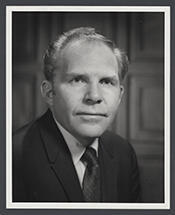
Here you will find contact information for Representative Koln Gunn McKay, including email address, phone number, and mailing address.
| Name | Koln Gunn McKay |
| Position | Representative |
| State | Utah |
| District | 1 |
| Party | Democratic |
| Status | Former Representative |
| Term Start | January 21, 1971 |
| Term End | January 3, 1981 |
| Terms Served | 5 |
| Born | February 23, 1925 |
| Gender | Male |
| Bioguide ID | M000490 |
About Representative Koln Gunn McKay
Koln Gunn McKay (February 23, 1925 – October 6, 2000) was an American politician who represented Utah in the United States House of Representatives from 1971 to 1981. A member of the Democratic Party, he served from January 3, 1971, to January 3, 1981, beginning in the Ninety-second Congress and in four succeeding Congresses, completing five terms in office. During this decade in Congress, he participated actively in the legislative process and represented the interests of his constituents in Utah’s 1st Congressional District during a significant period in American political and economic history.
McKay was born in Ogden, Weber County, Utah, and was raised in the Church of Jesus Christ of Latter-day Saints (LDS Church). He attended the Weber County public schools and later studied at Weber State College in Ogden and Utah State University in Logan, from which he graduated in 1962 with a degree in education. His family was prominent in both civic and religious circles: his brother, Monroe G. McKay, was appointed in 1977 as a judge of the United States Court of Appeals for the Tenth Circuit, and he was a cousin of David O. McKay, president of the LDS Church from 1951 to 1970.
During World War II, McKay served in the United States Coast Guard. After the war, he fulfilled an LDS mission in England, an experience that preceded a varied early career as a farmer, businessman, and high school history teacher. In 1950 he married Donna Biesinger, and together they had ten children. His professional work in education and agriculture, combined with his church service and community involvement, helped establish his reputation as a civic-minded leader in northern Utah.
McKay’s formal political career began in the Utah House of Representatives, to which he was elected in 1962. He completed two terms in the state legislature, serving on several prominent committees, including the legislative council, the Utah Long Range Goals and Planning Committee, and the Utah Government Reorganization Committee. In these roles he gained experience in state-level policy development and governmental restructuring. From 1967 to 1970 he served as administrative assistant to Utah Governor Cal Rampton, a fellow Democrat, advising on policy and administration during a period of growth and modernization in the state. Concurrently, he was an active leader in the LDS Church, serving as president of the Ogden Stake between 1967 and 1970.
In 1970, Utah voters in the 1st Congressional District elected McKay as a Democrat to the Ninety-second Congress, and he was subsequently reelected to four succeeding Congresses, serving until January 3, 1981. His congressional service coincided with the Vietnam War’s final years, the Watergate era, and significant shifts in western and national politics. McKay was a strong advocate of federal investment and government development in Utah. As chairman of the Military Construction Subcommittee of the House Appropriations Committee, he played a central role in defense-related projects in the state: he helped reopen Utah’s Minuteman missile production line, secured the F-16 fighter mission for Hill Air Force Base, and obtained appropriations to increase security at the nerve gas storage facility near Tooele, Utah. At the same time, he worked to protect and enhance Utah’s natural resources, securing funding that further developed Capitol Reef National Park, Glen Canyon National Recreation Area, Arches National Park, and Zion National Park. He also drafted legislation concerning Utah’s Lone Peak Wilderness Area and was involved in legislative efforts related to the Clean Air Act, reflecting his interest in environmental protection alongside economic and military development.
McKay’s decade in Congress unfolded as the Republican Party gained strength in the West. In the 1980 election, during the landslide victory of Ronald Reagan and a broader conservative realignment, McKay was defeated in his bid for a sixth term by Republican James V. Hansen. He sought to reclaim the seat in subsequent campaigns in 1986 and 1988 but was unsuccessful on both occasions. Despite these defeats, his earlier congressional tenure left a lasting imprint on Utah’s military infrastructure and public lands policy.
After leaving Congress in 1981, McKay devoted much of his time to religious service and international engagement through the LDS Church. From 1981 to 1984 he served as president of the Edinburgh Scotland Mission, overseeing missionary work and church administration in that region. He and his wife later undertook additional church assignments abroad, serving a two-year mission in Kenya and another two-year mission in Malaysia. While on yet another mission in Pakistan, McKay’s health declined, and he returned home early due to illness.
Koln Gunn McKay died in Huntsville, Utah, on October 6, 2000, at the age of 75, from complications of mesothelioma. His papers are held by Utah State University, and his career has been documented in reference works such as the Utah History Encyclopedia and the Biographical Directory of the United States Congress, reflecting his enduring role in Utah’s political and religious history.