Representative L. William Paxon
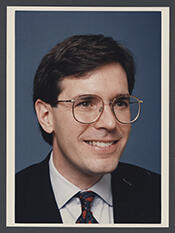
Here you will find contact information for Representative L. William Paxon, including email address, phone number, and mailing address.
| Name | L. William Paxon |
| Position | Representative |
| State | New York |
| District | 27 |
| Party | Republican |
| Status | Former Representative |
| Term Start | January 3, 1989 |
| Term End | January 3, 1999 |
| Terms Served | 5 |
| Born | April 29, 1954 |
| Gender | Male |
| Bioguide ID | P000148 |
About Representative L. William Paxon
Leon William Paxon (born April 29, 1954) is an American lobbyist and former member of the United States House of Representatives from New York who served five terms in Congress from 1989 to 1999. A member of the Republican Party, Paxon represented his western New York district during a significant period in American political history, contributing to the legislative process and participating actively in House Republican leadership. Over the course of a 21-year public service career preceding his work as a lobbyist, he held elective office at the county, state, and federal levels.
Paxon was born in Akron, New York, near Buffalo. He became involved in politics at an early age, volunteering at age 15 for the first congressional campaign of former Buffalo Bills quarterback Jack Kemp, who would later become the Republican vice-presidential nominee in 1996. Paxon attended St. Joseph’s Collegiate Institute in Buffalo, graduating from high school in 1972, and went on to earn his degree from Canisius College. In recognition of his public service and political career, he later received honorary doctorates from Daemen College, Roberts Wesleyan College, and Canisius College.
Paxon’s formal political career began in local government. In November 1977, at the age of 23, he was elected to the Erie County Legislature, becoming the youngest person ever elected to that body at the time. Building on his county-level experience, he advanced to state office and served as a member of the New York State Assembly from 1983 to 1988. During his tenure in Albany, he sat in the 185th, 186th, and 187th New York State Legislatures, gaining legislative experience and establishing himself within the state Republican Party.
In 1988, Paxon was elected to the U.S. House of Representatives and took office on January 3, 1989, as a member of the 101st Congress. He was subsequently re-elected to the 102nd, 103rd, 104th, and 105th Congresses, serving continuously from January 3, 1989, to January 3, 1999. As a Representative from New York, he participated in the democratic process and represented the interests of his constituents during a period marked by the end of the Cold War, the Gulf War, and the Republican takeover of the House in the 1994 elections. A conservative Republican, Paxon was active in party strategy and campaign efforts and became a prominent figure in the House Republican Conference.
Paxon’s influence within the national party structure grew in the early 1990s. In 1992, he was elected to chair the National Republican Congressional Committee (NRCC), playing a key role in recruiting candidates and directing campaign resources for House races across the country. Following the Republican gains in the 1994 midterm elections, he rose further in the House leadership. During the 105th Congress, he chaired the Republican House Leadership Committee, making him part of the inner circle surrounding Speaker Newt Gingrich and placing him at the center of strategic decision-making for the House majority.
Paxon became a central figure in an internal Republican leadership crisis in the summer of 1997. Concerned that Speaker Gingrich’s public image had become a political liability, several House Republicans explored a plan to replace him. The effort began on July 9, 1997, with a meeting between Republican Conference Chairman John Boehner of Ohio and Leadership Chairman Paxon. Under their proposal, House Majority Leader Dick Armey, House Majority Whip Tom DeLay, Boehner, and Paxon would present Gingrich with an ultimatum to resign or face a vote to remove him. Armey, however, objected to the idea that Paxon would become the new Speaker and instructed his chief of staff to warn Gingrich of the plan. Gingrich, after assessing the situation with senior Republican leaders on July 11, refused to step down and cautioned that a forced removal could open the door for Democrats and dissenting Republicans to elect Democratic Leader Dick Gephardt as Speaker. On July 16, 1997, Paxon, who was the only member of the leadership appointed by Gingrich rather than elected by the conference, offered his resignation from his leadership post, stating that he had not handled the situation properly. Gingrich accepted the resignation and directed Paxon to vacate his leadership office. Paxon later considered, but ultimately rejected, a challenge to Armey for the position of majority leader, and he decided not to seek re-election in 1998, bringing his congressional career to a close at the end of the 105th Congress.
After leaving Congress in January 1999, Paxon transitioned to a career in government relations and lobbying. He became an advisor to Republican members of Congress and joined the Washington, D.C., law and lobbying firm Akin Gump Strauss Hauer & Feld LLP. Beginning in January 1999, he advised a wide range of public- and private-sector clients on federal policy issues and legislative strategy. Over the years, he has been consistently rated as one of Washington’s top lobbyists. Among his corporate clients, Paxon was hired by Boeing to lobby members of Congress, reflecting his continued engagement with major national policy and business interests.
During his time in Congress, Paxon worked closely with then-Representative Susan Molinari, a moderate Republican from Staten Island who also later became a lobbyist. The two married on July 3, 1994, and established their home in Alexandria, Virginia. They have two daughters. Paxon’s career, spanning local, state, and federal office and later high-level lobbying, has kept him closely connected to the legislative process and to the Republican Party long after his formal service in the House of Representatives ended.