Representative Lane A. Evans
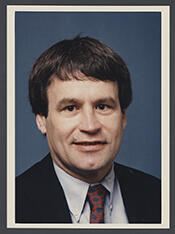
Here you will find contact information for Representative Lane A. Evans, including email address, phone number, and mailing address.
| Name | Lane A. Evans |
| Position | Representative |
| State | Illinois |
| District | 17 |
| Party | Democratic |
| Status | Former Representative |
| Term Start | January 3, 1983 |
| Term End | January 3, 2007 |
| Terms Served | 12 |
| Born | August 4, 1951 |
| Gender | Male |
| Bioguide ID | E000250 |
About Representative Lane A. Evans
Lane Allen Evans (August 4, 1951 – November 5, 2014) was an American attorney and Democratic politician who served as a member of the United States House of Representatives from 1983 until 2007, representing Illinois’s 17th Congressional District. Over 12 consecutive terms in Congress, he became known as one of the chamber’s most liberal members, a strong advocate for veterans, and a founding member of the Congressional Progressive Caucus. His congressional career, which spanned from the 98th through the 109th Congresses, unfolded during a significant period in late twentieth- and early twenty-first-century American history, and he was recognized for his active participation in the legislative process and his representation of the interests of his constituents in western and central Illinois.
Evans was born on August 4, 1951, in Rock Island, Illinois, one of four sons in a working-class family. He attended Alleman High School in Rock Island and later enrolled at Augustana College, also in Rock Island. Before completing his college education, he enlisted in the United States Marine Corps during the Vietnam War era. Although he was not deployed to Vietnam, he served on active duty and was stationed in Okinawa, Japan. After leaving the Marines in 1971, Evans returned to Rock Island and resumed his studies at Augustana College, graduating in 1974. He then moved to Washington, D.C., to study law at Georgetown University Law Center, where he earned his Juris Doctor degree in 1977.
Following his graduation from Georgetown, Evans returned to the Quad Cities area and began his legal career as an attorney with the Quad Cities Legal Clinic (Mid America Law Offices, Ltd.) in Moline, Illinois. In this role, he provided legal services to low-income clients, work that helped shape his later legislative priorities on economic justice and veterans’ issues. His early legal practice and community involvement established him as a progressive voice in local politics and laid the groundwork for his entry into elective office.
In 1982, Evans ran for the Democratic nomination for Illinois’s 17th Congressional District, which included most of Illinois’s share of the Quad Cities and had recently been renumbered from the 19th District after Illinois lost two seats following the 1980 census. The district had been in Republican hands for all but two years since 1939 and was traditionally represented by moderate Republicans. Evans’s prospects improved when 16-year Republican incumbent Tom Railsback lost his primary to a more conservative challenger, State Senator Kenneth McMillan. Capitalizing on voter discontent during the recession of the early 1980s, Evans won the general election by about five percentage points and entered the House of Representatives on January 3, 1983. During his first term, he earned the highest level of opposition—approximately 90 percent—to President Ronald Reagan’s legislative agenda of any member of Congress, underscoring his position on the left wing of the Democratic Party. In a 1984 rematch, despite Reagan’s national landslide, Evans defeated McMillan handily, winning about 57 percent of the vote and outpolling Reagan in the 17th District by more than 5,000 votes. This was one of the few districts in which Reagan’s two-way percentage in 1984 was lower than his three-way percentage in 1980.
Over the next two decades, Evans consolidated his hold on the district through a series of competitive campaigns. He faced opposition in each of his next four elections and in 1990 defeated Republican Dan Lee by more than 50,000 votes, taking 67 percent of the vote. In 1994, when Republicans captured control of the House of Representatives, Evans retained his seat, winning by nine points over little-known Republican Jim Anderson, who spent very little money. The relatively easy victory encouraged Republicans to invest more heavily in the district in 1996, when Evans faced Mark Baker, a television news anchor at WGEM-TV in Quincy, the district’s third-largest city. That year, President Bill Clinton carried the district by about 30,000 votes, and Evans defeated Baker by roughly 11,000 votes. A 1998 rematch with Baker proved closer, with Evans prevailing by about 6,000 votes, while a third contest between the two in 2000 resulted in a 10-point Evans victory. Following the 2000 census, redistricting—guided in part by House Speaker Dennis Hastert of Illinois’s 14th District and Representative Bill Lipinski of the 3rd District—altered the 17th District by adding Decatur and part of Springfield and removing some rural areas, making the seat more favorable to Evans. He was re-elected in 2002 and 2004, continuing his service through the 109th Congress.
Within the House, Evans developed a reputation as a staunch progressive and a leading advocate for veterans. He was a founding member of the Congressional Progressive Caucus and the House Populist Caucus, and he consistently received a near-perfect lifetime rating from Americans for Democratic Action, while the American Conservative Union gave him its lowest rating among Illinois members of Congress from outside Chicago. He is widely credited with sponsoring and securing passage of the Agent Orange Act of 1991, landmark legislation that established a presumption of service connection for certain diseases associated with exposure to Agent Orange and other herbicides used during the Vietnam War, thereby easing the burden of proof for affected veterans seeking benefits. In recognition of his work on veterans’ issues, he received the Silver Helmet Award from AMVETS (American Veterans) in 1995. Evans was also active in party politics and progressive organizing, and he was a co-founder of the political organization 21st Century Democrats, which supported liberal and populist candidates. In 2004, he played an instrumental role in the election of Barack Obama to the United States Senate from Illinois, lending organizational support and political backing during Obama’s successful statewide campaign.
Evans’s later congressional career was marked by both continued political engagement and growing health challenges. Beginning in 1995, he battled Parkinson’s disease, a progressive neurological disorder. For many years, his opponents declined to make his health a campaign issue, but in 2004 his Republican challenger, Andrea Zinga, a former television anchorwoman at KWQC-TV and WQAD-TV in the Quad Cities, argued that Evans’s condition prevented him from fully representing the district. The line of attack backfired with voters, and Evans was re-elected comfortably. In the House, he remained one of the most liberal members, and in January 2005 he was one of 31 House Democrats who voted to reject Ohio’s 20 electoral votes in the 2004 presidential election, challenging the certification of President George W. Bush’s victory in that state. His long tenure also included scrutiny of his campaign practices. On June 27, 2005, his campaign committee agreed to pay $185,000 to settle a Federal Election Commission investigation into allegations of illegal coordination between the Lane Evans Committee, the 17th District Victory Fund, and the Rock Island Democratic Central Committee during the 1998 and 2000 election cycles. The FEC contended that the Evans Committee helped create and direct the Victory Fund, which raised and spent more than $500,000, including over $200,000 in prohibited labor union treasury funds, and that at least $330,000 spent on voter identification and get-out-the-vote activities effectively constituted excessive and prohibited contributions to Evans’s campaign. The Rock Island Democratic Central Committee agreed to a separate civil penalty of $30,000.
As his Parkinson’s disease advanced, Evans decided to bring his congressional career to a close. He won the Democratic primary in 2006 and was initially set for a rematch against Andrea Zinga in the general election. However, on March 28, 2006, he announced that he would not seek a 13th term in November due to the increasingly debilitating effects of his illness. He made a brief return to Washington in June 2006 before retiring at the end of the 109th Congress on January 3, 2007. His withdrawal from the race required local Democrats to select a replacement nominee, and they chose his longtime district director, Phil Hare, who went on to win the seat in the general election and succeed Evans as representative of Illinois’s 17th District. Evans’s departure marked the end of nearly a quarter-century of continuous service in the House of Representatives.
In retirement, Evans lived quietly in Illinois as his health continued to decline. His decades of work on veterans’ affairs, progressive economic policy, and grassroots Democratic organizing remained influential in Illinois politics and among national progressive circles. On November 5, 2014, Lane Evans died at the age of 63 in a nursing home in East Moline, Illinois, from complications of Parkinson’s disease. His life and career were later chronicled in the biography “Guts: The Lane Evans Story,” authored by Devin Hansen and published by Strong Arm Press in 2019, which highlighted his personal courage, legislative achievements, and long-standing commitment to public service.