Representative Larry Combest
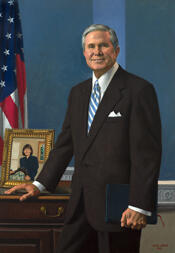
Here you will find contact information for Representative Larry Combest, including email address, phone number, and mailing address.
| Name | Larry Combest |
| Position | Representative |
| State | Texas |
| District | 19 |
| Party | Republican |
| Status | Former Representative |
| Term Start | January 3, 1985 |
| Term End | May 31, 2003 |
| Terms Served | 10 |
| Born | March 20, 1945 |
| Gender | Male |
| Bioguide ID | C000653 |
About Representative Larry Combest
Larry Ed Combest (born March 20, 1945) is a retired American Republican politician who represented Texas in the United States House of Representatives from 1985 to 2003. A member of the Republican Party, he served 10 terms in Congress and contributed to the legislative process during a significant period in late 20th- and early 21st-century American history, representing the interests of his Texas constituents over nearly two decades.
Combest was born in Memphis, Texas, a small town in West Texas and the seat of Hall County. He was raised in a family deeply rooted in agriculture; his family operated a farm for four generations, an experience that would later inform much of his policy focus in Congress. He attended public schools in Texas and went on to pursue higher education in the state.
In 1969, Combest earned a bachelor of business administration degree from West Texas State University in Canyon, Texas. His academic training in business, combined with his agricultural background, provided the foundation for his early professional work in federal agricultural policy and later for his legislative focus on rural and agricultural issues.
Combest began his career in public service in 1971, when he briefly served as director of the Agricultural Stabilization and Conservation Service of the U.S. Department of Agriculture. Later that year, he became a legislative assistant to Republican U.S. Senator John Tower of Texas. He held that position from 1971 to 1978, working in Washington, D.C., during a period when Tower emerged as a leading conservative voice in the Senate. Combest left Senator Tower’s staff after Tower won his fourth and final term in office. From 1978 until his election to Congress in 1984, Combest worked in private business, further developing his experience in the private sector before seeking elective office.
Combest entered electoral politics in 1984, when Democratic Congressman Kent Hance declined to run for a fourth term in the U.S. House of Representatives from Texas’s 19th Congressional District and instead pursued, unsuccessfully, the Democratic nomination for the United States Senate. Combest sought the open House seat and won the Republican nomination in a runoff over fellow Lubbock conservative Ron Fleming. In the general election held in November 1984, amid President Ronald Reagan’s landslide reelection victory, Combest was elected to Congress. In a district where Democratic presidential nominee Walter F. Mondale barely managed 20 percent of the vote in many areas, Combest received 102,805 votes (58.1 percent) to 74,044 votes (41.9 percent) for Democrat Don R. Richards, a former aide to Hance. He thus became only the third person to represent the 19th District since its creation in 1934, and the first Republican to hold the seat. He was one of six freshman Republican congressmen elected from Texas that year who became known collectively as the “Texas Six Pack.”
During his tenure in the House of Representatives from 1985 to 2003, Combest served through a period of major national and international change, including the end of the Cold War, the Gulf War, and the early years of the war on terror. Although the 19th District had become increasingly friendly to Republicans at the national level—no Democratic presidential candidate had carried the district since Lyndon B. Johnson in 1964—conservative Democrats continued to win many state and local offices there until the Republican gains of 1994. At the federal level, however, Combest’s position quickly became secure. He was reelected nine times with no substantive Democratic opposition, running unopposed in 1990 and 1994 and facing no major-party opposition in 2000 and 2002. Over his 10 terms, he participated actively in the democratic process, working on legislation and committee matters that reflected the priorities of his largely rural and agricultural district.
Combest held several key leadership roles in Congress. In the 104th Congress (1995–1997), he served as chairman of the House Permanent Select Committee on Intelligence, overseeing matters related to national security and the intelligence community during the post–Cold War transition. Later, he became chairman of the House Committee on Agriculture in the 106th and 107th Congresses (1999–2003), a position that placed him at the center of federal farm policy, rural development, and agricultural trade issues. His chairmanships reflected both his seniority and his longstanding ties to agriculture and rural Texas. His office also served as a training ground for future political figures; one of his interns, Morgan Meyer, was later elected in 2014 as a Republican member of the Texas House of Representatives from District 108 in Dallas County.
After the deaths of his father and a daughter within a short period of time, Combest announced on November 12, 2002—just one week after winning election to a tenth term—that he would resign from Congress. He stated that he and his wife, Sharon, had come to “realize how fragile life and health are” and that these losses had caused them to “rearrange our priorities,” expressing a desire to spend as much time together as possible while they had their life and health. Combest formally resigned from the House of Representatives on May 31, 2003. In the subsequent special election, fellow Republican Randy Neugebauer won the seat and was sworn into office on June 3, 2003, succeeding Combest as the representative of Texas’s 19th District.
In the years following his departure from Congress, Combest’s name surfaced in connection with a controversy over the tax-exempt status of the National Association for the Advancement of Colored People (NAACP). In 2006, lawyers for the NAACP disclosed that Combest was one of six Republican congressional leaders who had secretly requested an Internal Revenue Service investigation into the NAACP’s tax-exempt status after NAACP chairman Julian Bond criticized President George W. Bush’s policies as racially divisive. This episode added a post-congressional coda to Combest’s long record of partisan and policy engagement. Now retired from elective office, Larry Ed Combest remains noted for his extended service in the House, his leadership on intelligence and agricultural issues, and his role in the broader realignment of Texas politics toward the Republican Party at the federal level.